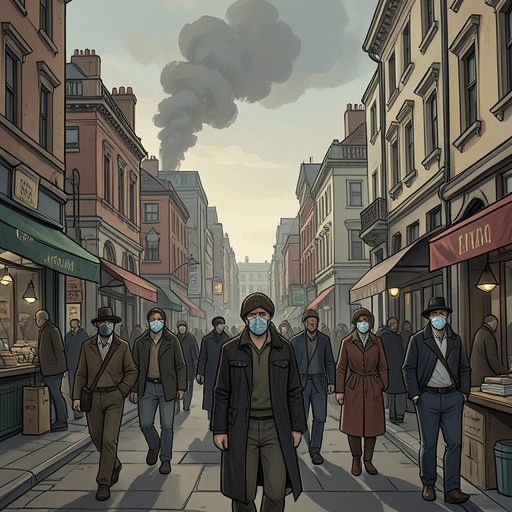
The city’s public health and sanitation crisis
Love in the Time of CholeraThe city’s public health and sanitation crisis grew from the ordinary systems by which residents obtained water, disposed of waste, and supplied the market. Sewers emptied into the bay, refuse accumulated in the mangroves and market grounds, and unsafe cistern water remained in common use. These conditions made disease a civic and infrastructural problem rather than a danger confined to hospitals. Juvenal Urbino recognized the crisis as a threat that could recur, but his proposals met the inertia of institutions and habits that had long accommodated contamination.
Infrastructure and unequal exposure
The colonial sewer system was an immense breeding ground for rats, and its contents emptied into the cove at the market. Urbino appealed to the authorities to replace it with a closed sewage system that would discharge in a distant drainage area. The need was starkly unequal: well-equipped colonial houses had latrines with septic tanks, while two thirds of the population lived in shanties at the edge of the swamps and relieved themselves outdoors. The waste dried in the sun and became dust inhaled by the city’s inhabitants. Urbino also urged the City Council to require training so that poor residents could learn to build latrines. The proposal addressed a public need, but it placed responsibility for basic sanitation on people whose living conditions made them especially vulnerable to its absence.
Waste collection was another unresolved part of the emergency. Urbino tried to stop residents from throwing garbage into mangrove thickets, which had become swamps of putrefaction, and proposed collecting it at least twice a week for incineration in an uninhabited area. The proposal treated disposal as a public system rather than a matter that could be left to individual households. The persistence of dumping, however, showed how far the city’s infrastructure lagged behind the needs its population generated.
Water provision likewise depended on household arrangements rather than a reliable municipal supply. Building an aqueduct seemed fantastic to those able to rely on underground cisterns, where rainwater collected beneath a thick layer of scum. Carved wooden collectors and stone filters fed water into large earthen jars, while an aluminum dipping cup had jagged edges intended to discourage people from drinking directly from it. The water might look clear and taste cool, yet Urbino knew that waterworms lived at the bottom of the jars and that simple stone filters could not stop them. He had learned that they were mosquito larvae, not supernatural creatures, and understood that familiar safeguards could preserve the appearance of cleanliness without securing safe water.
The market as a focal point
The public market on Las Ánimas Bay concentrated several failures in one place. Sailing ships from the Antilles docked beside a market described as rich and noisy, but its ground was effectively its own garbage heap and it lay at the mercy of the tides. The bay could carry sewer filth back onto land; the adjoining slaughterhouse added animal refuse, including heads and viscera, to the same surroundings. Rats and dogs competed with buzzards amid food displayed at the stalls. The market’s commercial abundance therefore depended on a setting that endangered public hygiene.
Urbino wanted the slaughterhouse moved and a covered market built in its place, modeled on the clean, sheltered markets he had seen in Barcelona. The plan joined waste management and food safety to a broader civic ideal: provisions could be presented in a setting that made their cleanliness visible and protected them from the surrounding filth. His proposals were treated by even accommodating friends as an illusion. The contrast between their pride in the city’s history and their blindness to its deterioration made sanitation a test of civic perception as much as engineering. Urbino’s attachment to the city did not require him to idealize it; he valued it enough to acknowledge the decay.
Cholera and the city’s memory
The earlier cholera epidemic demonstrated what could follow from contaminated conditions. Its first victims fell in the standing water of the market, and over eleven weeks the outbreak caused the greatest death toll in the city’s history. Burial arrangements quickly failed: after two weeks the colonial cemetery was full, while churches and convent grounds could no longer accommodate the dead. Burial in the Community’s orchard had to stop when the saturated ground became unsafe, and the city resorted to a cattle ranch later consecrated as the Universal Cemetery. The crisis reached beyond the sick themselves, overwhelming the ordinary places and practices through which the city dealt with death.
The response mixed official action with superstition. Once the cholera proclamation was issued, the garrison fired a cannon from the fortress every quarter hour, day and night, in the belief that gunpowder purified the air. The disease devastated the city’s larger and poorer Black population more severely, though it did not spare people on the basis of color or background. The epidemic ended as abruptly as it began, and its full toll was never established. The account attributes that silence not to an inability to count, but to a widespread reticence about personal misfortune. A disaster rooted in public conditions consequently left an incomplete public record.
Juvenal Urbino’s understanding of sanitation was shaped by the death of his father, Marco Aurelio Urbino, who had served as a civic health official during that epidemic and had also died of the disease. Looking back at his father’s measures, Juvenal judged their method more charitable than scientific and, in important respects, contrary to reason; he believed they had helped the epidemic spread. He could recognize that failing without dismissing his father’s diligence, self-sacrifice, and courage. The inherited memory thus carried both grief and a warning: good intentions and personal bravery could not substitute for effective public-health practice.
Prevention and the return of risk
After his father’s death, Juvenal studied cholera intensively, including under Professor Adrien Proust, an epidemiologist associated with the creation of cordons sanitaires. Returning home, he read the city’s conditions as evidence that catastrophe could happen again: the market’s stench, rats in the sewers, and children playing in street puddles were not isolated signs, but parts of the same exposure. His professional knowledge connected the present environment to the earlier outbreak and transformed sanitation into preventive work, not merely a response to the visibly ill.
Within a year, students at Misericordia Hospital sought his help for a charity patient whose body had turned blue. Urbino recognized cholera and responded to the possibility of transmission: the patient had arrived three days earlier on a schooner from Curaçao, so he alerted colleagues and had officials warn neighboring ports in order to locate and quarantine the vessel. He also restrained the city’s military commander, who wanted martial law and a return to firing the cannon every fifteen minutes. The patient died, but no further cases appeared in the following weeks. Later reports of children’s deaths led to further investigation, separation and quarantine of the affected family, and medical supervision of the neighborhood; a child who contracted the disease recovered. The episode shows a different approach from the cannon ritual: surveillance, notification, quarantine, and attention to the possibility of spread.
The crisis persisted as a tension between knowledge and capacity. Urbino could identify unsafe systems, propose sewerage, latrines, waste collection, and a safer market, and organize a measured response to a suspected outbreak. Yet the city’s dependence on contaminated water, its resistance to reform, and the unequal distribution of adequate facilities remained larger than any single intervention. Cholera made that gap impossible to treat as abstract: the remembered epidemic and the later threat both arose in a city where public health depended on infrastructure that was incomplete, neglected, and unevenly shared.