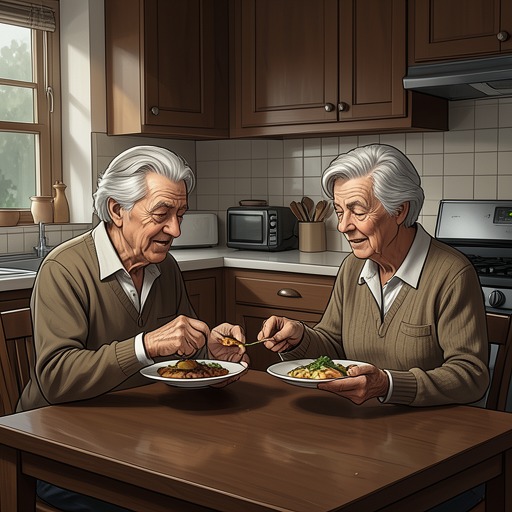
The problem with marriage is that it ends every night after making love, and it must be rebuilt every morning before breakfast
Love in the Time of CholeraJuvenal Urbino’s aphorism that marriage ends each night after lovemaking and must be rebuilt before breakfast turns marital endurance into a daily practice rather than a permanent achievement. It emerges from his effort to explain the distance between himself and Fermina Daza, while the surrounding memories show that their bond can be renewed in brief, embodied moments even after love has seemed to fade.
The Saying and Its Argument
Urbino describes marriage as an arrangement that repeatedly reaches an ending and requires a new beginning. The formulation is deliberately domestic in scale: the interval between lovemaking at night and breakfast the next morning makes the work of sustaining a marriage part of ordinary life. Marriage, in this account, is neither secured once and for all by a wedding nor sustained automatically by shared residence. It has to be remade.
He supports the thought with a severe account of matrimony as an improbable institution. Two people who barely know each other, with different characters, upbringings, and even genders, are suddenly expected to live together, share a bed, and bind their destinies, though those destinies may be moving in opposite directions. Their only possible bond, he argues, is love, which is itself fickle and uncertain. The aphorism compresses this broader skepticism into a memorable daily cycle: intimacy does not abolish the difficulty of living together; the couple must begin again after it.
The Marriage Behind the Aphorism
The remark belongs to a period of strain in Urbino’s marriage to Fermina Daza. He attributes their difficulties to the nature of matrimony, even as the narration connects them to the atmosphere of their household and to the social distance between their opposing classes in a city still dreaming of the return of the Viceroys. His general theory therefore does not erase the particular pressures shaping their life together; it is also a way of interpreting, and partly rationalizing, their own discord.
Their relationship had once included an easy physical tenderness. Urbino would ask Fermina to soap him while he bathed, and she began doing so with what remained of the love they had brought back from Europe. In that familiar scene, arguments, the poisonous eggplant, his sisters, and his mother do not entirely extinguish their desire. Memories soften them against their wishes, and they find themselves wanting one another again without saying so. The aphorism’s account of marriage as repeated reconstruction is thus set beside a concrete instance of affection surviving within domestic conflict.
Repetition, Memory, and Renewal
The narrative tests Urbino’s formulation through recurring returns of intimacy. After a wild fiesta, nostalgia sometimes catches the couple by surprise, and for five minutes they become again the uninhibited lovers of their honeymoon. These brief reversals do not cancel the ordinary estrangement; their force depends on its persistence. The marriage is not continuously restored to its first condition but intermittently reanimated by memory, desire, and shared experience.
The saying therefore functions both as Urbino’s explanation of marriage and as a structural key to the couple’s history. Its daily rebuilding is neither a guarantee of happiness nor proof that love remains unchanged. Instead, it names a fragile practice: a relationship can feel finished, revive for a moment, and require renewed effort when that moment passes. The contrast between the aphorism’s crisp domestic rhythm and the couple’s longer, more complicated history gives the line its significance.