Widowhood
Love in the Time of CholeraWidowhood in the novel is both a profound loss and a possible release from the habits and obligations of marriage. Through Florentino Ariza’s observations of widows, it becomes a condition in which grief may gradually give way to renewed agency: a woman can recover command of her time, her body, and her identity. Yet Florentino turns that possibility into a private forecast for Fermina Daza, mistaking his interpretation of widowhood for knowledge of what she would want.
Bereavement and the Household
Florentino’s idea of widowhood begins with women he has encountered after their husbands’ deaths. He has seen some overwhelmed by grief, pleading to be buried in the same coffin as the dead men rather than face a future without them. The novel does not erase that initial devastation. Instead, it follows the contrast between public mourning and the more gradual changes that come as a widow recognizes the reality of her new condition.
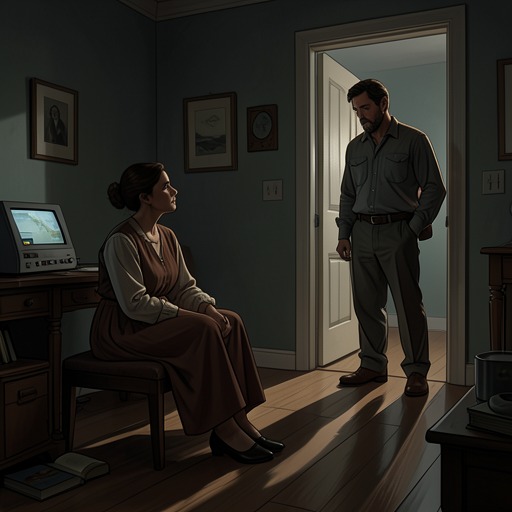
At first, some widows seem to live as dependents of sorrow in large, emptied houses. Their daily routines remain organized around the absent husband: they confide in servants, keep his soap in the bathroom and his monogrammed pillowcase on the bed, and leave his place set at the table as if he might return. They sew buttons onto his clothes and repeatedly iron his shirts so that their collars and cuffs remain ready. Such acts preserve his presence in the home, but they also show how completely domestic life had been arranged around him.
The narration sets these careful continuities against the life that the women had led within marriage. Florentino imagines the husbands as men whom their wives had to nurture and tend until the end, while the women bore the anxiety of waiting for them to return from the world they had urged them to conquer. In this account, love and marriage are not identical: whatever love existed could belong to a separate life, while everyday companionship also involved care, responsibility, and fear. Widowhood changes that arrangement by removing the husband from the household and leaving the woman to confront the life that remains hers.
Recovery of Agency
The decisive change comes not with the first shock of loss but through the restorative idleness of solitude. In the widows Florentino observes, mourning gradually gives way to an awareness that they are once again mistresses of their fate. Their recovery is described as more than a practical change in household routine: they had relinquished their family names and identities for the security marriage seemed to promise, and now they can begin to reclaim a self not defined by a husband.
That freedom appears in modest, bodily terms. A widow can eat when hungry, love without lies, and sleep without pretending to be asleep to escape what the narrator calls the indecency of official love. She has an entire bed to herself instead of having to share its space, air, and night. The emphasis is not on a single dramatic act of emancipation but on ordinary choices that marriage had restricted or negotiated. Solitude becomes restorative because it allows a woman to attend to her own desires and dreams without arranging them around another person.
The account also shows that this newfound autonomy remains socially constrained. At dawn, Florentino sees widows returning from five o’clock Mass, dressed in black. When they notice him, they cross the street rather than risk being seen walking near a man and having their honor stained. Their movement suggests that independence does not automatically remove the rules governing women’s reputations. The widows can be newly free within their homes and still have to navigate public expectations of propriety.
Florentino’s Interpretation
Florentino makes this pattern central to his own romantic hopes. His affairs with widows, beginning with Widow Nazaret, have convinced him that bereaved women may eventually become happy again. He regards a widow’s grief not as the whole of her future but as a condition that may give way to vitality and a new sense of possibility. The women he has known turn what had been a dream into something he believes he can grasp: that Fermina, after her husband’s death, might be ready to accept him as he is.
His expectation depends on a particular contrast between kinds of love. He imagines that Fermina could have an everyday love with him, enriched by the renewed experience of being alive, while also retaining a separate love belonging to her alone, made invulnerable by the husband’s death. In his mind, bereavement would clear a path toward a second happiness without requiring her to betray or erase the life she had already lived. The hope draws upon his observations, but its certainty belongs to him: he believes he is prepared to make a widow happy and assumes that she might, in turn, make him happy.
Limits and Significance
The narrative directly qualifies Florentino’s vision. He is enthusiastic because he has not understood how far Fermina is from the assumptions he has built around widowhood. His account of widows may identify a real possibility—the recovery of agency after years of marriage—but it cannot predict Fermina’s response or turn her bereavement into a promise to him. The gap between his confident theory and her unanticipated reality keeps the subject from becoming a simple celebration of freedom after loss.
Widowhood consequently holds two meanings at once: it is the aftermath of a husband’s death and a potential reopening of a woman’s independent life. The detailed household objects—the place set at the table, the carefully kept clothes, the pillowcase and soap—make the persistence of marriage visible even in absence. Against them, the solitary bed and the widows’ return to their own rhythms mark a quieter change in ownership of the self. Florentino sees that change as an opening for his love; the account also reveals the limits of treating another person’s grief and renewed freedom as the fulfillment of one’s own desire.