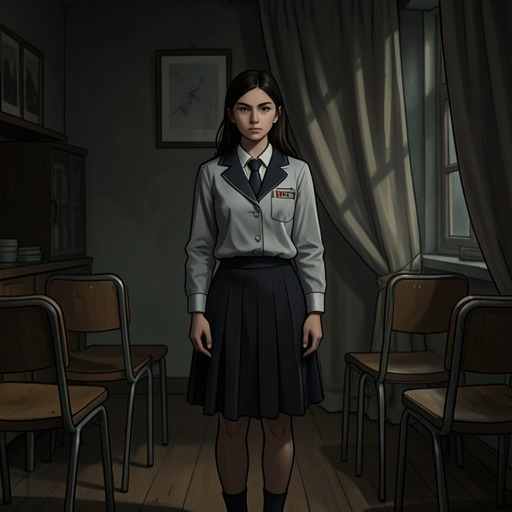
Ardmore police station
Luckiest Girl AliveThe Ardmore police station is the site of two consequential interviews with TifAni FaNelli: first, when detectives investigate her history with Dean and the events she reports, and later, when they revisit her account in connection with the Bradley shooting. Its interrogation rooms turn private memory into an official record, while the questions put to TifAni expose how readily her account can be tested against assumptions about friendship, loyalty, and culpability.
Setting and Arrival
The station first enters the narrative after TifAni and her mother have spoken with detectives about Dean. By the time a lawyer arrives, the windows are opaque, dark squares; he appears under the hallway’s sallow lights. TifAni’s mother had initially been reassured by Detective Dixon’s manner, but changed her mind after calling TifAni’s father. The family obtained the lawyer through a coworker of TifAni’s father, and neither mother nor daughter is impressed by him. These details place the interview within a family effort to understand what is happening while also securing formal representation.
The lawyer, Dan Rosenberg, wants to hear TifAni’s account before the detectives join them in the interrogation room. He asks for the whole story, beginning with the start of the school year, and stresses that every connection and detail matters. TifAni understands the room as deliberately uncomfortable: in her view, its low temperature is meant to make people confess sooner. The station is therefore not a neutral backdrop in her recollection. It is a controlled environment where the demand for a complete account meets her difficulty recounting humiliating and traumatic experiences.
The First Account
During the first interview, Detective Dixon asks whether TifAni and Dean were friends. TifAni’s mother is present and does not understand why the detectives are asking about Dean. Dixon suggests that TifAni might speak more comfortably without her mother, making the family’s presence part of the interview’s tension. The detectives’ focus on Dean shifts the conversation away from Arthur, whom TifAni had expected them to discuss.
With Dan’s prompting, TifAni recounts the night at Dean’s house, including the periods when she became aware of what was happening, and the later incident at Olivia’s house. She also explains her concern about involving Mr. Larson, and Dan insists that the relevant details should be included. When he asks whether Mr. Larson harmed her, TifAni denies it. The distinction matters to her account: a traumatic night and its aftermath involve different people and different actions, and the interview requires her to separate them rather than let them collapse into one undifferentiated story.
The Recorded Interrogation
At a subsequent recorded session, the detectives and TifAni gather around a table with a cup of water and a recording device at its center. Detective Dixon initially gives the wrong date, saying November 14, 2001; Detective Vencino corrects him to November 15, just after midnight. Dixon then formally identifies those present, including TifAni and her lawyer, Daniel Rosenberg. The exacting formalities briefly give TifAni greater confidence in Dan, whose full name she has only just learned.
TifAni tells the story again, this time for the recording. Dixon and Vencino mostly let her speak without interruption, but Dan gently reminds her of a detail she has omitted: she encountered Mr. Larson at Wawa that night. Once she finishes, Dixon summarizes the accusations she has made against Dean, Liam, and Peyton at Dean’s house and against Dean again at Olivia’s. TifAni confirms the account. Vencino then asks why she would have tried to save Dean from Arthur if Dean had assaulted her. TifAni answers that she was trying to save herself. The question treats her action as a puzzle about loyalty; her answer recasts it as an effort at self-preservation.
The Return and the Yearbook Pages
TifAni returns to the station with her mother and Dan after Detective Dixon calls, about seven days after the shooting. Her father is still on his way when she and Dan are taken into the interrogation room. Detective Vencino brings a thick file, and Dixon spreads photocopies of Bradley yearbook pages across the table. The detectives point to crude notes written by TifAni and Arthur, including a Halloween-related phrase TifAni had written on Olivia’s picture. What had begun as an immature classroom exercise and private exchange is now presented as material to be examined in a criminal investigation.
The station thus holds two kinds of evidence beside TifAni’s spoken account: her recollection of events and the surviving marks of her relationship with Arthur. Their presence helps explain why the questions have widened from what happened to her to what she may have known about the attack. The interview does not, by itself, establish that she committed a crime; the later account makes clear that there was not enough evidence to charge her. Nevertheless, the yearbook pages become part of the suspicion surrounding her.
Significance
Across these visits, the station makes the struggle over interpretation concrete. TifAni is asked to recount assaults, clarify the people involved, explain her actions toward Dean, and account for notes associated with Arthur. The investigators’ questions give official form to doubts that also surface beyond the station, where her conduct and emotional response are judged. At the same time, the recorded interview preserves her direct confirmation of what she says happened, even as the questioning tests her credibility and motives.
The Ardmore police station is therefore more than a procedural setting. It is where TifAni’s memory becomes testimony and where personal relationships are recast as evidence. The contrast between her account and the yearbook pages also anticipates the wider conflict over whether she will be understood through what she says happened to her or through the suspicions others attach to her connection with Arthur and the shooting.