Arthur
Luckiest Girl AliveArthur is TifAni FaNelli’s friend, an observant schoolmate whose companionship gives her a place to belong when acceptance elsewhere is uncertain. His loyalty matters most when TifAni is isolated: she later remembers that he was the only person who stood up for her when many others turned against her. Yet their friendship is not uncomplicated. Their closeness gives way to strain, and Arthur’s place in the story ultimately connects early school life to the violence at Bradley, the accusations that follow, and TifAni’s lasting effort to preserve a truthful memory of him.
Identity and Introduction
Arthur first appears waiting outside Andrew Larson’s classroom, his book bag propped on a broken desk while he rummages through it. When TifAni approaches, he looks up and greets her. The exchange is brief, but it begins a relationship in which Arthur repeatedly helps determine whether she can find company and shelter in school life.
He soon introduces TifAni to his lunch-table circle. At a table near an antique fireplace, Arthur sets down his bag and presents her to the group as a girl who has had a difficult time and should be treated kindly. The introduction carries more than social convenience: he makes her difficult background part of the reason his friends should welcome her, rather than a reason to exclude her. The Shark greets TifAni warmly, and Arthur’s circle becomes a place where she can spend time while waiting to be accepted by more socially prominent classmates.
Friendship and School Life
Arthur and his friends provide steady company during TifAni’s gradual effort to move closer to Hilary and Olivia. Those girls are warming to her, but remain cautious; TifAni knows she has not yet earned invitations to lunch or to their homes. In the meantime, Arthur’s group accepts her presence. Its friendships have lasted for years, and its members remain together despite judgments about appearance or changing social standing. Arthur himself is the group’s energetic source of gossip, often learning embarrassing stories before even someone who attended the relevant party knows them. Through him, school becomes a network of rumors and shifting reputations, not simply a backdrop to TifAni’s search for popularity.
Arthur also helps TifAni navigate the ordinary constraints of school. The Shark tells her that students can avoid physical education by participating in a sport, and the possibility matters to TifAni because gym is the part of her week she dislikes most. Arthur’s circle thus offers practical knowledge as well as companionship: for a newcomer trying to understand the rules, belonging is partly made out of these small pieces of inside information.
Their friendship later becomes tense. When TifAni enters Andrew Larson’s classroom during a period of acute anxiety about whether the girls she has been sitting with will accept her at lunch, Arthur acknowledges her with a solemn nod. She understands the gesture as a sign that he intends to discuss what she has done. Rather than reassuring her, his grave reception makes her more nervous, and the possibility that he may reject her compounds her uncertainty about the cafeteria. His importance to her is visible in how much she needs his compassion, even when she recognizes that he is displeased.
The Bradley Attack and Public Judgment
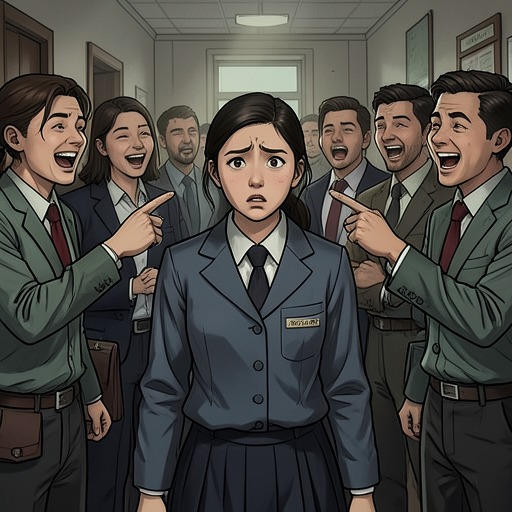
Arthur’s story later becomes inseparable from the Bradley attack and the competing accounts of what happened. When TifAni speaks with Detective Dixon and Detective Vencino, the questions turn to her connection with Dean and to her claim that Dean, Liam, and Peyton assaulted her at Dean’s house, and that Dean assaulted her again at Olivia’s house. Detective Vencino challenges her explanation that she was trying to save herself from Arthur, arguing that Arthur had been her friend and would not have hurt her. The exchange shows how the fact of their friendship is used against TifAni: to the detective, it appears to contradict her account of danger, while for TifAni it does not erase the fear behind her actions.
After the attack, the school initially resists TifAni’s return. Although there is not enough evidence to charge her with a crime, public opinion treats the surviving evidence against her as grounds for suspicion. Her fingerprints are found on the gun alongside those of the attackers; notes and yearbook writing are scrutinized; and Anita interprets TifAni’s apparent lack of grief as evidence that she welcomed the deaths of classmates she considered problems. Dean, paralyzed from the waist down, claims that Arthur handed TifAni the gun and told her to kill him as they had planned. TifAni knows Arthur never said this, but Dean’s status as a popular soccer player, and the future that his injury has cut short, make his account difficult for others to question. The story’s contrast is stark: Arthur’s absent voice cannot answer the accusation, while TifAni’s account is judged through the very signs—her behavior, her associations, and her fingerprints—that others read against her.
Memory, Photograph, and Legacy
Years later, TifAni’s memories of Arthur include not only the public story of the attack but also the friend who had once defended her. During work connected with the documentary about the Five, she deliberately says something positive about him, recalling that he stood by her when many people turned away. The recollection restores a dimension that the public narrative cannot supply: Arthur was not only a participant in the tragedy or a name in its disputed explanations, but also someone who had offered TifAni friendship and protection.
A photograph of Arthur with his father gives that memory a physical form. In TifAni’s stored Bradley materials, the image shows the two of them laughing beside the drab Jersey ocean, with pastel seashells around the frame. She has promised to return it to Mrs. Finnerman, and its presence among memorial cards and news clippings links the private affection of the image to the public record of the tragedy. When TifAni cannot find it, the loss unsettles her; she insists she would not have moved it.
The photograph’s disappearance ultimately exposes a breach with Luke Harrison. At their wedding, TifAni sees a seashell and confronts Luke about the picture. He admits that he gave it to John, who wanted a picture or frame to use while taking cocaine, explaining that he did not want to give away a photograph of himself and TifAni. When the frame broke, Luke threw the picture away. He had decided that keeping it would upset TifAni and that it was better for her to move on. To TifAni, the decision is not protection but the destruction of something she had promised to preserve. Arthur’s photograph therefore becomes more than a keepsake: its loss reveals how Luke has substituted his judgment for hers about what she should remember. Arthur remains present in the novel not through a final resolution of every disputed claim, but through TifAni’s insistence on holding together the friend she knew, the image she meant to return, and the truth that public accusation tried to flatten.