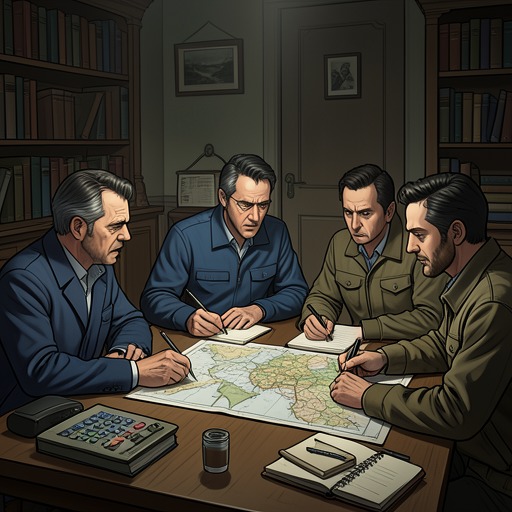
Arthur Finnerman and Ben
Luckiest Girl AliveArthur Finnerman and Ben Hunter were partners in the planning of the Bradley School attack, but not equal architects of it. Their relationship began with violent fantasies that Ben treated as jokes and Arthur regarded as possibilities. After Ben’s crisis made him more receptive to action, Arthur proposed the attack and shaped its aims. The distinction matters: the story’s later investigation presents Ben’s despair as a crucial opening, while identifying Arthur as the person who called the plan into being.
Early fantasies and unequal dispositions
During middle school, Arthur and Ben traded violent fantasies about killing classmates and teachers. For Ben, the talk remained a joke; Arthur, by contrast, was waiting for circumstances that might turn fantasy into a serious proposal. The two therefore shared a vocabulary of violence without sharing the same relationship to it. Their connection gave Arthur an audience, but the evidence does not portray Ben as the original driver of their plans.
The account distinguishes their dispositions without making Ben harmless. Ben was depressive and suicidal, and was not necessarily predisposed to violence in the way Arthur was; nevertheless, he was not opposed to violence. His wish to die later became bound up with a desire to make others pay. Arthur’s role was different: he treated violence as an intended act and, according to the later psychological review, understood how to turn another person’s anger into momentum.
The crisis that changed the partnership
The turning point followed Kelsey Kingsley’s graduation party. In the woods, Dean Barton and Peyton Powell humiliated Ben, an experience associated with his first suicide attempt. Less than two weeks after Ben was hospitalized, Arthur visited him and raised the idea of an attack on Bradley. The timing places the proposal close to Ben’s crisis: what had been joking talk acquired a practical direction when Ben was at his most vulnerable.
Arthur’s diary records the calculated circumstances of that visit. He waited for a change in the nurses’ shifts so that he and Ben could have privacy. The diary also describes the resources and steps he imagined: his father had a gun, Arthur could obtain a fake identification card and pose as an adult, and instructions for making a pipe bomb were available online. He reasoned that they were capable of carrying out the plan. Ben, in Arthur’s assessment, had crossed a threshold and would not return to his former state. The diary thus presents recruitment not as a spontaneous agreement between equals but as Arthur’s deliberate effort to test and enlist a distressed friend.
Ben’s own motive, as the account reconstructs it, was shaped by hopelessness and retaliation. Believing he had nothing to lose, he could regard dying as inevitable and the attack as a way to make those who had hurt him pay. That motive helps explain his participation, but does not account for the full design Arthur developed. The partnership joined Ben’s grievance to Arthur’s initiative, rather than reducing their different roles to a single shared impulse.
Rumor, grievance, and Arthur’s broader purpose
The public explanation that Arthur and Ben were bullied for being strange, overweight, or gay is explicitly challenged by the police reports described in the narrative. Arthur was widely understood to be gay; Ben was not. A rumor that Olivia Kaplan had seen Arthur and Ben in an intimate encounter at The Spot was false. It was teenage gossip that hurt and angered Ben, and Arthur used the rumor as leverage, recording that he had promised him Olivia. The episode shows how misinformation could deepen Ben’s resentment while giving Arthur a means to influence him.
Arthur’s interest, however, extended beyond revenge against the people who had humiliated Ben. He proposed a list of targets partly to entice Ben, but the narrative says Arthur’s contempt reached anyone he considered intellectually inferior. His intended scope included the cafeteria as a whole, not only particular tormentors. The distinction between Ben’s grievance and Arthur’s broader contempt complicates the simplified account of the attack as a response to bullying: an injury to Ben became an opening for a plan with a much wider intended reach.
Planning, attack, and forensic judgment
Arthur and Ben planned the attack for six months. During almost all that period, Ben was confined to a mental rehabilitation center, where he presented himself to doctors and nurses as no longer a danger to himself. Arthur, meanwhile, found what the later psychological report describes as a new female companion who reinforced his anger and helped keep his violent intentions active. The report did not name her; TifAni FaNelli recognized herself in that description and wondered whether, at their last meeting in Arthur’s room, she had set him off or interrupted an attempt to tell her about the plan and ask her to join it. Her uncertainty is not proof that she was a planner, but it reveals how the partnership’s history reached beyond the two boys in the aftermath.
Arthur’s plan involved bombs in the cafeteria and a subsequent armed attack. At least five bombs were believed to have been placed, but only one detonated. The explosion occurred near the table favored by the most popular students; when Arthur saw that the single blast had caused less damage than intended, he began shooting. His stated design, as reconstructed in the account, was to wait for the explosions, witness the destruction, and then die on his own terms rather than surrender control to the police.
The immediate toll was seven dead, including Arthur and Ben, and five victims; nine students were hospitalized with severe but not life-threatening injuries. The failed detonation did not prevent the attack, but it changed its course: Arthur shifted from waiting for the planned destruction to using the gun. The outcome makes the difference between the partners’ roles especially consequential. Ben’s willingness to die and retaliate joined a plan whose scale, methods, and insistence on control were attributed principally to Arthur.
Aftermath and the contested account
In the aftermath, the country’s most prominent psychologists examined Arthur’s and Ben’s journals, school records, and interviews with people who knew them. They reached the conclusion that Arthur had called the attack. Their assessment supports the narrative’s distinction between a partnership and an equal partnership: Ben participated, but Arthur was judged to have initiated the plan and driven its direction. The review also sought to explain how the two could reinforce one another, describing the pair as a dyad in which Arthur’s appetite for violence and Ben’s volatility served different functions.
That forensic conclusion stood against a media narrative centered on bullying. The contrast does not erase the humiliation Ben experienced or the false rumor that intensified his anger. Instead, it separates those circumstances from a complete explanation of the attack. The relationship is presented as a convergence of vulnerability and agency: Ben’s despair made him receptive, while Arthur converted shared fantasies and personal grievances into a sustained plan. TifAni’s later doubts about whether she had helped keep Arthur’s anger alive add another uncertainty, but the evidence does not establish that she knew of or joined the attack. The partnership’s significance lies in that imbalance, and in how public explanations could obscure it by treating the two boys as interchangeable products of the same grievance.