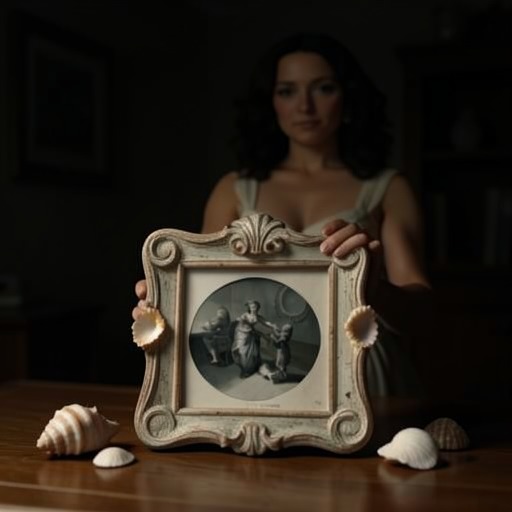
Arthur’s treasured photo with his father
Luckiest Girl AliveArthur’s treasured photo with his father is a keepsake TifAni takes from Arthur Finnerman’s room after a fight and keeps without returning. The picture becomes more than evidence of their quarrel: it is a personal family object whose absence matters to Arthur’s mother, Kathleen Finnerman, and whose eventual disclosure forces TifAni to acknowledge both the smallness of her motive and the lasting consequence of her action.
Identity and Significance
The photograph shows Arthur with his father. Kathleen identifies it as the picture with the seashells, and TifAni confirms that Arthur used to keep it in his room. The available scenes do not describe the image’s exact pose or setting; what they establish is its intimate status. It belonged to Arthur’s private space, represented a connection between father and son, and was important enough that Kathleen had been looking for it everywhere.
That importance is not initially visible to TifAni. When she first explains the theft, she presents the photograph as something she took because Arthur had said cruel things and she wanted to get back at him. The picture’s meaning therefore exceeds the purpose TifAni assigned it at the time. To her, in the immediate aftermath of their conflict, it was leverage in a personal retaliation; to Kathleen, its disappearance is the loss of a sought-after family keepsake.
The Theft and Its Concealment
In the hospital, TifAni is asked why Arthur was angry with her. Fiddling with a loose string on the blanket, she says that she stole the picture of him and his father. She does not tell the whole story: doing so would require discussing the night at Dean Barton’s house, a subject she says she cannot face. Instead, she gives the narrower explanation that Arthur had been mean to her and that taking the photograph was an attempt to hurt him in return.
The physical gesture and the limits of the explanation matter. TifAni tries to stretch out her toes against her irritation while describing a moment when her own anger had also narrowed what she could acknowledge. The theft is admitted, but its surrounding history remains closed off. The photograph thus marks both a specific act she can name and the boundary of a larger account she is not yet willing to enter.
Later, at a table with TifAni’s mother, Detective Dixon raises TifAni’s relationship with Arthur and their fight at the time of the incident. TifAni nods along and volunteers that she took the picture and still has it, offering to produce it. Detective Dixon stops her: the detectives have not come to discuss Arthur. TifAni’s readiness to return to the photograph shows how prominently the theft sits in her own account of their conflict, even when the investigators’ purpose lies elsewhere. The object is both a concrete fact she can offer and a subject she expects to explain the situation.
Disclosure to Kathleen Finnerman
Much later, TifAni tells Kathleen that she has a photograph of Arthur and his father. During this visit, Aaron guides a microphone around the room. TifAni holds a coffee mug that has gone lukewarm as she explains that Arthur kept the picture in his room. Kathleen immediately asks whether it is the one with the seashells, confirming the identifying detail that links the object in TifAni’s possession to the missing keepsake she remembers.
Kathleen’s response changes the emotional character of the disclosure. The light enters the living room as a cloud moves, and TifAni notices Kathleen’s blue eyes; then Kathleen’s expression hardens as she asks how TifAni has the photograph and says she has been searching for it everywhere. The object has moved from an undisclosed consequence of a quarrel into a loss legible to the person who wants it back. Its absence has a history independent of TifAni’s account of why she took it.
TifAni admits that she and Arthur fought, that she took the photograph to upset him, and that she never got the chance to return it. She looks into her cold coffee as she says this. Kathleen asks for the picture back, and TifAni agrees, beginning to apologize. The exchange makes the practical consequence plain: the photograph is still in TifAni’s keeping, and Kathleen wants it restored to her.
Interruption and Narrative Role
TifAni’s promise is interrupted when Kathleen screams. Kathleen flings her mug onto the table, spilling the remaining tea onto newspapers, and claws at her temples with her eyes shut. The scene does not establish that the photograph causes this episode; it establishes only the sequence, with Kathleen’s distress breaking into the moment just as TifAni is about to apologize. The requested return therefore remains unresolved in the scene provided.
Across these encounters, the photograph recurs at moments when TifAni’s relationship to the past is being tested. In the hospital, it lets her acknowledge one piece of the conflict while withholding the story she associates with Dean Barton’s house. During Detective Dixon’s questioning, it is the explanation TifAni expects to give, though the detectives redirect her. In Kathleen’s home, the same object reveals what that explanation leaves out: the theft did not end with the fight, because TifAni kept an image another person was actively seeking.
The photograph’s significance rests on this change in perspective rather than on any newly described feature of the image. It begins in TifAni’s account as a stolen possession used for retaliation; it emerges in Kathleen’s as a missing keepsake with personal value. Because TifAni never returned it before Arthur’s death, the object carries a belated obligation into her meeting with his mother. Her admission and offer to give it back cannot undo the taking, but they make the concealed, unfinished consequence visible.