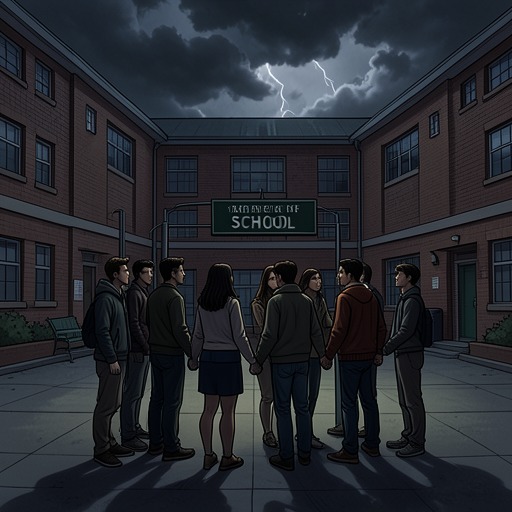
Bradley’s post-attack closure and rebuilding
Luckiest Girl AliveThe Bradley School’s post-attack closure and rebuilding unfolded in stages: an indefinite suspension whose end was initially unclear, a return to classes while the cafeteria remained unusable, and a public struggle over security and the story of the attack. Reopening restored a school routine, but it did not settle who belonged in the community, how much protection the institution owed its students, or how the violence should be explained.
Immediate suspension and public response
In the aftermath, the school was shut down for an uncertain period. At the hospital, Anita Perkins told TifAni FaNelli that the closure would last some time and that she did not know how administrators planned to complete the semester. The suspension was later described as indefinite. TifAni’s mother observed that TifAni was fortunate not to be a senior, since the disruption would have made college applications especially difficult. The interruption therefore reached beyond the damaged campus: it suspended the ordinary timetable on which students’ academic plans depended.
The scale of the attack became public through television coverage. A report from the school described seven deaths, including the two attackers and five victims, and nine students hospitalized with severe but non-life-threatening injuries. One victim had died in a cafeteria explosion caused by a homemade bomb hidden in a backpack; authorities believed several bombs had been placed, though only one detonated. The report located the attack within the school’s social geography by identifying the cafeteria table near the blast as one favored by popular students. News coverage made the school’s tragedy legible to a national audience through casualty counts and physical damage, while leaving the community to live with the consequences after the cameras moved on.
The loss was also marked in gatherings beyond the classroom. At Liam’s funeral, attendance exceeded the meetinghouse’s seating, forcing people to listen from outside through its air-conditioning vents. TifAni recognized that many student mourners had barely known Liam, yet felt a connection to him herself. The memorial and the school’s suspension were different responses to the same rupture: one gathered people around a death, while the other removed the ordinary school day that had brought them together.
Security and the terms of return
After the attack, state and media pressure called for metal detectors and armed guards. The administration resisted those measures, treating the shooting as an isolated incident and arguing that intrusive searches and armed security would needlessly frighten students and compromise their privacy. Parents supported that position; many were Bradley graduates and opposed treating the school as though it required the same security regime as an inner-city public school. This defense of privacy and institutional identity left a visible tension in place: later, the Athletic Center was unlocked, prompting TifAni to criticize the school’s security. The school’s post-attack policy did not simply restore normality; it defined normality as a refusal to make heightened security permanent.
TifAni’s return was itself disputed. Headmaster Mah told her mother that he was surprised TifAni wanted to come back and unsure whether returning was right for her or for the school. There was not enough evidence to charge her with a crime, but suspicion continued in public opinion. Notes and yearbook entries, her fingerprints on the gun, and an assessment that she showed little emotion for her dead classmates were treated as grounds for mistrust. Dean Barton further alleged that Arthur Finnerman had given TifAni the gun and instructed her to kill him as part of a plan. TifAni maintained that Arthur had never said this, but Dean’s public standing as a popular athlete left her account vulnerable to disbelief.
Dan Rosenberg challenged the school’s hesitation, warning Headmaster Mah that excluding TifAni could expose it to an even larger lawsuit. Other parents were already suing, including Peyton Powell’s family. Their case concerned the failure of sprinklers in the old cafeteria to activate and the resulting spread of fire into the Brenner Baulkin Room. The coroner determined that Peyton died from smoke inhalation rather than the gunshot wound. The dispute joined a question of institutional responsibility for the building to the larger difficulty of deciding who would be allowed back into the school community.
Reopening and rebuilding
When the spring semester began, the school had resumed classes, but reconstruction was incomplete. The cafeteria would not be rebuilt for another year, so students ate lunch at their desks. Pizza was frequently ordered, and the changed arrangement became part of the makeshift routine of the reopened school. The delay made rebuilding tangible in daily life: students could return to lessons without regaining the shared dining space around which much of school life had been organized.
The return also did not restore TifAni’s former social position. She described the disappearance of the people who had made her life miserable as difficult to believe, but the absence of those classmates did not erase the loneliness that followed. During the first month back, she dry-heaved every morning before school and came to treat loneliness as a dependable companion. The school’s physical reopening thus contrasted with her continued distress: the timetable restarted, while her sense of safety and belonging did not.
Competing explanations of the attack
The school’s recovery took place amid efforts to explain the attackers and prevent another attack. Public discussion often framed Arthur and Ben Hunter as victims of bullying, but later examination of police reports, journals, academic records, and interviews with people who knew their families produced a more complicated account. Psychologists reviewing the evidence agreed that Arthur had taken the lead. The investigation described Ben’s despair and Arthur’s influence, while also identifying Arthur’s contempt for people he considered intellectually inferior as central to his plans. The emerging account therefore challenged a simple explanation in which bullying alone had caused the attack.
The contrast between those accounts mattered to the school’s attempt to make sense of its past. A bullying narrative offered a familiar cause; the later evidence described planning, manipulation, and a target wider than the attackers’ immediate tormentors. TifAni also wondered whether her final encounter with Arthur had set him off, while recognizing that she could not know what he might have intended to tell her. Such uncertainty remained alongside the investigations and official explanations. The school could reopen its classrooms and rebuild its cafeteria, but neither construction nor public inquiry could make every question about responsibility and motive disappear.