Bryn Mawr Hospital
Luckiest Girl AliveBryn Mawr Hospital is the setting for TifAni FaNelli’s immediate aftermath of the Bradley attack: a place where evidence is collected, medical care is offered, and the question of what life will look like after the violence begins to press in. Its role is brief but consequential. The hospital holds TifAni between the attack itself and the uncertain prospect of returning to school, while her sharply physical memories of the place record how little control she feels over what happens next.
Setting and Arrival
The hospital appears in TifAni’s account not as a neutral backdrop but as a setting filtered through shock. She recalls its interior through a green cast, an impression that makes the building seem inseparable from the crisis that brought her there. The memory of the hospital is tied to a concentrated stretch of time in which ordinary adolescence has been replaced by the consequences of the attack. TifAni later corrects the staff member’s estimate that she has been through a great deal over the preceding twenty-four hours: the most devastating events have occurred within roughly eighteen hours. That distinction underscores how abruptly her life has changed, even as the hospital’s routines attempt to organize the emergency into manageable steps.
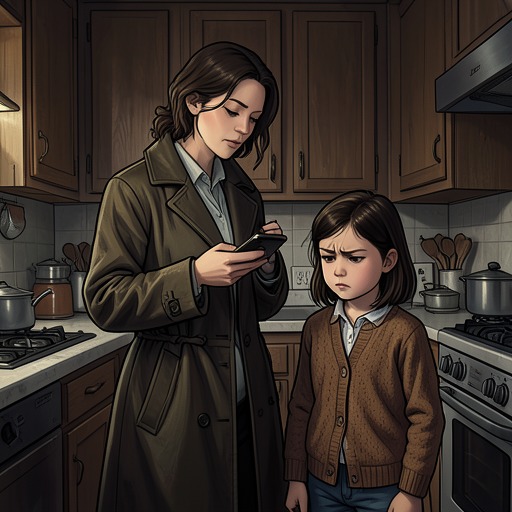
The hospital scene also gathers the practical details of post-attack care. TifAni is given a hospital gown and sits on the bed while her Mother remains nearby, crying. TifAni has told her Mother not to approach or touch her, and the distance between them persists despite their physical proximity. Her Father is kept in the hallway during the examination. These arrangements show that the hospital is a place of family presence and separation at once: her parents are close, but TifAni sets strict limits on contact while she tries to manage the immediate aftermath.
Examination and Evidence
At the hospital, Dr. Levitt explains that a person in shock may not recognize an injury and proposes an examination to make sure TifAni is not hurt. TifAni insists that she is not, but the doctor’s concern introduces a tension between her own account of her condition and the possibility that shock has made it difficult to assess. The examination does not proceed immediately. A female officer interrupts to say that TifAni must first be swabbed so the examination will not compromise evidence. Medical assessment and forensic procedure therefore occupy the same room, with the order of events determined partly by the need to preserve evidence.
The handling of TifAni’s clothing extends that procedural atmosphere. Her clothes are placed in a clear evidence bag, and she is distressed by the thought of her personal belongings being exposed to whoever handles them. The episode makes the hospital more than a site of clinical attention: it is also where private experience becomes material for investigation. Her discomfort is not presented as a rejection of evidence collection; rather, the scene shows how an essential procedure can intensify her sense that intimate parts of her life are no longer under her control.
Anita Perkins and Conversation
A later conversation begins when Anita Perkins introduces herself by her first name and asks whether there is anything she can get for TifAni. Her manner contrasts with the earlier examination. Anita sits beside TifAni rather than opposite her, and TifAni notices the difference in their positioning. The shared orientation makes the exchange feel less like a formal interrogation, allowing the possibility of conversation without requiring TifAni to face someone across a desk.
Anita acknowledges the scale of what TifAni has experienced and asks whether she wants to talk. TifAni accepts the invitation, though her response also reflects the gap between a professional summary of events and her own sense of their timing. The hospital thus becomes a place where speaking is offered rather than demanded. The contrast between the officer’s evidence-first interruption and Anita’s effort to sit alongside her gives the setting two simultaneous functions: it processes the attack as an investigable event, while also making room for TifAni to respond to it as a person.
Departure and Narrative Significance
When TifAni leaves the hospital, her Father drives because her Mother is too shaken to do so. The route home becomes a transition from the hospital’s immediate procedures to questions about the future. As the car moves away from the Main Line’s boutiques and luxury-car lots toward fast-food restaurants and strip malls, TifAni begins to fear that classes at the Bradley School may not resume. Her question about whether she will return to Bradley exposes how strongly she remains attached to the school, despite everything that has happened there. The hospital visit has not resolved where she belongs or what comes next; it has brought those uncertainties into focus.
The hospital’s significance therefore lies in its position at a hinge in the story. Inside, TifAni is examined, her belongings are collected, and a potential conversation with Anita begins. Outside, her family must navigate home while the possibility of losing her place at school shadows the journey. The building does not restore the life that preceded the attack, nor does it settle the consequences. Instead, it marks the interval in which emergency care gives way to an unsettled aftermath, and in which TifAni’s need for privacy, her parents’ distress, and her attachment to the world she knew all become visible.