Control of one's own story
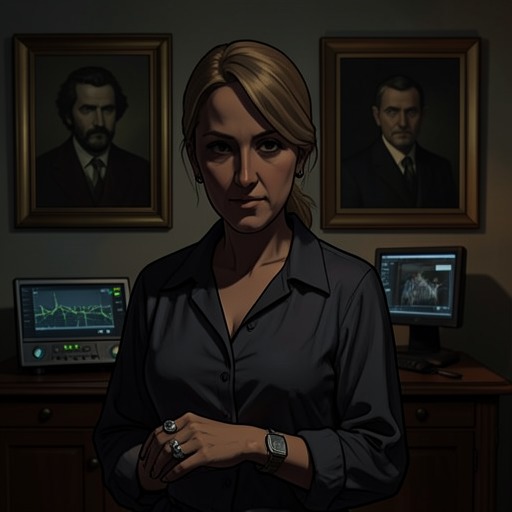
Luckiest Girl AliveControl of one's own story is the effort to determine what others know about TifAni FaNelli and how they interpret it. The effort begins with her name and extends to her public identity, her account of the past, and the documentary meant to carry that account to an audience. Reinvention gives her a measure of authorship, but the story also shows how easily that authorship is shared or contested by producers, cameras, and the people whose histories overlap with hers.
Name, Identity, and Self-Presentation
TifAni FaNelli first recognizes her name as a source of social difference when she enters high school at The Bradley School. Among classmates whose names seem more conventional and socially polished to her, her own appears conspicuous. She later describes the school as having taught her to dislike the name, even as its reputation becomes part of the story she can tell about how far she has traveled from her earlier life. Her relationship to the past is therefore not simply concealment: the same history can embarrass her and serve as evidence of achievement.
At Wesleyan University, her friend Nell suggests that she drop the Tif and use Ani, pronounced to distinguish it from the more ordinary Annie. Ani presents the change as a choice about who she wants to become, not as an attempt to hide her history. The new name grows into Ani Harrison, a carefully constructed identity associated with the person she believes others did not expect her to become. The distinction between TifAni and Ani is both a form of self-definition and a performance for an audience: a name can make the past less immediately visible without making it disappear.
That audience matters in her professional life as well. When asked whether her name change was prompted by the events at Bradley, she has a practiced explanation: a college professor supposedly advised her to use a name that would be judged on its own merits. She also downplays the idea that people remember her name, suggesting that Bradley is what they remember instead. The account is a deliberate, socially acceptable version of a more complicated truth. Her ability to move between explanations demonstrates how self-presentation can protect a person while also narrowing what she is willing to disclose.
The Documentary as an Opportunity
The documentary Friends of the Five first attracts TifAni as a chance to redeem herself and tell her side of the story. She is conscious, however, that public testimony will be judged alongside the life she appears to have built. Before agreeing to participate, she wants the markers of success in place: an impressive job and address, a body she considers suitably disciplined, and a wealthy, desirable fiancé. Her engagement to Luke Harrison is thus both an intimate commitment and part of the public image she wants to present. She pushed for it; Luke had wanted to wait for a later bonus, but eventually had Mammy's emerald ring reset for her. The ring makes visible how closely, in her own thinking, personal security and social legitimacy have become linked.
Her wish to reconnect with Andrew Larson also belongs to this search for a coherent account. She says she wants to know whether they will be filmed at the same time and what he will discuss, then insists that she wants to talk with him about everything. Luke, who is Andrew Larson's client, worries that their contact could become messy. TifAni presses for the address, writes Andrew Larson a warm email, and eagerly accepts his invitation to coffee, though she resents being treated as a former student. The exchange shows her trying to arrange not only what will be said on camera but also which relationships and memories can enter the documentary.
Cameras, Editing, and the Limits of Authorship
TifAni knows from her work in television that editing does not merely preserve an account: questions and selected answers can be arranged to produce a desired result. She admits to Andrew Larson that she can decide what she wants a piece to say before researching it, and can change whom she asks if an expert's response does not fit. Her caution about the documentary follows from this professional knowledge. She wants the platform, but does not assume that the finished film will be a neutral container for her testimony.
The studio interview makes that tension concrete. In a black-walled room above a Starbucks in Media, Pennsylvania, producer Aaron asks her to state her name, age, and age on November 12, 2001. He wants her to tell the story from beginning to end in one continuous take, maintaining its emotional continuity, while allowing himself to interrupt if she digresses. The camera's apparent intimacy—Aaron asks her to imagine a conversation between the two of them—coexists with an explicit production plan. She is invited to speak freely within a structure whose pacing and boundaries someone else helps determine.
TifAni's own account has boundaries too. She habitually ends the story of Arthur's death at the point she has selected for Aaron, while withholding a private thought she had at the time. That omission makes narrative control more than a matter of the camera: she has already edited her memory for different listeners, deciding where the account stops and what remains unspoken. The distinction between a true statement and a complete one becomes central to the documentary's promise.
Recorded Speech and the Return to Her Name
During the filming with Dean, TifAni challenges the vagueness of his apology by naming actions and experiences he has not acknowledged. Dean then asks for filming to stop, and the crew hesitates before Aaron tells the cameraman to comply. The moment exposes the documentary's competing claims: TifAni needs a direct account of what happened, while Dean wants control over whether this confrontation becomes part of the record. Aaron's response also reveals that he had not understood the extent of what Dean needed to answer for.
Even after filming stops, the microphones have recorded their conversation. Aaron later tells TifAni that he reviewed the footage and that both she and Dean were miked. She had wanted Dean to name the assault, aware that the recording might preserve words the camera could otherwise miss; she asks whether the footage can support her story. For Aaron, the recording is a possible scoop as well as a means of giving her account public force. He warns that using it may provoke a backlash. The evidence gives TifAni more control over what can be shown, but it also makes the consequences of disclosure harder to contain.
The final naming sequence marks a change in what she is prepared to claim. With Aaron's support, she introduces herself by her birth name and states that she was fourteen on the date of the Bradley shooting. At his request, she repeats the introduction using only her name. The progression does not erase Ani Harrison or settle who will control the documentary's final meaning. Instead, it places TifAni FaNelli at the beginning of the account, no longer only as the person behind a protective identity but as the person choosing to speak under her own name.