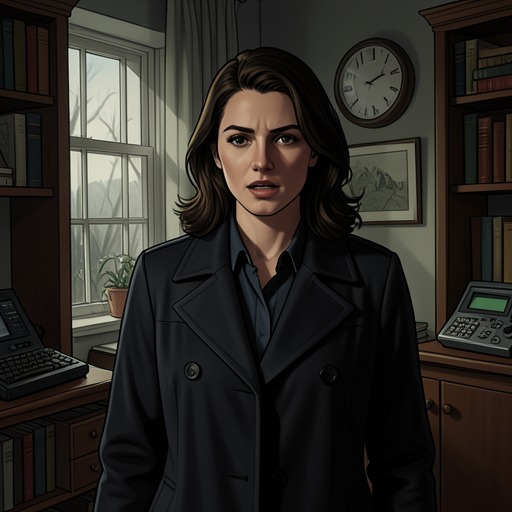
Friends of the Five
Luckiest Girl AliveFriends of the Five is the provisional title of an HBO documentary project about the events surrounding the Bradley tragedy. For TifAni FaNelli, participating offers a chance to give her side of a story shaped by public suspicion; the filming also creates a new tension between her control over that account and the production’s cameras, questions, and recordings.
Project and Personal Stakes
Nearly a year before filming, HBO producers asked TifAni to participate in a documentary loosely titled Friends of the Five. She did not consider herself one of the five’s friends, but saw the invitation as an opportunity to redeem herself and tell her side of the story. Participation was bound up with her ambitions for a public reinvention: she wanted the visible markers of having made it, including a desirable job, an impressive address, a thin body, and an impressive fiancé.
TifAni had been dating Luke Harrison for three years when she pressed for an engagement. She wanted the ring and the relationship to strengthen the image she hoped to present on camera, even as she recognized that measuring her independence by whether she wore a ring repeated a standard she thought she should resist. Luke had Mammy’s emerald ring reset for her, and she agreed to take part in the documentary. In her imagined account to the camera, the ring would be conspicuous as she performed a composed, tearful revelation. The project thus begins, for her, not only as an invitation to speak but as a stage on which she hopes to appear beyond challenge.
The Event and the Anticipated Audience
The documentary’s title also attaches to a planned Friends of the Five gathering. After meeting Spencer, TifAni noticed an Instagram comment asking whether Spencer would attend the event, scheduled to take place at a pub in Villanova, Pennsylvania. Months before it was due, TifAni imagined arriving with Luke, wearing cashmere and her emerald ring. She pictured the crowd interpreting her presence in opposing ways: as audacious, or as a provocation. Her fantasy also included the possibility of encountering a man who, she feared, still believed she owed him sex.
The imagined appearance depends on both status and bodily control. TifAni considers whether she might reach her goal weight before the gathering and pictures the former social world of The Main Line as a place she has outgrown. When an email later appears with an urgent subject line announcing a schedule update, it interrupts her attention to a bridesmaid fitting. The message’s contents are not supplied, but its arrival makes the documentary-related commitment suddenly immediate.
The Interview and Its Form
Filming begins in a studio above a Starbucks in Media, Pennsylvania. Before the interview, Aaron asks TifAni to state her name, age, and age on November 12, 2001, the date around which her account will be organized. A makeup artist checks her foundation while TifAni worries about shine on her nose. The staging makes the interview’s two demands visible: she is being prepared for the camera even as she is asked to narrate painful events.
Aaron asks her to speak as if the two of them were having a conversation and hopes to capture the story in one take, from beginning to end. He emphasizes emotional continuity and says he may interrupt if she digresses. The format therefore offers TifAni an uninterrupted account while reserving some control over its direction to the director. Her own anticipated reactions are less orderly: she thinks she may become physically ill rather than tearful, recalling that vomiting had long been one way she coped. After the studio interview, the crew plans to film location shots around the outskirts of The Bradley School, where Aaron wants her to identify significant places from her past.
Public Narratives and Contested Credibility
The project’s stakes sit within a public record already crowded with competing accounts. In coverage of the Bradley shooting, NBC reports seven deaths, including the two shooters and five victims, and describes a cafeteria bomb, additional suspected bombs, and injured students. The tragedy is thus presented to a national audience through a rapid accounting of casualties and possible causes.
Afterward, TifAni faces suspicion despite the absence of evidence sufficient to charge her with a crime. Notes, yearbook material, and her fingerprints on a gun become part of public judgment; Anita’s assessment of TifAni’s emotional response also circulates. Dean Barton claims that Arthur Finnerman gave TifAni the gun and told her to kill him as planned. The media’s desire to assign responsibility and the public’s willingness to trust Dean leave TifAni’s account at a disadvantage. Meanwhile, psychological examinations of Arthur and Ben’s records lead investigators to identify Arthur as the leader, and the evidence challenges a simplified media explanation that the attack was caused by bullying. These surrounding disputes establish why TifAni regards the documentary as more than a chance to revisit the past: it is a possible means of contesting the account others have made dominant.
Recording, Exposure, and Control
The limits of production control become concrete during filming with Dean Barton. When TifAni challenges his vague apology by naming his conduct toward her when she was fourteen and intoxicated, and a later assault at Olivia Kaplan’s house, Dean turns his wheelchair toward the camera and demands that filming stop. Aaron initially appears stunned; the cameraman waits for direction, and Aaron eventually tells him to stop recording. The encounter reveals that the director had not understood the full extent of what Dean had to answer for.
The exchange nevertheless remains available in the recording. Later, Aaron tells TifAni that both she and Dean were miked and that the camera recorded their conversation. TifAni had wanted Dean to name what happened as rape, in part because she knew an active microphone could capture his admission; she had wanted the record in case she chose to speak publicly, even if doing so conflicted with Luke. Aaron recognizes the material as a significant scoop, but also warns her to expect public backlash. His response joins two roles that the project cannot easily separate: director interested in consequential footage and friend concerned for the person whose story it may expose. Friends of the Five consequently stands for both the possibility of TifAni telling her truth and the unresolved question of who controls, preserves, and presents that truth once the cameras are running.