Hilary
Luckiest Girl AliveHilary’s place in TifAni FaNelli’s life is defined by a sharp reversal: she first appears to offer entry into Bradley’s influential social world, then becomes entangled in the humiliation that makes that welcome suspect. After the school attack, Hilary is among the people whose lives are permanently changed. Her departure from The Bradley School and the unanswered letter TifAni sends her leave their relationship unresolved.
Identity and Introduction
Hilary first approaches TifAni FaNelli in the cafeteria, complimenting her orange cargo pants and asking whether she is new. Her look sets her apart from the school’s dominant androgynous prep style: she wears a hot-pink button-down with a plaid skirt, and her strawberry-blond hair appears uniformly bleached. The narration presents her as both striking and difficult to categorize, with an assured manner that suggests she has authority in the room. Rather than blending into Bradley’s prevailing style, she makes difference part of her presence.
That difference is deliberate. Later, when Hilary calls TifAni over outside school, her very short skirt reveals red underwear; TifAni understands the outfit as a form of rebellion, not simply a failure to observe the rules. The distinction matters to TifAni, who is trying to restrain her own clothing choices and sees in Hilary a way of dressing that succeeds because it is purposeful. Hilary’s style is therefore more than decoration: it signals a practiced command of how she will be seen.
Hilary also has a distinctive husky voice, which the narration describes as carefully cultivated. Her casual greeting to TifAni and her later invitation to join her and Olivia Kaplan show how readily she can make social contact. Yet this ease exists alongside a sharp awareness of status: Hilary belongs to a circle whose attention can change how other students treat someone newly arrived.
Social Position and the HOs
Hilary is closely associated with Olivia Kaplan, her best friend. At lunch, Arthur Finnerman explains the HOs label as an acronym formed from Hilary and Olivia’s names, and takes pleasure in the claim that the girls do not even understand the joke. The label places them in a social world where reputation is made and traded by others, even as their own visibility gives them power over who is included. Hilary’s prominence is apparent in the cafeteria scene: a boy at the most esteemed table calls out to her, and she moves easily among the people whose approval TifAni wants.
Hilary’s growing connection with TifAni follows a moment of uncertain significance. After Dean Barton receives detention for something he said to Mr. Larson, Hilary asks TifAni to eat lunch with her the next day. The narration says the events were somehow connected, but TifAni does not know how and is too eager to claim a place at the girls’ table to investigate. The invitation also unsettles Arthur, who sees TifAni’s new athletic and social affiliations as a departure from their previous closeness. Hilary’s attention thus has consequences beyond the two girls: it changes TifAni’s position among her peers and strains her friendship with Arthur.
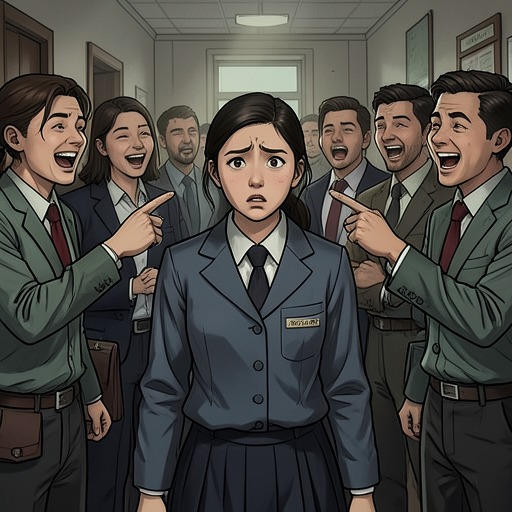
The apparent inclusion continues when Hilary and Olivia find TifAni in the locker room and ask what she is doing that evening. TifAni is surprised that they have sought her out. The next day, her running shorts are displayed on a bulletin board beneath a mocking sign. She remembers that Hilary and Olivia had behaved unusually kindly in the locker room and connects that encounter to the public humiliation. The scene presents TifAni’s suspicion and the sequence that produces it, but does not establish which girl put up the sign. Hilary’s role remains part of the painful uncertainty: the invitation that seemed to promise friendship now appears, to TifAni, as possible preparation for ridicule.
Performance, Gender, and Background
Hilary’s appearance is described through the contrast between her chosen presentation and other people’s judgments of her. Boys call her HIMary because of her broad shoulders and athletic frame, while TifAni notices her toned body and regards it with fascination. The account does not portray Hilary as a sports participant: she does not play a sport, and her mother forges a letter from a squash coach to excuse her from gym class. Her body is nevertheless read and discussed by others, making the gap between her own self-presentation and the school’s labels part of her social experience.
Her clothes and voice are similarly shown as deliberate performances. A short skirt and hot-pink clothing, a cultivated huskiness, and her confident manner together make her appear to set her own terms of visibility. That appearance does not make her invulnerable to the social judgments around her. The HOs nickname, the boys’ derogatory name for her body, and TifAni’s shifting reading of her kindness all show how quickly other people turn Hilary into an object of commentary. The narrative gives her a vivid public persona but relatively little access to her private thoughts, so her intentions toward TifAni remain uncertain rather than resolved.
Injury and Departure
During the school attack, Hilary is found gravely injured in the Brenner Baulkin Room. TifAni’s recollection of the moment is silent, and the detail about Hilary’s voice comes later through what TifAni is told: the carefully cultivated huskiness had given way to a frightened call for her mother. Hilary’s left foot had to be amputated. Olivia, who is beside her, is dead. The contrast makes Hilary’s survival a profound consequence of the attack, not a return to the confident social life that preceded it.
The survivors gathered in the room come from different school years and social positions. Their presence creates, in TifAni’s understanding, a bond imposed by the catastrophe. Hilary is no longer only the girl whose invitation could alter TifAni’s place at lunch or whose possible involvement in a prank leaves TifAni hurt and suspicious. She is also one of the people whose futures have been broken open by the same event. When TifAni later asks about her, the answer is stark: Hilary is an amputee. TifAni immediately wants to know whether she will recover and whether she will return to Bradley, making Hilary’s absence part of TifAni’s anxious effort to imagine what the school will become.
Hilary does not return. Her parents move her to Illinois, where her father’s family is from. TifAni writes her a letter, but it comes back unopened. The returned envelope supplies no explanation for the silence, and the story does not say whether Hilary chose not to read it or whether some other circumstance intervened. The failed correspondence leaves the earlier fracture between them unresolved, while confirming that Hilary’s life has moved beyond the school where their connection began.
Narrative Role
Hilary’s narrative importance rests on the changing meaning of her presence. At first, she embodies access to Bradley’s inner circle: her invitation offers TifAni a route out of isolation, and that route appears to bring recognition as well as risk. The bulletin-board incident makes the invitation difficult to trust, but the evidence keeps Hilary’s precise responsibility uncertain. This ambiguity preserves the difference between TifAni’s suspicion and what can be stated as fact.
The attack then alters the terms on which TifAni remembers her. Hilary’s injury and departure do not erase the social harm associated with the girls’ circle, nor do they settle what Hilary intended. Instead, they place that adolescent uncertainty beside a life-changing loss. TifAni’s concern for Hilary after the attack, followed by the unopened letter, gives their connection an unfinished shape: a relationship that began with an easy greeting and an offer of inclusion, passed through distrust, and ended without a reply.