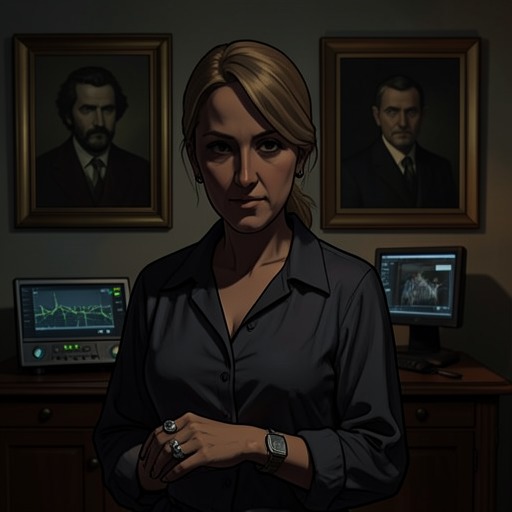
No one can hurt me if I’m Ani Harrison.
Luckiest Girl Alive“No one can hurt me if I’m Ani Harrison” is TifAni FaNelli’s compact description of a protective identity: she imagines that becoming Ani Harrison can shield her from the vulnerability attached to her earlier self. The expression is not a claim that she feels safe. It reveals how urgently she wants safety, and how she has tied it to a new name, a socially secure relationship, and the appearance of having escaped the person who was hurt.
Meaning and Formulation
TifAni explains the idea to Andrew Larson while describing her fear of marrying Luke Harrison. With Luke, she says, she sometimes feels crushing loneliness; she also recognizes that he is not a bad person and that their life together has good parts. She calls the relationship a kind of insurance. In that context, Ani Harrison is more than a name: it represents the composed, protected self she hopes a marriage and its attendant security can preserve.
Her explanation draws a sharp division between two versions of herself. TifAni FaNelli is, in her account, the girl who can be diminished; Ani Harrison is supposed to be beyond that reach. The phrase turns reinvention into a private rule of survival, but its absolute promise also exposes its limits. A change in identity may alter how she presents herself and what she can access; it cannot erase what happened or guarantee that others will treat her fairly.
Andrew answers by rejecting the premise that TifAni FaNelli was simply weak or insignificant. He says, “I don’t remember anyone squashing TifAni FaNelli.” TifAni responds by indicating how small she felt she had been made. Their exchange places her self-protective formula beside a different form of recognition: Andrew does not accept her description of herself as someone who could be crushed without consequence, even as she insists on the depth of the injury.
Security and the Social World
The word “insurance” makes the expression relational as well as personal. TifAni does not describe Luke as the source of her loneliness, but she doubts he understands the painful parts of her past. She fears that this may be the best she can hope for, and weighs that emotional cost against the security the relationship provides. The imagined protection of Ani Harrison therefore depends partly on a life built with Luke, even while TifAni questions whether that life can meet her need to be understood.
The world around that relationship gives security a social dimension. At a gathering with Luke and Whitney, Andrew, and others, TifAni reflects on the ring and address associated with her new standing and on the convincingness of her social mask. She also confronts Luke over his family and friends’ support for Mitt Romney in 2012, objecting to the candidate’s position on abortion and its possible consequences for rape and incest victims, women whose lives were endangered, and Planned Parenthood. Luke dismisses the prospect of those consequences. The exchange shows TifAni challenging the assumptions of the circle whose approval and protection her reinvention has helped her approach.
Other scenes expose the hostility that can sit beneath that circle’s polish. During a conversation about London, Hallsy makes a racist remark; Mrs. Harrison leaves the table, and TifAni’s thoughts return repeatedly to Hallsy’s insistence that her aunt knows she is right. The moment does not explain TifAni’s identity formula, but it complicates the social world in which that identity is meant to secure her place: status can offer belonging while leaving prejudice and cruelty intact.
Limits of the Protective Identity
The phrase’s promise is tested by events in which TifAni cannot control how others interpret her. When detectives question her about Dean Barton, she confirms that Dean, Liam, and Peyton assaulted her at Dean’s house and that Dean assaulted her again at Olivia Kaplan’s house. Detective Vencino challenges her account by asking why she would want to save Dean from Arthur Finnerman. TifAni answers that she was trying to save herself. The exchange makes visible the gap between her motives and the explanation an authority figure is prepared to accept.
That gap extends beyond the interview. After the Bradley shooting, Headmaster Mah questions whether TifAni should return to The Bradley School and whether her return is right for the institution. Although there is not enough evidence to charge her with a crime, public suspicion persists. Dean claims that Arthur gave TifAni the gun and told her to kill him as they had planned; the claim is false, but Dean’s popularity and his changed circumstances lend it credibility for many observers. TifAni’s reinvention cannot prevent that public story from being told about her.
The expression thus carries both refuge and contradiction. Ani Harrison is a self-fashioned barrier against being hurt again, yet TifAni’s experience shows that the barrier cannot guarantee understanding, trust, or control over her own story. Its significance lies not in a completed escape from vulnerability, but in the starkness with which it states the terms of her attempted escape.