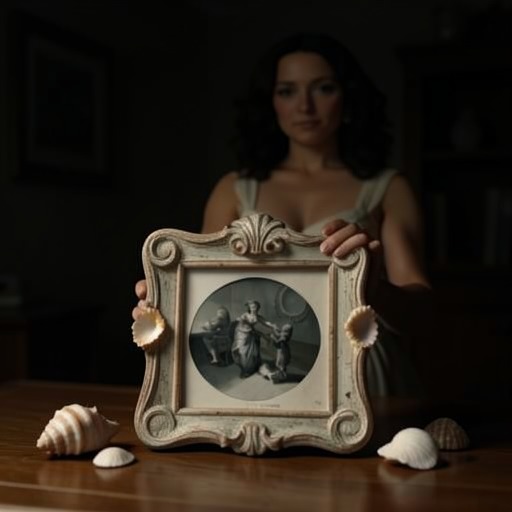
Photograph of Arthur and his father
Luckiest Girl AliveThe Photograph of Arthur and his father is a personal image of Arthur Finnerman and his father laughing beside the ocean, preserved by TifAni FaNelli among her Bradley keepsakes. Its later disappearance—and Luke Harrison’s admission that he gave it away and threw it out—makes the photograph a focal point for a conflict over memory, trust, and TifAni’s right to decide what she keeps.
Identity and Custody
The photograph shows Arthur and his father together at the ocean, laughing against a scene TifAni remembers as a drab Jersey shoreline. Pastel seashells lined its frame, giving the image a distinctive border as well as a connection to the place and relationship it recorded. It was not one item among ordinary household pictures for TifAni: she kept it with Bradley-related materials, including news clippings and memorial-service cards, in a folder stored on the bottom shelf of a bookcase.
That placement joined a particular family image to a larger personal archive. TifAni had promised Kathleen Finnerman she would return the photograph, so the object carried an obligation as well as a memory. Its importance therefore rested both in what it depicted—Arthur with his father—and in the fact that it belonged to a history TifAni was trying to preserve and to people beyond her own household.
The Search and Its Stakes
When TifAni went looking for the photograph, she was already discussing Dean Barton with Luke. She had told Luke that she had gone to see Dean by choice, and that Dean no longer believed she had contributed to what happened; she also explained that he had apologized on camera for having said otherwise. The conversation brought the painful past into the open between the couple, while the photograph’s promised return gave TifAni a concrete task connected to Bradley and to Arthur’s family.
TifAni searched the folder on the floor, turning through its contents more than once, but the photograph was missing. Luke suggested she might have moved it and forgotten. TifAni rejected that explanation, insisting she would not have moved it. Her certainty makes the absence feel consequential rather than incidental: this was an object she had deliberately kept in a known place, and she understood herself to be responsible for returning it.
Luke’s Explanation
The truth emerges later, when Luke enters the bathroom and sees TifAni holding a seashell. She asks what he did with the picture. He first says he had not wanted to upset her further, then explains that John had bought cocaine during a weekend in New York and wanted a picture to use as a surface. Luke says he objected to the purchase, but gave John the photograph of Arthur and his father rather than a picture of himself and TifAni. In his account, someone knocked it over, the frame broke, and he threw the photograph away.
Luke’s explanation establishes that the image was not misplaced by TifAni: he chose to hand it over, and then disposed of it. He presents the choice as a way to protect their own photographs, although TifAni points out that there were many pictures of their friends in the apartment. The distinction matters. Luke treated the image of Arthur and his father as replaceable, while TifAni regarded it as an entrusted object with a specific recipient and history.
Memory, Trust, and Control
Luke also justifies the disposal by saying that TifAni is sensitive about such things, becomes angry, and would have been upset if she had seen the picture without its frame. He describes getting rid of it as better for her and urges her to move on, calling her attachment creepy. In doing so, he substitutes his own interpretation of her needs for her expressed promise to return the photograph. The conflict is not only about the loss: it is also about Luke’s decision to manage what TifAni could see and remember without asking her.
TifAni cups the seashell carefully in her lap and tells Luke she cannot believe him. The shell links the confrontation to the distinctive frame, while the photograph itself is gone. Luke kneels before her as he had when proposing and tries to wipe away her mascara; she pulls back. His apology, followed by a request not to let the incident ruin the night, does not undo the concealment or restore the object. The photograph’s destruction thus exposes a break in trust at a moment when the couple’s future is already under strain, and underscores the difference between preserving the past and being told by someone else to move on.