TifAni’s disordered eating and compulsive exercise
Luckiest Girl AliveTifAni FaNelli’s disordered eating and compulsive exercise form a recurring effort to govern her body through restriction, exertion, and discipline. The pattern appears first in the aftermath of Dean Barton’s party and persists into her adult life: eating becomes something to control, exercise a demand to fulfill, and visible thinness a measure that can outweigh exhaustion or discomfort. Across those different periods, her body registers costs that her pursuit of control tries to override.
Identity and Pattern
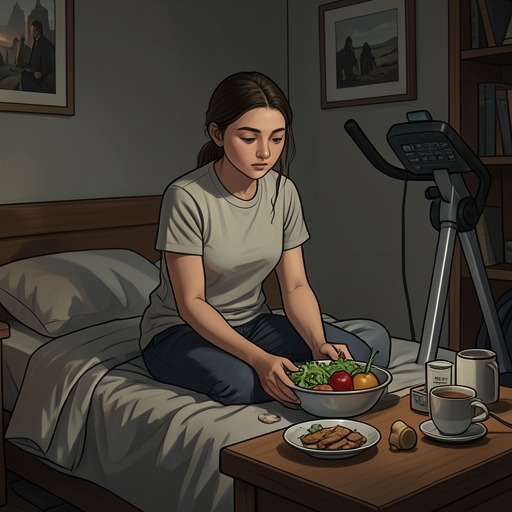
TifAni’s account presents disordered eating not as a single episode but as a cycle. When she is off the Dukan diet, she describes herself as being off altogether: she exercises not at all, drinks wine until she falls into a sleepless night, and eats as much as her shrinking stomach can hold before the next period of starvation. The alternation matters. Restriction and excess are not separate outcomes so much as opposing phases of a routine organized around control.
That routine also links food and exercise to the scale. In adulthood, TifAni recognizes that she is overexercising and grinding herself into exhaustion, yet the scale is moving, and that result still governs her judgment. The measure offers a concrete reward for a regimen whose bodily costs she can already feel. Her recognition does not immediately loosen its hold.
After Dean Barton’s Party
Nearly three weeks after the night of Dean Barton’s party, TifAni tells Olivia that her weight loss is from cross-country running. The explanation conceals a more severe change: since that night, the only food she can stomach is cantaloupe. Her runs are not bringing the improvement she claims to be pursuing; her mile time is getting worse, while Andrew Larson calls out to her with exasperation rather than encouragement.
The contrast between the bright explanation and the physical reality makes thinness legible to other people while keeping its cause hidden. Olivia notices the change in TifAni’s appearance, but TifAni answers by presenting it as athletic effort. Running can therefore function at once as a socially acceptable explanation and as a practice carried on while her eating has narrowed drastically. The evidence records no quick recovery: the change in her appetite and the deterioration in her running occur together.
Adult Exercise and Its Cost
Years later, while visiting Luke Harrison, TifAni is expected to join him for a run after the other people in the house have gone to lie down. She has been off her diet and has eaten heavily, but that does not make the run feel restorative. The previous routine she describes was barre class in the morning and a four-mile run at night. She remembers having once felt strong when she ran; now her legs feel heavy, and her muscles seem to fail her.
On the run with Luke, he sets the pace and does not slow when she falls behind. About half a mile in, a stitch catches in her side. TifAni stops to stretch, then says she is turning back because she does not feel well. She explains that she has not been eating and has just eaten a large amount of lobster and cheese. Her account connects physical distress to both sides of the cycle: restriction has left her depleted, and eating after restriction brings its own discomfort.
Luke runs on after expressing disappointment and saying that he does not deserve to be treated that way. TifAni watches him sprint away, then sits in the dirt as the sun spins around her. The scene gives her body an immediate consequence that cannot be managed through the scale: she is breathless, in pain, and dizzy. It also unsettles her sense of the relationship. Because she has previously relied on charming Luke, his anger makes her think that maintaining the polished version of herself will be her responsibility for the rest of their lives. In that moment, bodily control and the work of preserving an appealing image become difficult to separate.
Appetite, Clothing, and Appearance
TifAni’s reflections at dinner with Nell show that appetite remains a point of comparison even outside the run. Nell orders a burger but, in TifAni’s estimation, will lose interest in it after a few bites because of Adderall. TifAni says that stimulants do not suppress her appetite in the same way: even after taking one of Nell’s pills, or on an occasional night when cocaine stretches into morning, hunger returns. What works for her, she says, is discipline. The distinction places her control not in effortless lack of appetite but in the sustained effort to override it.
The wedding-dress fitting gives that effort a visible form. The seamstress notices the gap between TifAni’s waist and the size-six bodice she ordered. TifAni had balked at that size, but a salesgirl had explained that wedding gowns use different sizing from ordinary clothes; a person who wears a two or zero at Banana Republic might need a six or eight in a gown. TifAni insists that the eight not be ordered and reacts with horror at the prospect of shopping at Banana Republic. The fitting brings together bodily measurement, the pressure of wedding presentation, and her concern with what clothing size says about her. As filming approaches, the dress is not simply a garment: its fit makes her changing body and the image she is preparing to present tangible.
Narrative Significance
Across the teenage and adult episodes, TifAni’s body supplies evidence that her explanations cannot entirely contain. She calls the earlier weight loss cross-country, although she can stomach only cantaloupe and her times are worsening; later, she knows that she is exercising beyond what her exhausted body can bear, but the scale’s movement still counts as success. The repeated mismatch between stated purpose and physical consequence makes the pattern visible without turning it into a simple story of willpower or recovery.
The account also shows discipline as both a chosen method and a form of pressure. It gives TifAni a way to pursue a measurable change and to present a controlled appearance, but it does not prevent weakness, hunger, pain, or dizziness. Her run with Luke sharpens that contradiction: she has been pushing herself to become smaller, yet when she cannot keep pace, she fears that the flaw is hers to hide and repair. The regimen promises mastery over appearance; the episodes reveal how little mastery it grants over the body’s needs or the judgments surrounding it.