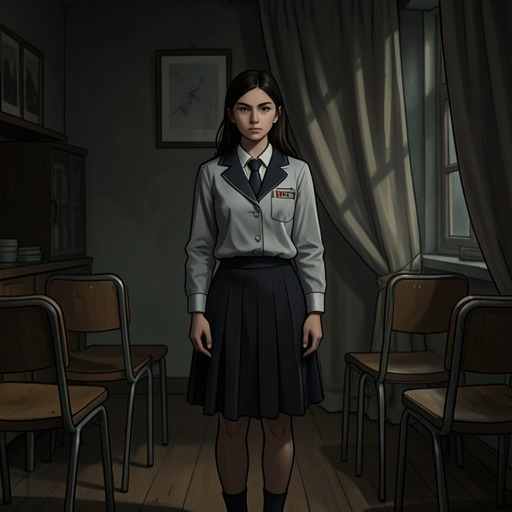
TifAni’s withdrawal of her accusation against Dean during the school investigation
Luckiest Girl AliveTifAni FaNelli’s withdrawal of her accusation against Dean Barton during the school investigation turns on a denial made under institutional and social pressure. Called into Headmaster Mah’s office after Andrew Larson reported another issue involving Dean and Liam Ross, TifAni said nothing had happened, despite a cut on her face. The school’s relief, Dean’s swift suspicion, and TifAni’s later account of why she stayed silent show how a private retreat became part of a larger pattern of humiliation and self-blame.
The Meeting and the Denial
On Monday morning, Andrew Larson had already spoken to Headmaster Mah about another issue involving Dean and the new student Liam Ross. TifAni was summoned before reaching homeroom. She passed through the school and into the administration wing, where Andrew Larson stood in the corner of Headmaster Mah’s office and left the single chair open for her. She avoided his gaze and focused on her rain-marked clogs as she denied everything. In her recollection, the physical details register the discomfort of the meeting without explaining the cut on her face or establishing precisely what had happened over the weekend.
Headmaster Mah asked whether she had an incident to report and appeared relieved when she said she did not. His relief was not separate from the school’s interests: the Barton family had financed a new cafeteria addition. The detail gives the meeting an institutional dimension. The headmaster was responding not only to a student’s account but in a school where Dean’s family had contributed materially. The narrative does not establish that the donation caused TifAni’s denial or dictated the school’s actions; it does place the headmaster’s relief beside the family’s influence, making the school’s response difficult to read as neutral.
The cut on TifAni’s face was barely covered with concealer. Headmaster Mah noticed it, but TifAni still said there was nothing to report. The account does not identify the cut’s cause, so it cannot serve as proof of a particular incident. Its presence instead sharpens the contrast between what is visible and what she is prepared to disclose: the injury is noticed, while the account that might give it meaning is withheld.
Andrew Larson’s Challenge
After the meeting, Andrew Larson demanded to know what had happened. TifAni asked him to let it go and kept walking. He seemed to want to stop her, but did not touch her; she moved faster, trying to escape his disappointment. The scene does not turn her silence into an easy choice. Andrew Larson recognizes that something is wrong and presses her to speak, while TifAni responds by ending the exchange rather than accepting his help.
Her later explanation makes the social stakes explicit: she was afraid that speaking up would cost her popularity, and she became angry with herself for letting Dean get away with it. She recalls having judged another student in college for not reporting an assault, only to recognize that she had not been able to report her own experience either. That reversal links the school meeting to a longer struggle over blame. TifAni’s earlier judgment of someone else becomes a means of understanding her own silence, not evidence that she had been free to act without fear.
Dean’s Public Response
At lunch, Dean arrived carrying a tray and announced to the group at the table that he had received a warning about an incident over the weekend. He said he might be unable to play in the important Haverford game that week, though he could still play if nothing else happened before then. Peyton objected to the warning, and Liam agreed. The discussion immediately made the school’s private intervention public among students, recasting the matter as a threat to Dean’s place on the team and his standing with his peers.
Dean then turned on TifAni. He asked whether she had been in Headmaster Mah’s office and pressed the implication that the school would not have summoned her unless she had said something. TifAni replied that Andrew Larson and Headmaster Mah had called her in and that she had not chosen to go. She offered no account of what had happened, and Dean treated the summons itself as evidence against her denial. The group laughed at his insult; Olivia, Liam, and Peyton smirked, while Hilary avoided looking at TifAni. TifAni left the new cafeteria beneath a plaque crediting the Barton family, dated 1998. Her departure follows a meeting in which she withheld an account and a lunchroom scene in which that silence offered no protection from public suspicion.
Retrospective Meaning
Years later, TifAni describes the moment as an instance of being unable to report what Dean had done. Her recollection carries both the fact of the denial and the cost of it: she wanted to preserve her popularity, then felt anger at herself for doing so. The narrative also places the episode within the culture of The Bradley School, where Dean’s warning became a source of group discussion and the Barton family’s contribution stood visibly in the cafeteria. These details show the pressures around her decision without making them a complete explanation for it.
The scene is told retrospectively by TifAni, who can compare her younger self’s silence with her adult understanding of it. That structure lets the reader see the school meeting and lunchroom confrontation before hearing her later admission that she had been afraid. Her account resists a simple division between knowing what should be done and being able to do it: she remembers condemning another student for not reporting, then recognizes the same inability in herself. The withdrawal is therefore both a consequential act within the school investigation and a recurring source of self-reproach, bound to the social cost of disclosure and the school’s unequal distribution of protection.