1921 Peace Agreement
M: Son of the CenturyThe 1921 Pacification Pact was an attempt to end the violence between Fascists and Socialists by committing both sides to stop attacks and prosecute offenders. Signed by parliamentary representatives and labor leaders, it briefly made peace an official undertaking. Yet provincial Fascists rejected it almost immediately, and a secret agreement linking it to the creation of a Fascist Party helped determine its fate: the pact became a bargaining instrument, then was formally repudiated.
Background: Conflict beyond the negotiating table
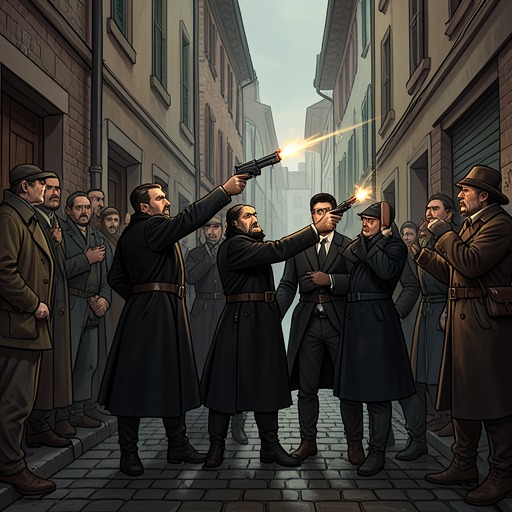
The pact was proposed against a backdrop of fierce political and economic conflict. In the Po Valley, Socialist leagues had built extensive influence in rural communities and organized hiring, work schedules, threshing, seed supplies, and crop planting. Disputes over wages and employment were consequently also struggles over who controlled the countryside and its resources. In Emilia, Socialists controlled 223 of 280 municipalities, while the leagues’ membership in Ferrara reached 81,000 by mid-May 1920.
The conflict had tangible consequences for both farmworkers and landowners. Farmhands averaged about 120 working days a year, making wages and access to employment urgent questions of survival; landowners, meanwhile, faced compulsory labor agreements, fines, and the leagues’ control of recruitment. In August 1920, harvested grain left unthreshed rotted in the fields amid the labor struggle. These conditions help explain why a commitment to end violence addressed more than a contest between party organizations: it touched a rural order already organized around competing claims to work, property, and authority.
Signing and stated terms
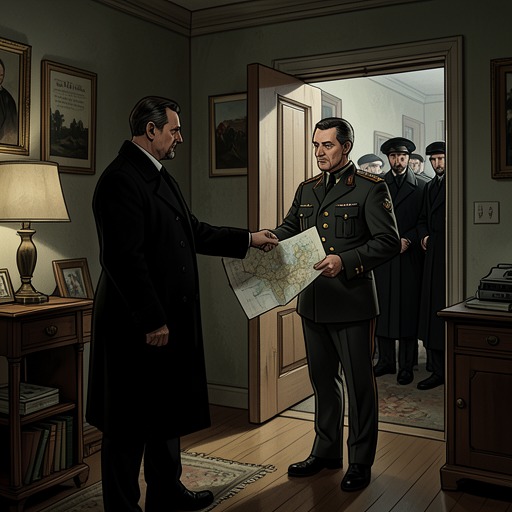
The pact was signed on the evening of August 3 in the office of the president of the Chamber. Representatives of the Fascist and Socialist parliamentary groups took part, alongside representatives of the General Confederation of Labour. Benito Mussolini’s was the first signature on the list, giving the agreement the public imprimatur of the Fascist leader.
Its terms were direct: the two parties undertook to cease immediately every kind of violence and to prosecute those who violated the agreement. The pact was meant to decree an end to the conflict between the Reds and the Blacks, translating a general desire for peace into reciprocal obligations. A report that Socialist leaders refused to shake hands with Mussolini after the signing circulated as gossip, and the account treats it as uncertain. The provincial Fascist rejection, by contrast, was unmistakable.
Provincial revolt and the party bargain
Within forty-eight hours, Fascists from Tuscany, Veneto, and Emilia had denounced the agreement at an assembly. Mussolini answered by belittling them as provincial and politically narrow, and invoked the image of a father correcting a wayward son. The rebuke exposed a dispute not only over whether to stop the violence but over who had authority to define Fascism: the national leader pursuing a pact, or local forces whose politics were bound to confrontation in their regions.
Dino Grandi answered publicly on August 6. He rejected Mussolini’s paternal claim and argued that genuine Fascism had been born in Bologna, through the violence surrounding Palazzo d’Accursio, rather than in Milan. Italo Balbo likewise insisted that the struggle with Socialism could end only through the elimination of one side. Benito Mussolini, with Cesare Rossi behind him, countered that Emilia’s Fascism had become subordinate to agrarian interests. The dispute made the pact a test of the movement’s direction as well as a proposed truce.
At the Fascist congress, the apparent confrontation between Mussolini and the dissidents concealed a prior negotiation. The day before the public debate, Mussolini and Grandi had met secretly and agreed to trade the pacification pact for the establishment of a Fascist Party. The deal was nearly settled while delegates shouted as if they could still decide the issue. Mussolini’s public reconciliation with Grandi therefore marked the pact’s political defeat: the agreement was set aside as the movement’s leaders reached for a new organizational settlement.
Repudiation and significance
The pact was formally retracted on November 14, after Fascist assaults had been repelled by workers in the streets of Rome. When Giacomo Matteotti addressed Parliament on December 2 to denounce Fascist terror in Polesine, the withdrawal was already part of the immediate political past. Benito Mussolini could list Fascist dead before parliamentarians, while the agreement that had required the two sides to cease violence no longer constrained his movement.
The pact’s trajectory—from signature, through rapid provincial rejection and a concealed bargain, to formal retraction—shows how limited its authority was in practice. It prescribed reciprocal restraint but could not command the local forces whose actions shaped the conflict, nor survive the political calculations of Fascist leaders. Its importance lies in that contrast: peace was publicly signed, while the contest over the party’s identity and the movement’s use of violence continued to be decided elsewhere.