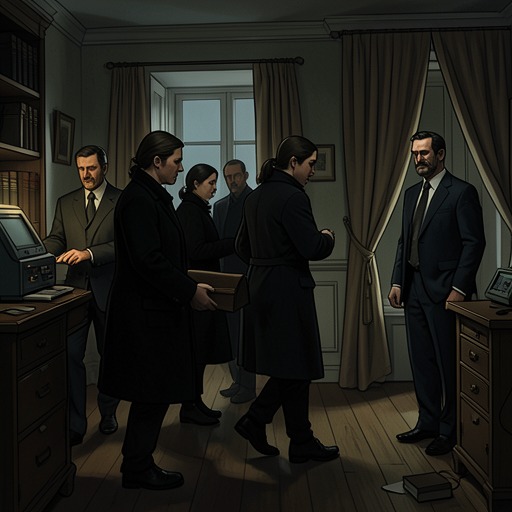
Albino Volpi
M: Son of the CenturyAlbino Volpi is presented as a figure in whom the boundary between wartime violence and postwar political violence nearly disappears. A thirty-year-old carpenter and former Arditi, he carried a reputation for daring in the trenches alongside convictions for non-political offenses. In Milan, he became part of the armed circle around Benito Mussolini; by 1924, he was among the men who abducted and killed Giacomo Matteotti. His story links the mythology of the war veteran to the practical work of Fascist coercion.
Identity and Wartime Reputation
Volpi’s appearance is described as deliberately theatrical. At a secluded table with Benito Mussolini and other Arditi, he wore a gray-green military jacket over a black turtleneck marked with a skull and dagger. A real dagger, with a mother-of-pearl handle, hung from his belt. His stocky build, fixed expressions, and posed bearing made him seem to inhabit the violent persona attached to his clothing. The account makes the image part of his characterization, not merely a detail of dress: Volpi appeared prepared to be watched even when no one was looking.
His reputation rested on two conflicting kinds of record. Civilian courts had convicted him of offenses including theft, breaking and entering, assault, and insulting a public official; a military court had convicted him of desertion. At the same time, stories circulated about his conduct in the war. He was said to have gone alone into enemy lines with a dagger, and was identified as one of the so-called Caimans of the Piave, commandos who crossed the river at night to attack sentries. The book preserves the uncertainty surrounding such tales: the Caimans’ exploits could be exaggerated or even partly created by wartime propaganda. Yet the legend mattered as a public identity, setting the veteran’s reputation for courage beside the criminal record that official respectability could not erase.
The narrative draws attention to Volpi’s physical habits as well as to what was said about him. When the socialist gathering near his table grew louder and Mussolini was denounced, Volpi instinctively changed his grip on the knife he was using to cut food. Mussolini checked him with a small movement of the head. Volpi’s response precedes any spoken exchange: the hand tightens, the weapon is already present, and intervention is needed to prevent a confrontation. The episode establishes a pattern in which violence appears not only as a chosen political tactic but as an immediate bodily readiness.
In Mussolini’s Armed Circle
Volpi was part of a network assembled to protect Mussolini during a campaign marked by attacks on interventionist speakers. For a Fascist rally, Mussolini brought in republicans and anarchists from Romagna as an armed guard, while other men arrived from nearby cities. Volpi and fellow Arditi filled backpacks with iron bars and grenades. Organizers planned for possible clashes, instructed participants to keep silent if questioned about those who disrupted the meeting, and designated an exit route for uninvolved members of the public. The preparations show that Volpi’s presence belonged to an organized apparatus of intimidation, not simply to a collection of veterans gathered by chance.
The connection between Volpi and Mussolini was also visible in moments when restraint, rather than attack, served the group’s interests. After the socialist insults at the restaurant, Mussolini prevented Volpi from acting and then left without accepting an escort. Volpi remained in the background, alert to the knife in his hand and to the possibility of escalation. The scene does not make him a political strategist; it makes him one of the armed men whose capacity for violence surrounded Mussolini and could be held back, or brought forward, by a signal from the leader.
The Bombing of the Socialist Procession
On the evening of November 17, 1919, Volpi watched a socialist procession celebrating an electoral victory as it moved along Via San Damiano toward the headquarters of Avanti!. He carried two Thévenot bombs and a dagger. To reach the Bridge of the Sirenette without being seen from the Arditi headquarters on Via Cerva, he climbed over a wall and crossed the garden of Palazzo Visconti. He then stood alone on the bridge while thousands of people—men, women, and children—continued toward the rally.
The account contrasts the procession’s collective movement with Volpi’s isolated position. He regarded the crowd as disorderly and as a political threat, and the narrative presents his hostility as a rejection of the socialist assembly’s claim to represent a people. He removed the safety pin from a bomb and threw it into the procession. The explosion stopped the singing and sent the crowd scattering; cries and reports of wounded people followed. From the bridge, Volpi watched the result. The action turned the veteran’s knowledge of explosives into a means of attacking a civilian political demonstration, and the book connects this act to his belief that a single armed man could disperse a much larger crowd.
The following day, police raided the Arditi Association headquarters on Via Cerva and seized grenades, pistols, daggers, maces, and ammunition. Captain Ferruccio Vecchi and others were arrested, but Volpi and several other veterans suspected of involvement in the attack escaped over the rooftops. The episode established both his place in the armed organization and his ability to evade immediate capture. It also foreshadowed his later role: a participant in political violence who could disappear from the authorities’ reach, at least temporarily.
From Street Violence to the Matteotti Abduction
In June 1924, Volpi was recruited into the operation against Giacomo Matteotti. Cesare Rossi tracked Amerigo Dumini down and ordered him to come to Milan to coordinate the operation. The plan drew on Dumini’s Florentine associates and on the Milanese Arditi associated with Volpi. Volpi also sent a telegram from Milan to Dumini in Rome indicating that he was waiting to be called if his presence was urgently needed. These details place him within a coordinated chain of communication and personnel, rather than at the edge of an improvised encounter.
Volpi was one of five men waiting in a Lancia Lambda near the home of Matteotti, whose movements they had studied. Along with Dumini, Giuseppe Viola, Augusto Malacria, and Amleto Poveromo, he waited for the deputy to appear with a white envelope marked Chamber of Deputies. When Matteotti unexpectedly walked beside the river, Malacria first seized him. Volpi initially pointed him out to Malacria and seemed reluctant to take hold of him; when Matteotti resisted, however, Volpi joined the attack. Poveromo struck Matteotti, and Volpi held him as the assault became fatal. The sequence preserves a significant hesitation without mistaking it for withdrawal: Volpi did not initiate the first grab, but he took part in the abduction and killing.
The killing’s aftermath further connects Volpi to the political machinery around Mussolini. Volpi forced Arturo Benedetto Fasciolo to act as the messenger who first informed Mussolini of the crime. Fasciolo later faced pressure from Dumini in connection with the operation. The episode shows how the perpetrators’ actions reached into the government’s immediate circle even as the regime sought to manage the resulting crisis.
Arrest and Narrative Significance
After the crime, Volpi escaped arrest for a time. He was eventually stopped at a hotel restaurant in Bellagio while having lunch before crossing the Swiss border. Other accused men were also arrested, while Dumini continued to deny that Fascist leaders were involved and described Matteotti’s death as accidental. Volpi’s arrest marks the end of his immediate evasion, but the evidence presented here does not establish the outcome of his later legal proceedings.
Across these episodes, Volpi’s role changes in scale but not in kind. In 1919 he acted alone on a bridge, using a bomb against a procession; in 1924 he worked within a group that surveilled and abducted an elected deputy. His record joins the soldier’s legend, the convicted offender, the armed political retainer, and the operative in a killing. The book’s account does not treat the transition from war to political violence as an abstraction: it follows weapons, hands, routes, and associates. Volpi’s readiness to act, his temporary escapes, and his eventual capture make him a recurring link between the violence of the streets and the concealed operations used to defend Fascist power.