Aldo Tarabella
M: Son of the CenturyAldo Tarabella, a decorated Great War veteran and member of the original Milan fascio, appears as one of the militia’s most forceful representatives. In a confrontation with Benito Mussolini, he challenged the leader’s effort to restrain Fascist violence and insisted that the revolution could not be treated as finished. His intervention turns the conflict between personal loyalty and political obedience into a direct test of Mussolini’s authority.
Identity and Background
Tarabella’s earlier life is presented through his military record and his place in Milan’s Fascist movement. He had served as a captain in the Arditi during the Great War, where he received six decorations for valor: three bronze medals and three silver. He had also received special training in the use of the submachine gun, then a new assault weapon. These details establish him not as a provincial political notable but as a veteran whose authority within the movement was grounded in military experience and an established reputation for courage.
By April 1919, Tarabella belonged to the original Milan fascio. That early membership placed him among the movement’s founding generation, before its later consolidation as a party and the incorporation of its armed supporters into a national structure. The book gives no extended account of his private life or of the stages of his career between that early membership and his later militia role; it instead makes his wartime credentials and continued presence in the movement the foundation for his appearance in the political crisis.
From Fascist Militant to Militia Consul
Tarabella’s position as a militia consul brought him into the conflict over whether Fascism would remain a movement organized around squad violence or become a party capable of controlling it. Benito Mussolini’s plan for the Voluntary Militia for National Security offered a means to legalize armed Fascist organization while dissolving the local squads and transferring their members into a body answerable to the prime minister. Its proposed oath was directed to Italy and, above all, to Mussolini; obedience was to be absolute. The arrangement promised to bring the squads under centralized command, but it also preserved an armed force bound personally to the head of government.
That effort at institutional control followed a wider attempt to turn the movement into a national party. The proposed party was intended to contain squad violence and reconcile otherwise incompatible political tendencies, even as Fascist leaders debated whether the movement should become a party or an army. The problem was not merely administrative: the local squads had helped bring Mussolini to power, yet their refusal to disarm threatened his ability to govern them. Tarabella’s later challenge came from within the new militia structure, demonstrating that formal incorporation had not erased the militants’ independent sense of obligation to the revolution.
The Consuls’ Confrontation with Mussolini
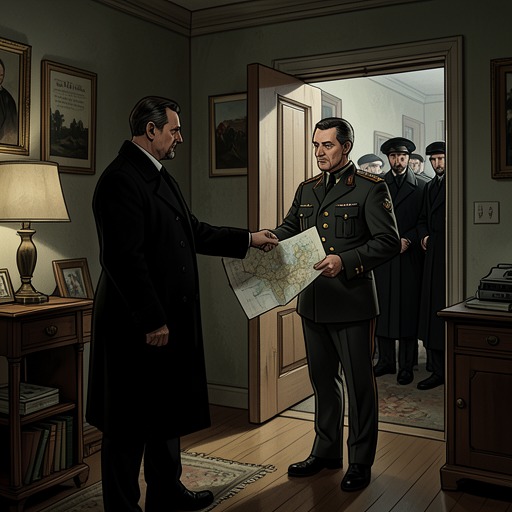
At the start of the new year, thirty-three militia consuls arrived in Rome separately and without drawing attention. They gathered in small groups near Palazzo Chigi, then entered the prime minister’s office in a body, wearing black shirts and decorations of valor; some carried daggers. Tarabella and Enzo Galbiati led the group. The staging made the visit more than a private consultation: the consuls placed themselves around Mussolini’s desk, bringing the armed organization’s discontent into the center of government.
Tarabella spoke first. He conveyed the consuls’ impatience with waiting, pointed to Fascists filling the prisons, and argued that Mussolini would not accept responsibility for carrying the revolution forward. The consuls, he said, would take that responsibility themselves and present themselves for imprisonment. His demand framed the choice as collective: either the consuls and Mussolini would face the consequences together, or they would all be released. The appeal fused loyalty to the leader with a refusal to let him separate himself from the movement’s actions.
Mussolini ordered Tarabella to stand down, but Tarabella maintained that the leader had helped inflame the militants against their socialist opponents and could not now expect them to accept pacification. The exchange sharpened the issue already confronting the regime: a leader who had used armed followers to gain power was attempting to discipline them without losing the threat that made his position formidable. Tarabella’s words made that contradiction audible inside the prime minister’s office.
The Dispute’s Outcome and Significance
When Mussolini shifted from command to persuasion and presented himself as abandoned by others, Tarabella answered by challenging the cost he was willing to accept for the revolution. The response turned the crisis over political responsibility into a pointed question of whether a death could be treated as an excessive price for revolutionary victory. The book does not make Tarabella the decision-maker in the ensuing political struggle; his importance lies in forcing the leader to confront the militants’ own account of what his cause required.
Mussolini again rebuked the consuls, reminding them that their departure from their posts without authorization could bring sanctions. Some stepped back, and he dismissed the delegation. Tarabella stayed behind. He indicated that the consuls remained at attention but were leaving in protest, an act that combined formal military deference with a visible refusal of political submission. The encounter left Mussolini isolated and shaken; later that evening, at the New Year reception at the Quirinal, he was shunned by prominent political figures and had to attach himself to his ministers’ company.
Tarabella’s narrative role is therefore defined by a limited but consequential confrontation. His decorated service and early place in the Milan fascio lend weight to his demand, while his position as a militia consul gives that demand institutional force. He embodies the militants whom Mussolini needed to control but could not simply discard: their loyalty had helped establish the new power, yet their continued readiness to act independently threatened its authority. In the scene, discipline does not dissolve dissent. Tarabella can stand at attention and still make clear that obedience has limits.