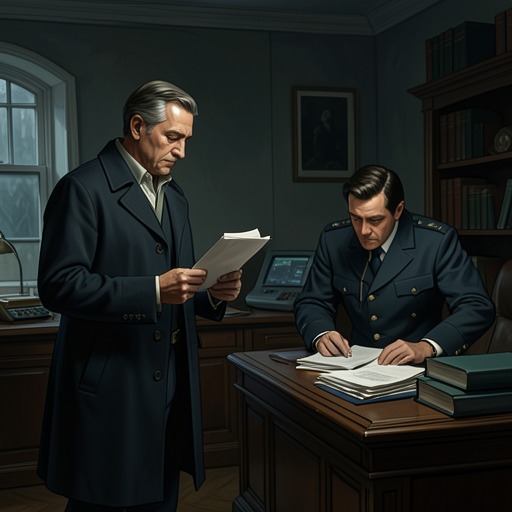
Assassination of Giacomo Matteotti
M: Son of the CenturyThe Assassination of Giacomo Matteotti was a political killing whose significance lay not only in the death of an opposition deputy but in the shock it sent through Italy’s public life. Matteotti was abducted in broad daylight in central Rome. His disappearance, followed by the discovery of his remains, turned fears about political violence into a direct crisis of accountability: the question was no longer whether violence could reach public life, but whether the state and the ruling movement would expose or conceal those responsible.
Political Violence and Parliamentary Life
The killing unfolded against a background in which organized political force was increasingly treated as an instrument of public life. Earlier fascist punitive expeditions had been planned with military methods, coordinated to strike multiple targets, and supplied with trucks by the Agrarian Association. By 1922, Prime Minister Ivanoe Bonomi’s efforts to regulate fascist armed formations had met with defiance: the National Fascist Party’s leadership declared party sections and combat squads inseparable, while the government’s orders went unenforced. This context does not establish a specific chain of command behind Matteotti’s murder, but it shows how the boundary between party organization and armed force had already weakened.
Parliamentary politics continued within this atmosphere of intimidation. In 1921, the insistence that the party ticket was not open to debate and that members would vote marked fascism’s advance into parliamentary competition. Matteotti’s abduction in 1924 made the stakes of that competition unmistakable. A parliamentarian had been seized in the city center, and the violence that had shaped political contests outside parliament now appeared to have reached directly into its ranks.
Abduction and Public Shock
The news of Matteotti’s abduction shattered ordinary expectations about safety and political conduct. Protest spread widely, including within fascist circles. Opposition newspapers issued repeated special editions, while readers continued to demand justice. The crime appeared so grave that corruption, the violent elimination of political rivals, and the erosion of political ideals—conditions that had become familiar—were suddenly intolerable to many.
The reaction was not confined to party leaders or newspapers. Public anger gathered around the unanswered question of what had happened to the deputy. Suspicion and demands for justice coexisted with a lack of reliable information, allowing the disappearance itself to become a political event. The longer Matteotti remained missing, the harder it became to treat the abduction as an isolated crime rather than a test of the institutions responsible for investigating it.
Confusion, Blame, and Concealment
Within the fascist camp, the response described in the narrative was fragmented and defensive. Amerigo Dumini and his accomplices became the focus of public suspicion, while some members of the movement sought to protect themselves from the consequences. Italo Balbo went to Palazzo Chigi demanding Dumini’s immediate shooting; at the same time, efforts began to conceal evidence, erase traces, and circulate misleading clues.
Those clues encouraged incompatible explanations: that Matteotti had gone abroad, that he was staying with a lover, or that other assailants had been involved. Rather than calming the crisis, the false reports helped widen suspicion. Aldo Finzi, a fascist deputy from Rovigo, himself fell under suspicion as the diversionary stories ricocheted against those spreading them. The resulting confusion was consequential in its own right: the public was left to judge both the crime and the credibility of the accounts offered by those with power to investigate it.
Discovery and the Limits of Certainty
Matteotti’s remains were found in the Macchia della Quartarella, in a shallow grave near the Via Flaminia, between Riano and Sacrofano. The grave was oblong, roughly 1.20 meters long and no more than 0.45 meters deep. A coarse metal file stuck in the ground served as its marker—the same kind of tool the killers had used to dig the grave. The medical examination concluded that the body had decomposed naturally in the earth and had not been mutilated. Two gold teeth helped confirm the identity of the remains as those of the missing deputy.
The examination could not establish the precise cause of death. The grave and the condition of the remains supported the conclusion that the body had been forced into a space too small and buried hastily, but they did not settle every question about how Matteotti died. Recovery therefore resolved the central uncertainty—he was dead—without resolving the full circumstances of the killing. The discovery confirmed the crime while leaving the public to confront an investigation clouded by concealment, false leads, and disputed accounts.