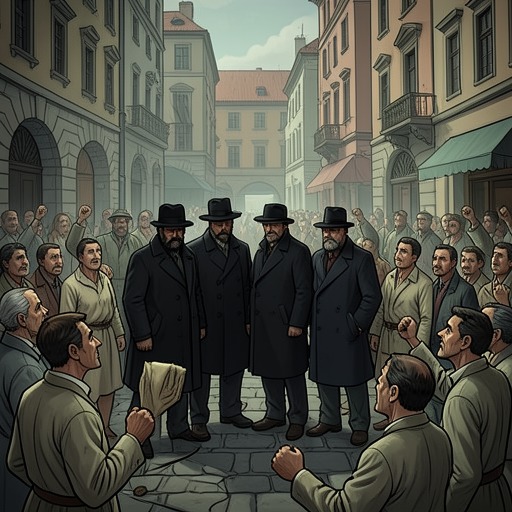
Bellagio Square
M: Son of the CenturyPiazza Belgioioso was an elegant square in central Milan that served as the setting for the Fasci di Combattimento’s only Milan electoral rally in November 1919. Benito Mussolini chose it for its restricted access: open on just one side, it could be defended if the gathering came under attack. The square’s aristocratic surroundings, controlled entrance, and improvised stage gave the rally a distinctively enclosed character, joining electoral politics to the movement’s language and imagery of wartime mobilization.
Setting and selection
Surrounded by stylish neoclassical buildings, Piazza Belgioioso was described as an outdoor salon of the aristocracy. Mussolini inspected the site in person and selected it within minutes. Its openness on only one side was not incidental: the Corso Europa entrance could be guarded, while the remaining approaches were effectively closed off. In a campaign marked by attacks on interventionist meetings, the square’s layout offered a practical means of controlling access and preparing for possible aggression.
The rally’s staging
The meeting was scheduled for nine in the evening. At eight, the square was still deserted and dark; residents of the surrounding city-center buildings had stayed indoors. A small crowd gradually passed through a cordon of Arditi stationed at the Corso Europa entrance. The stage was a troop-transport truck, parked sideways to block the passage between Via Morone and the house where Alessandro Manzoni had lived and died. Wind torches illuminated the makeshift platform and the armed men assembled around it, while the crowd waited in near-darkness.
The location carried an older political memory as well as an immediate defensive purpose. In 1848, young insurgents had gone to Manzoni’s house to ask the celebrated writer to lead them into the streets against Austrian rule; he sent them away. In 1919, a truck serving as a rostrum stood before that same house, facing a political gathering organized by a movement that presented itself through the aesthetics of combat. The contrast made the square’s setting more than a convenient venue: the scene placed a new, militarized political performance against the recollection of an earlier appeal for leadership that had gone unanswered.
A square transformed into a war scene
As the crowd gathered, a Very rocket rose from behind the truck. Its white flare briefly lit the sky above Milan, recalling the signals used to illuminate no-man’s-land during the war. The crowd watched it descend onto the roof of a neoclassical palace; in the account, its appearance marks the beginning of the rally’s action. Ferruccio Vecchi, captain of the Arditi, then addressed the gathering in language centered on wartime suffering, violence, and demands for justice. The flare, truck, torches, and armed formations made the electoral meeting resemble a staged mobilization, turning a guarded urban square into a temporary political theater of war and confrontation.