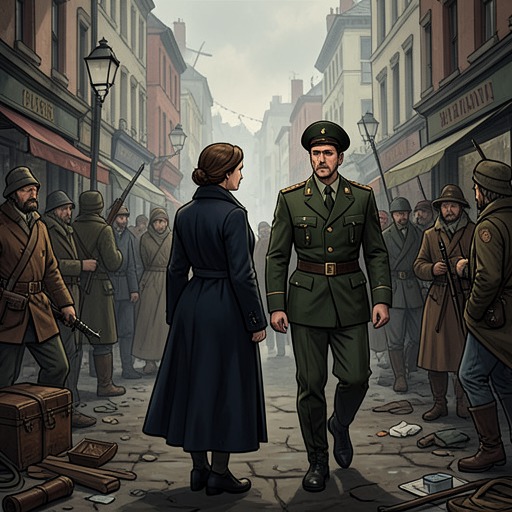
Bologna Massacre at Palazzo d’Accursio
M: Son of the CenturyBologna Massacre at Palazzo d’Accursio is a named episode of political violence in the book’s account of Italy’s postwar conflict. The surrounding passages trace the widening divide between socialist demonstrations, Fascist squads, and a state increasingly unable to contain armed political action, but they do not narrate the massacre itself or establish its immediate participants, sequence, or toll.
A Climate of Street Conflict
An earlier confrontation in Milan provides a distinct example of the tensions surrounding mass politics. In April 1919, a socialist procession swelled into the streets, while a smaller opposing cortege included officers, Arditi, and Futurists. A cordon of Carabinieri separated the groups; when it opened, stones and clubs came from the socialist column and gunfire from the opposing side. The brief clash shows how demonstrations could become encounters between opposing political forces, but the account presents it as a separate event, not as a scene from Bologna.
The Squads and Political Bargaining
The narrative later depicts the Fascist movement’s internal struggle over whether to pursue a pacification pact with the socialists. At a congress, the squadristi shouted as though they were directing events, although Benito Mussolini and Dino Grandi had already reached a private agreement: the pact would be abandoned in exchange for the creation of a Fascist Party. The assembly’s apparent drama therefore concealed a political decision made elsewhere, and the peace effort was effectively buried.
Violence and the Weakening State
In a later account of the liberal state’s crisis, the government’s attempt to constrain armed Fascist organization is shown failing against the movement’s own declarations. After the government issued a circular restricting weapons and treating Fascist paramilitary groups as illegal formations, Michele Bianchi asserted that party sections and combat squads were inseparable; the directive was published in Il Popolo d’Italia. Rather than arrest the organizers, the government issued another circular complaining that its public-order instructions had not been obeyed. This wider pattern supplies a context for the massacre’s place in the narrative: political violence was not an isolated rupture, but part of a conflict in which state authority and the boundaries between party and armed force were under pressure.
Narrative Significance
The book sets such violence against competing promises of national renewal. Gabriele D’Annunzio presented Fiume as youth, life, and a future built in the presence of the war dead; Benito Mussolini later described Fascism as a force that would remake the nation and bring the masses into a new political order. The contrast is consequential: the language of rebirth and unity coexisted with a political landscape divided by armed confrontation. Bologna Massacre at Palazzo d’Accursio belongs to that landscape, although the passages presented here do not supply the event’s specific narrative details.