Carnaro Republic
M: Son of the CenturyThe Carnaro Republic was the projected political order of Gabriele D’Annunzio’s Fiume regime, given its most developed form in a constitutional charter drafted by Alceste De Ambris. The charter imagined a community founded on the sovereignty of all citizens, social protections, and the transformation of work and culture into common civic achievements. Its ambition was revolutionary, but its carefully articulated promises remained in tension with both the economic conditions of the besieged city and the limitations of the property system it proposed.
Constitutional Vision
On March 18, 1920, Gabriele D’Annunzio received a draft of the Carnaro Charter from Alceste De Ambris, the syndicalist whom he had called to lead his cabinet at the beginning of the year. The text drew on radical socialist and libertarian ideas and set out a democracy grounded in the rights of workers and individuals. Its conception of citizenship was inclusive: collective sovereignty was to belong to all citizens without distinctions of sex, race, language, class, or religion. The charter therefore framed the Republic not simply as a national claim over Fiume, but as an attempt to specify a new social and political community.
The protections it proposed reached well beyond formal political participation. The charter envisaged freedom of the press, speech, thought, and religion, as well as sexual liberty. It also promised elementary education, physical education, minimum wages, and assistance in cases of illness, disability, unemployment, and old age. These provisions tied individual rights to material conditions: citizenship was to mean more than abstract equality, because the Republic would also assume responsibility for the welfare that made a dignified life possible.
Work, Culture, and Civic Life
The Carnaro Republic’s social ideal joined productive activity to cultural expression. Workers’ associations were to develop their own insignia, emblems, music, songs, prayers, ceremonies, and festivities. The charter treated these practices as parts of common life rather than private embellishments. It also imagined associations contributing to shared recreation, commemorations, and sports on land and sea. In this design, civic belonging would be made visible and audible through the institutions and rituals created by working people themselves.
That cultural program extended into the ordinary environment of labor. Construction workers’ organizations were to encourage the decoration of even modest homes with folk art, while music was assigned the status of a social institution. Work, including the humblest forms, was not to remain brutal and exhausting toil; it was to aspire to beauty and help beautify the world. The charter’s ideal of effort transformed work into a source of shared creation, connecting the dignity of labor to the quality of everyday life.
The envisioned community also defined full citizenship through contribution. Those who produced common wealth and common strength were described as the Republic’s fully participating citizens. Religious faiths could be practiced and places of worship established, but religious observance would not exempt anyone from obligations imposed by law. The arrangement paired religious liberty with a common civic duty: difference was to be recognized within the political community, not used to withdraw from it.
Property and Economic Tension
The charter tried to reconcile private property with social utility. It rejected the idea that an owner could treat property as an absolute possession, leave land uncultivated, or dispose of it in a way that excluded everyone else from its use. In particular, land was to be judged in relation to what it contributed to society. This was a significant part of the Republic’s attempt to connect economic rights to collective welfare rather than leave them entirely to individual ownership.
The proposal also exposed a fundamental tension in the project. Maffeo Pantaleoni, D’Annunzio’s former finance minister, observed that the clause restricting the use of property made the Carnaro Charter incompatible with modern capitalist economic and commercial activity. The charter could be read as a coherent statement of social purpose, but its treatment of ownership raised the question of how that purpose could operate within the economic order around it. The text did not resolve that conflict; it made the conflict part of the Republic’s design.
D’Annunzio, the Charter, and Fiume
D’Annunzio did not reject the charter, but he kept it close and revised it privately, recasting De Ambris’ draft in his own elevated, oracular style while leaving its substance intact. The distinction between drafting and revision mattered to the project: De Ambris supplied the constitutional framework, while D’Annunzio made its language his own. He worked on the text in the afternoons, but the Republic’s political imagination also took shape through his daily appearances among the troops.
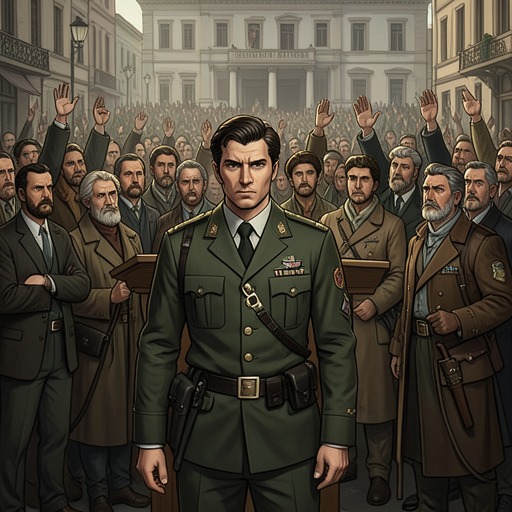
At dawn, D’Annunzio led military excursions into the valleys around Fiume. Regiments assembled in Piazza Roma before the Palazzo del Governo, and a different regiment followed him each day. After setting out in formation, the troops returned in scattered groups bearing branches and flowers. The contrast between the disciplined departure and the informal return offered a public image of collective life that was less rigid than the ranks and cadence with which it began. These marches did not constitute the charter’s institutions, but they show how the Commander’s presence and the troops’ shared practices accompanied the constitutional vision.
That vision emerged under severe material pressure. Fiume had waited for annexation to Italy since September 1919 and, by the spring of 1920, had spent seven months under siege. Rome controlled the supply of food, while shortages left the city rationed, cold, and without fuel oil. Poor children had been sent to Italian families in an appeal for aid, and the city had even prohibited the production and sale of its celebrated pastries. Against this background, the charter’s guarantees of food-related welfare, social assistance, and a beautiful life were not detached abstractions: they answered, at least in principle, to deprivation visible in the city around them.
An Ambitious but Unsettled Republic
The Carnaro Republic joined political inclusion to social provision, economic responsibility, and cultural participation. Its charter imagined citizens not merely as subjects protected by rights, but as participants who produced common wealth, shaped shared rituals, and made work part of a more beautiful world. Yet the project remained unsettled: D’Annunzio guarded and rewrote the charter, the property provisions challenged the assumptions of modern commerce, and Fiume’s blockade made the promises of social welfare acutely difficult to separate from immediate need. The Republic’s significance lies in this combination of an unusually broad constitutional imagination and the unresolved practical and economic tensions embedded within it.