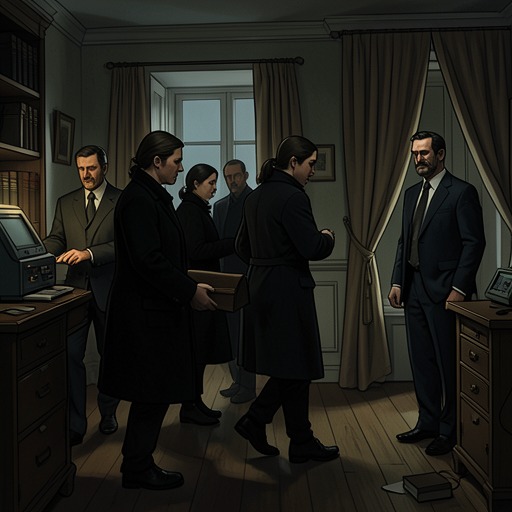
Cesare Rossi’s confidential letter
M: Son of the CenturyCesare Rossi’s confidential letter is both a threatened disclosure and a record of a collapsing political partnership. Dated June 15, 1924, and addressed to Benito Mussolini, it rejects Rossi’s treatment as the sole scapegoat for the crisis over Giacomo Matteotti’s killing. Rossi asserts that Mussolini knew of illegal actions he had ordered, warns that a detailed account is already held by trusted friends, and makes clear that attempts to silence him would also endanger the regime. When the account eventually reached the public, it turned a private warning into a challenge to the government’s legitimacy.
The letter and its warning
Rossi opens by saying that reports have led him to believe Mussolini has chosen him alone to bear the blame for the calamity that has struck Fascism. He refuses to cooperate with that arrangement. His appeal is framed not simply as a demand for personal protection, but as a claim on the solidarity due to a past collaborator and executor of illegal actions ordered by Mussolini. The letter thus presents an unequal partnership: Rossi describes himself as carrying out orders, while Mussolini, in his account, retains the power to disown the subordinate when the consequences become politically dangerous.
The warning is conditional and immediate. Rossi demands evidence within a few days that Mussolini recognizes his obligations to him. Otherwise, he says, he will carry out a plan he had already communicated that morning and finalized during the day. He does not spell out that plan in the surviving passage, but identifies its force: a long, detailed, documented statement has already been placed in the hands of trusted friends. The letter converts that undisclosed document into leverage. Its contents are not fully reproduced here; what is established is Rossi’s claim that the account exists, is supported by documentation, and can be released beyond his control.
Rossi also warns against physical suppression, including while he is in hiding or if he is captured. He argues that such an attempt would not save Mussolini: the statement would still destroy him and, in Rossi’s prediction, place the regime in danger as well. The letter’s central threat is therefore reciprocal. If Mussolini isolates or silences Rossi, Rossi’s prepared testimony can carry the crisis upward, from the fate of one former collaborator to the survival of the political order they served.
The chain of responsibility
The letter’s claims acquire force against the book’s account of the structures around Mussolini. Earlier, the Milan prefect had informed him of a confidential government circular urging Fascist collaboration in suppressing revolutionary attempts, provided the squads accepted command by the authorities. This episode depicts cooperation between state officials and Fascists as an institutional arrangement, not merely a set of private contacts. It does not establish the specific actions Rossi describes in his letter, but it supplies a context in which political violence and official authority were already entangled.
The book also describes a financial and political network surrounding Fascist power. During the March on Rome, Lombard industrialists led by Alberto Pirelli visited Mussolini and, after their meeting, directed the Banking Association to place two million lire in Giovanni Marinelli’s account as administrator of the National Fascist Party. In the later account of the Matteotti crisis, Marinelli is identified as head of the Cheka, a role assigned by Mussolini and shared with Rossi. The juxtaposition connects party administration, organized action, and the leadership’s dependence on trusted intermediaries. It helps explain why Rossi’s allegation of ordered illegal actions was politically explosive, without independently proving each allegation in the letter.
The proximity of the letter to the crisis is also notable. After an urgent meeting of the Fascist directorate at Palazzo Wedekind on June 1, Mussolini summoned Marinelli privately to his office; he summoned him again the following day. The letter followed on June 15. In the account of the same period, Mussolini’s anger over Matteotti’s parliamentary speech was directed at Marinelli through questions about what the Cheka was doing. These details place Rossi’s warning within an atmosphere of urgent private consultations and contested responsibility. They do not disclose every exchange among the men, but they sharpen the letter’s insistence that command and accountability could not simply be separated.
From private document to public evidence
Giovanni Amendola, leader of the Aventine secession, had Rossi’s account from the beginning of August. He held it for roughly three months, then sent it to Vittorio Emanuele III in mid-November in the hope that the king would intervene. The account describes a further delay through December, as the opposition waited for a response that did not come. The letter’s route—from Rossi’s warning, through Amendola’s possession and appeal to the sovereign—shows how the document was initially treated as evidence that might prompt action from above before it became a public accusation.
When the expected intervention failed, Amendola published the first extract in his newspaper, Il Mondo, on December 27. The publication recast Rossi’s private appeal as evidence against the political order. As presented in the account, it depicted Fascism as an illegitimate state and Mussolini as directly responsible for violence, while emphasizing his alleged care to secure an alibi. Those were the political implications drawn from Rossi’s revelations; the passage does not reproduce the full statement or independently adjudicate every charge.
The book notes the uncertainty over Mussolini’s response to publication. He had done nothing to prevent it, and it was said that he had encouraged the timing and demanded that it receive maximum visibility. The motive is left unresolved: the account raises calculation and appetite for crisis as possibilities rather than establishing either as fact. This ambiguity matters because the letter’s public impact cannot be reduced to the disclosure alone; the circumstances of its release were themselves politically contested.
Consequences and significance
The revelations produced an immediate political sensation. Fascist squadristi grew impatient, while Fascist newspapers dismissed the disclosures. Corriere della Sera, by contrast, openly called for the prime minister’s resignation for the first time. The publication therefore widened the conflict: Rossi’s allegations could be rejected by the movement’s press, but they also gave the government’s critics a specific account with which to press for Mussolini’s removal.
The letter’s significance rests on the collision between private knowledge and public responsibility. Rossi’s warning seeks to prevent him from being cut loose as an isolated subordinate; Amendola’s publication makes the same account a weapon against the head of government. Its movement from confidential correspondence to political evidence does not settle every question it raises, but it exposes the vulnerability in a system built on close collaboration: the people who had helped operate its hidden machinery could threaten to make that machinery visible.