Chamber of Deputies
M: Son of the CenturyThe Chamber of Deputies was the central parliamentary stage on which Italy’s liberal institutions encountered the rise of Fascism. In the book’s account, its trajectory is not a simple disappearance: the Chamber continued to assemble, debate, and vote, even as violence, threats of dissolution, and executive power narrowed what those procedures could mean. Its overwhelming support for Benito Mussolini’s government in 1922 and its silent reception of his challenge under Article 47 in 1925 mark the widening distance between parliamentary form and effective authority.
The parliamentary stage under pressure
The Chamber’s weakening began within a broader crisis of political legitimacy. The postwar landscape is described as crowded with millions of returning veterans and exhausted political figures, while old liberal habits appeared unable to meet the demands of a transformed mass public. The Chamber was therefore not simply a building in which competing policies were decided; it stood for a political order whose established representatives increasingly seemed remote from the forces gathering outside it.
Fascist entry into parliamentary politics made that tension explicit. In the run-up to the 1921 election, Benito Mussolini treated acceptance of the party ticket as a decision already settled: “The party ticket is not open to discussion. We vote.” The account presents this moment as a leap from the violence of the trenches and the streets into parliamentary competition. Support for including Fascists in the national blocs, previously resisted by Senator Luigi Albertini, owner and publisher of Corriere della Sera, the government-critical daily, had now been conceded. The Chamber and the electoral coalition thus became routes into office for a movement whose leaders did not regard parliamentary procedures as the ultimate source of political authority.
That contradiction was sharpened by the state’s inability to control Fascist armed organization. In December 1921, after Prime Minister Ivanoe Bonomi tried to restrict the squads through prefectural orders, Michele Bianchi declared that National Fascist Party sections and combat squads formed an inseparable unit. The party published his directive openly. The failure to arrest a party secretary asserting the existence of an armed militia exposed the gap between formal state authority and its practical reach. The Chamber operated within that gap: it could confer legitimacy through representation and votes, but the armed movement was not thereby made answerable to it.
Acclamation and capitulation in 1922
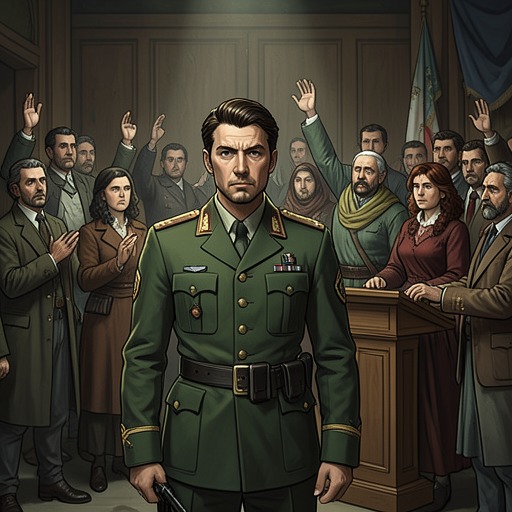
The Chamber’s first great encounter with Mussolini as head of government unfolded as a public spectacle. On November 16, 1922, its galleries and corridors were crowded with senators, diplomats, former deputies, well-dressed visitors, and ordinary onlookers. Mussolini entered at exactly three o’clock, preceded by chamber president Enrico De Nicola and followed by his ministers; General Armando Diaz, the minister of war, escorted him. Deputies from every side except the left rose to applaud, and the galleries joined them. The ovation came only fifteen days after the March on Rome. In those same fifteen days, Rome had recorded nineteen deaths and twenty serious injuries, a toll that the celebratory account of a bloodless revolution threatened to obscure.
Mussolini began by describing his appearance before the deputies as a formal courtesy, not a request for their recognition. He then argued that the Italian people had passed over a ministry and provided themselves with a government from outside and above parliamentary appointment. He claimed that the blackshirt revolution was legitimate and declared his intention to defend and empower it. The Chamber was addressed not as the source from which his government derived its mandate, but as an institution expected to acknowledge a power already established elsewhere.
His warning that the Chamber could be dissolved in two days or two years made that imbalance unmistakable. Mussolini requested full powers from the same assembly he had just threatened with dissolution. The Chamber did not rebel. Although the National Fascist Party held only thirty-five seats, the government won a confidence vote by 306 to 116, with seven abstentions, and received the requested powers. Even outspoken critics, including Deputy Gasparotto and Albertini, voted in its favor. Giovanni Giolitti declined an appeal to defend the Chamber’s dignity, replying that it had the government it deserved. The vote was legally consequential, but its political meaning was an act of capitulation: the institution empowered a government that had openly denied its primacy.
Opposition, absence, and the Matteotti crisis
The Chamber could still provide a platform for dissent, though the experience of its opponents showed how precarious that role had become. On May 30, 1924, Giacomo Matteotti was granted the floor amid murmuring and hostility. Over four years in office, he had delivered 106 long, painstaking speeches, often on finance and budgets; the account characterizes him as an isolated and irritating figure even to many fellow Socialists. His request to speak placed a persistent parliamentary critic before an assembly that had little patience for him.
After Matteotti’s disappearance, the Chamber’s proceedings became a test of whether official assurances could restore its authority. When Mussolini addressed it again at four o’clock, the opposition benches had been deserted in protest, while Velia Matteotti sat in the gallery. The 370 Fascist deputies present could not fill the political absence created by the opposition’s withdrawal or by her presence. Mussolini promised punishment for the perpetrators and condemned the crime, while presenting it as an injury to Fascism itself. The chamber setting gave those assurances a public audience, but did not dissolve the suspicion surrounding the government.
The Chamber’s response shifted in November. When it reconvened after a lengthy recess, its opening business included commemorating deputies who had died in recent months, among them Matteotti. Communist deputy Luigi Repossi came down from the Aventine opposition and challenged the Fascists’ right to mourn a man he called their victim. No Fascist deputy dared silence him. The episode briefly reversed the usual parliamentary pressure: an opposition voice spoke openly in the chamber, and the government’s supporters did not suppress it.
In the days that followed, signs of parliamentary resistance accumulated. Giovanni Giolitti was absent from the first session, then voted against a government bill on November 15 and confronted Mussolini over measures restricting press freedom. Vittorio Emanuele Orlando joined him a few days later, and the government lost support in successive votes. These actions did not yet remove Mussolini, but they showed that the Chamber’s earlier confidence was not an unalterable settlement. The institution could still register defections and make the government’s political isolation visible.
Article 47 and the limit of parliamentary resistance
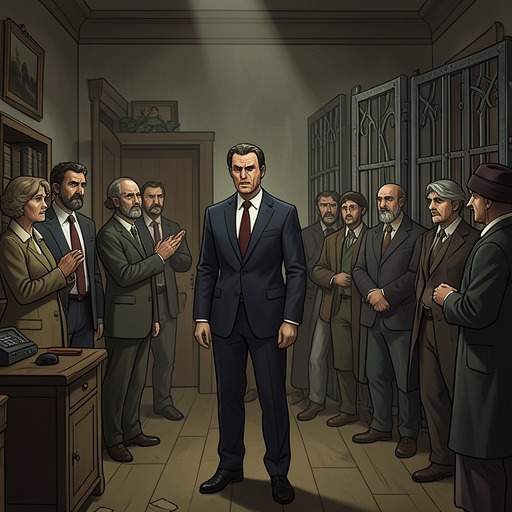
On January 3, 1925, the Chamber met again in a tense arrangement: the benches were packed from the center to the far right, while empty seats on the left marked the opposition’s continuing absence. Deputies joked and shouted, and Fascist supporters sang “Giovinezza.” The scene was noisy, but the assembly itself remained silent when the decisive challenge came.
Mussolini picked up the deputies’ manual containing the statute of the Kingdom and invoked Article 47. The provision gave the Chamber the right to impeach the king’s ministers and bring them before the Supreme Court of Justice. He asked whether anyone inside or outside the assembly wished to use it. No one answered. The raised volume of law turned a constitutional procedure into a public test of will: the Chamber possessed a formal instrument for holding ministers accountable, yet no deputy took up the invitation to use it against the government.
Across these episodes, the Chamber’s decline appears through repeated contrasts rather than a single closure. It could seat Fascist deputies, grant confidence, and confer extraordinary powers; it could also hear Matteotti’s critics, register liberal defections, and preserve provisions that theoretically allowed ministerial prosecution. But electoral participation did not bring the armed party under parliamentary control, and the Chamber’s votes did not prevent Mussolini from treating it as subordinate. By January 1925, the institution’s authority was still visible in the statute book, but its silence showed how little that formal authority could accomplish on its own.