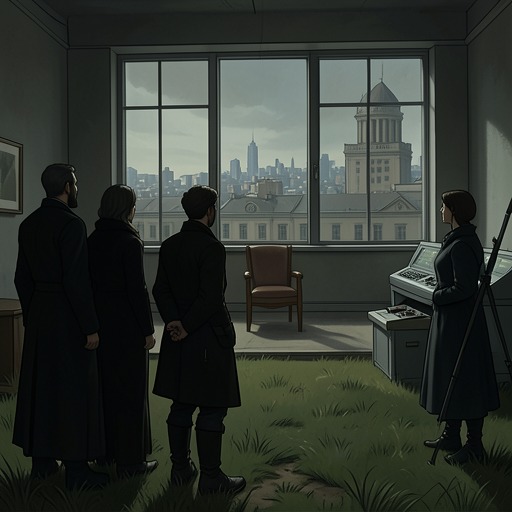
Discovery of Giacomo Matteotti's body
M: Son of the CenturyThe discovery of Giacomo Matteotti’s body on August 16, 1924, ended the uncertainty surrounding his disappearance and transformed a hidden killing into a public fact. The remains were found in Macchia della Quartarella, a wooded area near Via Flaminia, after a roadworker’s search for a blocked drain led to a torn jacket and a local carabinieri brigadier returned to the place with his dog. The discovery confirmed Matteotti’s death, but could not establish its precise cause. Its consequences were immediate: shock spread through Italy, and a secluded grave became the focus of national attention and political anger.
The search leads from the road to the woods
The first sign was not found at the burial place itself. While clearing a clogged drain at kilometre post 18 on Via Flaminia, roadworker Alceo Taccheri noticed a jacket with one sleeve missing. Its pocket-handkerchief piping was stained, and, on looking around, he found the detached sleeve nearby, its lining turned inside out. The garment brought the search for Matteotti into the landscape beside the road, but did not yet disclose where his body lay.
Ovidio Caratelli, a brigadier in the carabinieri who was on leave at his family home in Riano Flaminio, knew the surrounding woods from childhood hunting trips. He described the Macchia as dense and difficult to enter, with tall trees, thorny undergrowth, and a deep ravine beyond the outer edge. Between the road and the ravine lay a small clearing at an abandoned charcoal cellar, concealed by vegetation and brambles. On the evening after Taccheri’s find, Caratelli heard his dog barking and scratching at the ground there. It was already dark, so he went home rather than investigate further.
The next day, the dog ran into the brush as soon as they reached the woods and pawed at the same place. Caratelli probed the leaf-covered ground with a stick; when it sank into soft earth, he tested the spot with his foot. The ground gave way enough to reveal that something had been buried there. The dog’s repeated attention, first noticed in the fading light and followed up the next morning, brought the search to its decisive point.
The grave and the identification
As the soil was cleared, the remains of a human body emerged. Matteotti had been placed in a shallow, oblong pit, too short for the body. The dimensions recorded by investigators were stark: the grave was between 0.40 and 0.75 metres wide, no more than 1.20 metres long at its maximum, and 0.45 metres deep at most. It lay in the abandoned charcoal clearing, surrounded by brambles. A coarse metal file stuck in the ground served as a cross above the burial; it was also the tool the killers had used to dig the grave.
The medical examiner concluded that the body had remained in the grave for a long time and had decomposed there naturally. The burial had been made hastily and was too small, requiring the body to be compressed into it. The remains were not mutilated, but the examination could not determine the exact cause of death: the internal organs were absent, and there were no specific lesions on the skeleton. A stain on the seized jacket led investigators to consider a wound from a sharp-edged weapon as a likely explanation, but the evidence did not permit certainty. Two gold teeth, exposed as the gums had receded, confirmed the identification as Matteotti.
The file-cross and the dimensions of the grave made the act of concealment legible without resolving every question about the killing. The evidence established that the burial had been hurried and that Matteotti’s body had been forced into a pit too small for it; it did not provide a complete account of how he died. The distinction mattered: identification closed one central uncertainty, while the precise cause of death remained unproven.
From hidden burial to public crisis
Carabinieri searched the surrounding soil for further remains. Before evening, however, people with flashlights had gathered at the edge of the woods. Deputies of the Unitary Socialist Party were among the first to arrive. Filippo Turati pressed a handkerchief to his face; the account leaves open whether he was holding back tears or reacting to the smell from the grave. The scene had moved quickly from the secluded clearing into public view, with political representatives and onlookers converging on the place where Matteotti had been found.
Reports of the burial spread with particular force. Journalists described the makeshift grave and the way the body had been put into it, while conflicting accounts from Carabiniere captain Domenico Pallavicini and Caratelli, who had found the jacket, prompted skepticism about the circumstances of the discovery. Some suspected that the find had been manipulated. Such doubts did not prevent the news from provoking a national response. During the night, posters of Benito Mussolini in the capital were marked with blood-red paint, a visible sign of the anger released by the discovery.
The episode changed the status of Matteotti’s disappearance. Until the remains were found, the missing deputy’s fate remained a source of dread and uncertainty; the grave supplied physical confirmation of his death. The book presents the discovery as the moment when the nightmare of not knowing ended and another political phase began. The body’s return to public knowledge did not end the conflict over responsibility, but made the consequences of the killing impossible to keep at the level of rumor alone.
Burial and the meaning of return
On August 21, what remained of Matteotti was returned to the earth in Fratta Polesine, his home region. His wife, Velia, refused a political burial in Rome’s Verano cemetery and chose instead for the funeral to take place in the place of his origins. The coffin’s departure from Monterotondo station drew peasants, laborers, and railway workers to the tracks; in Fratta, tens of thousands of mourners awaited it. Their presence turned the return from the woods into a public act of mourning and protest, joining demands for vengeance and justice to acclamations of Matteotti and liberty.
The funeral also shifted the scene’s human focus from the young widow to Matteotti’s elderly mother, Isabella. A battalion presented arms along the provincial road, and a priest gave the ritual blessing before she was accompanied to the coffin. Her grief belonged to the intimate aftermath of a killing whose effects had become national. The contrast between the concealed clearing and the crowded funeral gives the discovery its decisive narrative force: the burial had hidden Matteotti, but finding him made private loss and political violence visible together.