Emilio De Bono
M: Son of the CenturyEmilio De Bono, a highly decorated general who entered Fascism after seeking political connections across Italy’s parliamentary parties, became one of the movement’s senior military figures. He helped plan the March on Rome, served first as police chief and later in the command of the Voluntary Militia for National Security, and was eventually removed from both positions. His trajectory links the insurrection’s military pretensions to the improvised, divided institutions that followed it, while his interventions during the Matteotti crisis placed him inside the effort to contain the scandal and its consequences.
Identity and Political Entry
De Bono is introduced as a general who had been pensioned off and was already prematurely aged. His decorations and professional standing set him apart from many of the movement’s provincial squad leaders, but they did not initially make him a fascist. He had sought political ties across the parliamentary spectrum; Fascism was the connection he ultimately found. The account thus presents his political entry not as a simple continuation of army service, but as a turn toward a movement that promised him a role in national power. That military identity brought both authority and personal ambition. At the planning meeting in Milan on October 16, De Bono was one of four experienced generals present. The senior fascist organizers were considering an armed insurrection, even though they knew the squads were not a trained army and would likely collapse if the regular forces fired on them. De Bono’s presence gave the deliberations the appearance of military expertise, but the gap between professional rank and the movement’s actual capacity remained central to the danger of the plan.
Planning the Insurrection
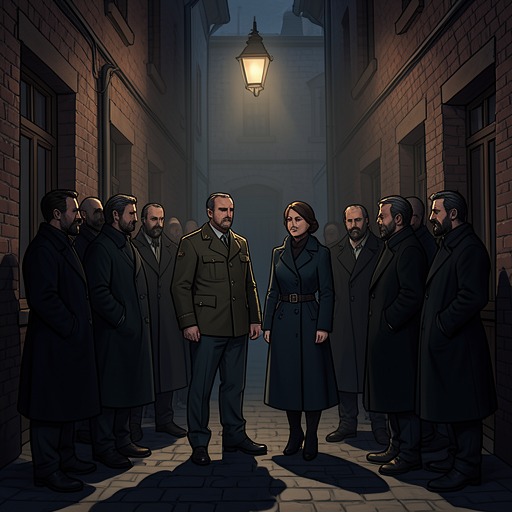
The meeting took place at the Fascist headquarters on Via San Marco, guarded outside by royal guards and inside by squad members. Before it began, De Bono objected to the presence of Generals Fara and Ceccherini, apparently unaware that they had also been summoned. Benito Mussolini brushed aside the dispute by emphasizing the newcomers’ military distinction. The disagreement was settled, and Italo Balbo took the minutes. The episode shows De Bono asserting his standing within the gathering, but also having to accept a wider circle of military participants chosen by Mussolini. De Bono was already caught between his army career and his fascist commitments. Two weeks earlier, he had wept in a Rome office when forced to choose between resigning from the army and leaving the Fascist Party. At the October meeting, he agreed with Mussolini’s proposed strategy: occupation of key public buildings and mobilization should happen at the same time. His assent came after Mussolini had framed the state as incapable of defending itself and Fascist seizure of power as necessary. De Bono’s position therefore combined military credentials with participation in a plan that treated the existing state’s weakness as its justification. The organization envisioned for the rising was elaborate on paper. Fascist powers would pass to the quadrumvirate at midnight between October 26 and 27; Italy would be divided into twelve zones, each assigned to an inspector general; and the mobilized squads would occupy key provincial points. From three locations near Rome—Santa Marinella, Mentana, and Tivoli—forces would assemble before the march. Yet the plan depended on communications and coordination that the actual command could not reliably provide. De Bono’s role as a general did not remove the discrepancy between a mapped operation and the movement’s limited capacity to direct it.
Perugia and the Limits of Command
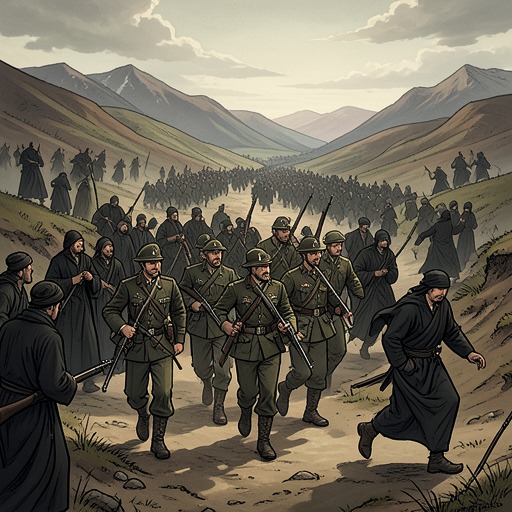
On October 27, De Bono and Michele Bianchi studied maps at the Hotel Brufani, the quadrumvirate’s headquarters in Perugia. The territory they were supposed to control was unfamiliar, and the town was poorly suited to command: its rail connections were indirect, regional routes were few, and telephone and telegraph communications were nearly nonexistent. The quadrumvirs considered moving their headquarters to Orte, nearer the troop-concentration points, but could not obtain permission from Mussolini, who remained in Milan. The command was left cut off from both its intended forces and reliable news of events elsewhere. When Cesare Maria De Vecchi arrived after an eight-hour journey through the mud, he told the others that fascists were moving south in rain and cold, poorly equipped and unarmed. Balbo arrived soon after and reproached De Vecchi, boasting of the occupation of Perugia’s prefecture. The quarrel exposed the difference between taking a public building and controlling the military forces around it. De Bono and Bianchi had little information from outside the hotel; the insurrection’s command center was not exercising the coherent control implied by its title. The danger became immediate when news arrived that a state of siege had been proclaimed and that the insurrection’s leaders were to be arrested. De Bono was summoned to Rome by an aide to King Victor Emmanuel III, while Mussolini remained in Milan. Soon afterward, the state of siege was revoked. At the hotel, however, the troops led by General Cornaro were advancing toward a public building guarded by squad members with only a couple of machine guns; the opposing formations were close to firing. De Bono stepped between them and announced that the state of siege had been revoked and that the king had summoned Mussolini to Rome. Cornaro stood down. In this moment, De Bono’s authority as a general served not to carry the insurrection forward but to prevent an armed encounter.
Police Chief and Militia Organizer
After the march, Fascist leaders protested that the new government had allocated too few ministries to their movement and had failed to appoint De Bono minister of war. Michele Bianchi and Giovanni Marinelli presented resignations in protest; De Bono was instead put in charge of the police. The appointment gave him a powerful public role, but it arose from factional pressure and the distribution of rewards after the seizure of power, rather than from the military portfolio he had sought. De Bono later presented a plan for the Voluntary Militia for National Security. The proposed force would defend the fascist revolution and maintain public order, duties that would no longer belong to the army or the Royal Guard. Recruitment was described as voluntary but limited to members of fascist military formations. The squads would be dissolved, with those wishing to remain fascists required to join the militia; senior officers would come from the army, assisted by selected fascist commanders. The new body was to swear allegiance to Italy and, above all, to Benito Mussolini, with obedience defined as absolute. The arrangement sought to bring the squads under a formal hierarchy, while placing a political militia alongside and partly in place of established state forces. Formal organization did not make the militia an army. When Balbo became its commander general, he traveled through the provinces to organize reluctant or unruly squad members. He commanded a force of 150,000 men, but it lacked standard dress, barracks, transport, and even muskets; much of its extraordinary budget had gone on uniforms. The book sets these shortages against the earlier language of military ranks and discipline. De Bono’s plan supplied an institutional design, but the force it helped shape remained poorly equipped and difficult to discipline.
The Matteotti Crisis and Removal
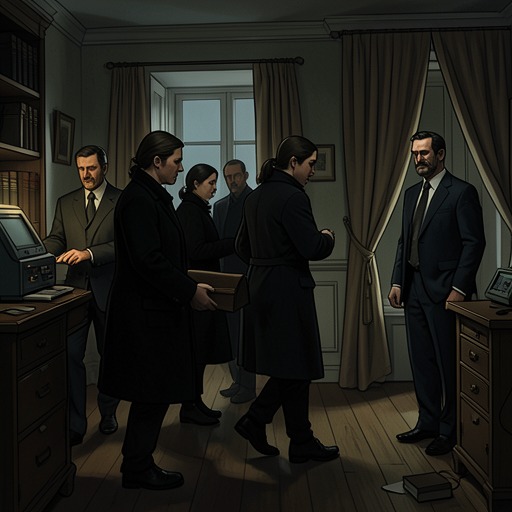
De Bono’s police position put him in the chain through which news of Giacomo Matteotti’s abduction reached Mussolini. After custodians near Matteotti’s home reported the registration number of a suspicious Lancia Lambda, police commissioner Rodolfo de Bernart transmitted the information to police headquarters, and De Bono passed it on to Mussolini. The detail made the investigation harder to contain: the car had been rented from a public garage, and its number had been recorded. A few hours after Amerigo Dumini was arrested at Termini station, De Bono took him to a private meeting at the commissioner’s office, outside normal arrest procedure. Dumini handed over a suitcase containing Matteotti’s bloodied clothes. De Bono instructed him to deny everything, presenting secrecy as necessary to save Fascism. Dumini was imprisoned under high surveillance, while the other members of the gang remained at large and he was promised an early release. The episode shows De Bono using police authority not simply to investigate the crime, but to manage the arrested man and the evidence in the immediate aftermath. During the ensuing crisis, De Bono telephoned Mussolini from a private line at the Ministry of the Interior and warned him that others were placing the blame on him. In June, Mussolini relinquished the interior ministry, dismissed De Bono as police chief, and replaced him with Crispo Moncada; De Bono was described as inept and implicated. Later, De Bono’s deposition about the accountability of Cesare Rossi and Giovanni Marinelli helped trap Dumini into changing his defensive line. By October, Dumini admitted that he had worked for the Fascist Cheka and followed the orders of his principals. De Bono’s role thus shifted from carrying the first police warning to participating in testimony that weakened the denials surrounding the operation. On October 22, after already losing the police post, De Bono was also forced to leave the militia command entirely in Balbo’s hands. His successive removals mark the narrowing of his authority: first the ministerial appointment he had wanted was denied, then the police office he received was taken away, and finally he lost his command role in the militia. The account leaves him as a decorated general whose rank helped lend Fascism a military appearance, but whose career within the movement was repeatedly shaped by political bargaining, weak institutions, and the effort to manage violence that the regime could neither fully control nor openly disown.