Fasci di Combattimento
M: Son of the CenturyThe Fasci di Combattimento emerged in 1919 from the unsettled politics of war and its aftermath: a movement of veterans and interventionists that sought both a place in public life and the power to remake it. Its identity was intentionally unstable. A sparse founding meeting and a platform full of sweeping promises gave way to an organization that treated action, local networks, and the mobilization of force as more decisive than doctrinal consistency.
Formation and founding program
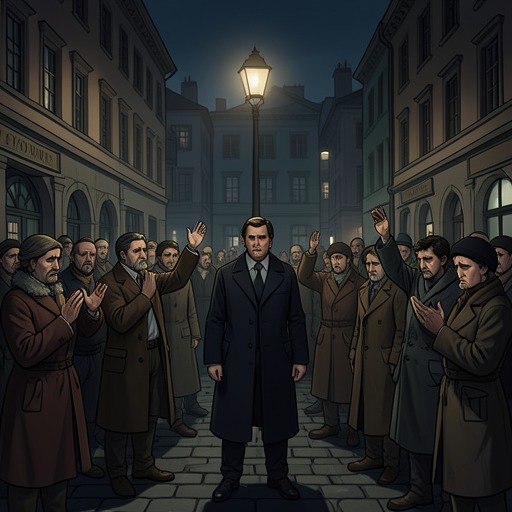
On March 23, 1919, fewer than a hundred men gathered at Piazza San Sepolcro in Milan for the formation of the Fasci di Combattimento. The scene was defined by the recent war and the returning soldiers whose experience the movement claimed to represent. In the months that followed, Benito Mussolini presented the fasci as an interventionist association: its program validated the war and its combatants, opposed foreign imperialisms said to threaten Italy, rejected imperial aggression against other nations, and called for an electoral contest over the war question. Enzo Ferrari and Ferruccio Vecchi were among the speakers at a regional meeting where these principles were approved, with cities across Italy represented. The published platform appeared in Il Popolo d’Italia on June 6, after nearly three months of discussion and revision. Among its economic proposals were a progressive special tax on capital, partial expropriation of wealth, seizure of 85 percent of war profits, and seizure of the assets of religious congregations. Its military demand was for an armed nation. The platform could therefore sound more radical than the reformist left, even as it sought to draw former socialist comrades into a new organization. Its breadth was part of its appeal, but also made the question of what the fasci actually stood for difficult to settle.
Action over doctrine
The movement answered that difficulty by treating ideological consistency as a burden rather than a condition of membership. Benito Mussolini described the fascists as an anti-party, a formation that could avoid the weight of fixed principles. The San Sepolcro platform remained on paper, but combat was presented as the movement’s operative program: the fasci could act as revolutionaries or reactionaries according to circumstance. Gabriele D’Annunzio’s emphasis on action offered a model that appealed to young activists, further shifting attention from the content of a settled program to the capacity to act. At the Teatro Olimpia, Benito Mussolini called the fascists antidoctrinal, dynamic, and practical, and described them as a synthesis of political affirmations and negations. He insisted that they were not simply a bodyguard for wealthy interests. That claim coexisted with an organization increasingly welcomed by parts of the bourgeoisie for its violence against the left, even while its demands for the redistribution of wealth alarmed them. The contradiction was not resolved; flexibility allowed the movement to approach different constituencies without surrendering its claim to stand above conventional party divisions.
Uneven growth and local foundations
Early expansion was smaller than the movement’s public claims suggested. Umberto Pasella announced 137 sections and 40,000 members, while Benito Mussolini gave a lower figure of 56 sections and 17,000 members. The account judges the real organization to have comprised only a few dozen sections and a few thousand members. It faced hostility from socialists and republicans, suspicion from monarchists and nationalists, and criticism from democrats. Its closest allies were the Arditi and war veterans. The disparity between its modest size and its ambitious language made organization on the ground essential to any future growth. In Bologna, the local fascio nearly collapsed in 1920 after its republican founders left; only six fascists remained, without enough money to rent an office. Benito Mussolini nevertheless assigned Leandro Arpinati responsibility for rebuilding the organization in the city and across eastern Emilia. The proposed method was to organize civic-defense militias in response to strikes. This organizing took place amid intense conflict: socialist institutions were powerful in the countryside, while labor leagues shaped employment, wages, and agricultural work. In Emilia, socialists controlled 223 of 280 municipalities, and Ferrara’s leagues counted 81,000 registered members by mid-May 1920. These were not fascist organizations but powerful opponents whose control of rural life helped define the terrain on which fascist mobilization developed.
Squads, resources, and mass mobilization
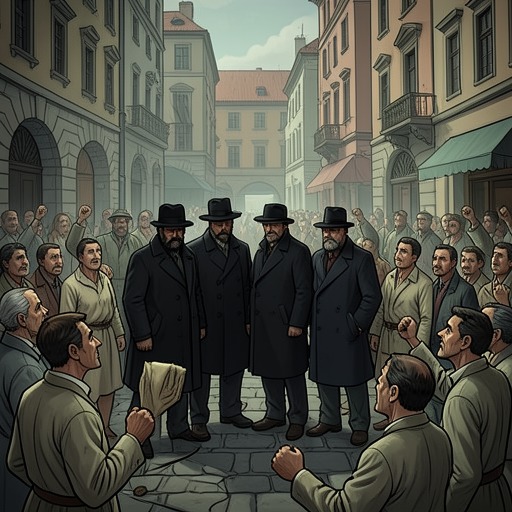
The movement’s local organization could also be used for planned, coordinated operations. On January 23, 1921, a Ferrara punitive expedition was prepared according to military methods. Dozens of armed men were assembled to strike several rural targets at once, relying on surprise and trucks supplied by the Agrarian Association. The operation illustrated how fascist organizing could combine local leadership, transport, and private financial or logistical support to act against the peasant leagues. A different kind of mobilization followed in Ferrara in May 1921. With Benito Mussolini’s authorization, Italo Balbo circulated instructions for a mass demonstration, and thousands of impoverished farm laborers began moving toward the city from the surrounding countryside at midnight on May 11. By morning, 50,000 workers had entered Ferrara. Fascist detachments controlled the procession; the city was paralyzed, telephone lines were cut, schools were requisitioned for lodging, and shops and businesses were ordered closed. The scale of the gathering turned rural numbers into visible political pressure and compelled the prefect to seek a meeting with Balbo. The movement also exploited a national confrontation between organized labor and the state. After the Labor Alliance called a general strike for July 31, 1922, Michele Bianchi issued an ultimatum giving the state forty-eight hours to demonstrate its authority. He declared that fascism would otherwise claim freedom to act and replace a state that had shown its impotence. The episode joined an immediate political crisis to a broader claim: that the movement’s organized force could stand in for state authority.
From movement to party and state
The Fasci di Combattimento’s political development did not end with street and rural organizing. In the 1921 election, Benito Mussolini accepted a place within the national blocs, and the movement’s candidates became part of parliamentary competition. At a later congress, a reconciliation among fascist factions preceded the birth of the National Fascist Party. Benito Mussolini then outlined a program of national unification, imperial ambition, accommodation with the Roman Church, and a state identified with fascism. He also described the movement as serving and educating the masses while claiming authority to discipline them, and assigned importance to the health of the national lineage. The growing relationship between party and armed organization became explicit when Ivanoe Bonomi’s December 15 circular attempted to place clubs and paramilitary groups under restrictions. Michele Bianchi, now secretary general of the National Fascist Party, answered that party sections and combat squads formed an inseparable unit; the directive appeared openly in Il Popolo d’Italia. The state did not arrest the party leadership. Instead, Bonomi issued another circular lamenting that his public-order instructions had not been followed. The episode exposed the distance between formal regulation and the government’s ability to enforce it. The movement’s later commemorations made its expansion part of its political message. At Piazza Belgioioso, Benito Mussolini recalled that the first fascist rally there had drawn only a few hundred people; four years later, thousands attended. He contrasted the former small groups with the present mass of volunteers, presenting their growth as a resurrection through which a people became a nation and a nation a state. The organization that began with a small gathering had become more than a protest against the postwar order: it had built networks capable of assembling crowds, fielding squads, entering parliament, and claiming the authority of the state itself.