Fascist dictatorship in Italy
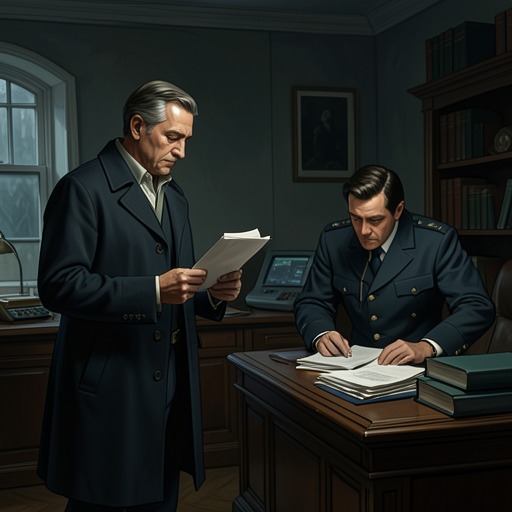
M: Son of the CenturyFascist dictatorship in Italy took shape through a sustained weakening of political competition, not through the immediate disappearance of parliament or the state’s formal procedures. The account follows the movement from postwar violence and cooperation with liberal authorities to electoral consolidation, tighter control of the press and party, and the increasingly perilous position of its opponents. Its central contradiction is that institutions continued to meet and laws continued to be debated even as coercion and intimidation made their operation less free.
Postwar crisis and the entry of fascism into public order
The postwar landscape is presented as a crisis of political authority and political imagination. Five million returning soldiers confront an older political class portrayed as exhausted and unable to avert further upheaval. In this account, the old order’s weakness does not produce a settled alternative: the returning veterans and the prospect of continuing conflict become the setting in which Fascist claims to represent a new political age can gain force.
The state’s response to revolutionary unrest helped create a channel for that force. During the preparations for the July 1920 general strike, Benito Mussolini opposed the strike while also seeking renewed cooperation with interventionist groups on the left. At the same time, Michele Bianchi, acting on Mussolini’s instructions, arranged for the Fascists to assist Milan’s prefect in maintaining public order. A confidential government circular urged Fascist collaboration in repressing revolutionary attempts, including by force, on condition that the groups accept official command. The state was not yet simply replaced by the movement: its authorities enlisted Fascist organization in an effort to defend the existing order, helping give a political movement a role in coercive public action.
A separate episode in Bologna shows how violence and organized self-defense could reinforce the movement’s appeal among threatened social groups. After a massacre in which eight people were killed and around thirty injured, the Chamber of Labor called a province-wide general strike. The ensuing disruption prompted business owners, professionals, landowners, public employees, and homeowners to organize the Bolognese Association of Social Defense. Its delegation accused the state of failing to respond to socialist violence and offered to act in the name of self-defense. These developments linked local fear and class conflict to the expansion of organized anti-socialist action.
Parliamentary inclusion and party organization
The movement’s growing parliamentary presence did not displace its street power; the two became complementary. In the lead-up to the 1921 election, the liberals’ willingness to include Fascists in the national blocs marked a decisive political threshold. Even Luigi Albertini, who had previously opposed their inclusion, urged readers of Corriere della Sera, the government-critical daily, to accept the alliance. The shift registered the movement’s passage from trench and street violence into parliamentary politics, without requiring it to repudiate the violence that had helped bring it there.
The party’s subsequent formation gave this political expansion a more organized shape, while leaving leadership and force closely connected. At the congress, the gathering’s enthusiasm turned into a public reconciliation around Mussolini; among those who helped raise him to the presidency table was Italo Capanni, identified in the account as the killer of Spartaco Lavagnini. The following day Mussolini outlined a future program that presented Fascism as a synthesis capable of absorbing liberalism after violence had buried earlier methods. He envisioned Italians unified beyond regional identities, national greatness tied to imperial ambition, and a state identified with the Fascist movement. He also described the masses as requiring an interpreter and discipline, and made national “health” and ethnicity part of the project of making history. His closing pledge to withdraw from the new organization sits uneasily beside a program that placed him at its center: the leader announced institutional self-effacement while defining the new order’s political vision.
The relationship between party and armed organization remained a direct test of the government’s capacity to impose its own rules. When Ivanoe Bonomi tried to regulate clubs and truncheons through prefectural circulars, the newly elected National Fascist Party secretary Michele Bianchi answered with a directive declaring party sections and combat squads inseparable. The directive was published in Il Popolo d’Italia. The account stresses the gap between the state’s apparent authority and its ability to enforce it: although the government could issue restrictions, a party with deputies openly asserted the unity of its political and armed organizations, and Bonomi’s subsequent circular complained that his public-order instructions were not being obeyed.
Crisis, government, and public acclaim
The October 1922 crisis briefly made the state’s remaining legal powers visible. Luigi Facta’s government prepared a state-of-siege proclamation, an exceptional measure that would suspend constitutional guarantees and transfer powers to military authority. In the morning, written orders for Rome’s defense went to General Emanuele Pugliese; arrest instructions were sent to prefects; a telegram announcing the state of siege was drafted; and the proclamation was posted in the streets. The sequence shows that constitutional machinery and administrative command had not simply vanished. Yet the ensuing political settlement brought Mussolini into government rather than ending the Fascist advance through the prepared emergency measures.
Fifteen days after the March on Rome, the Chamber of Deputies was packed with dignitaries, onlookers, and supporters when Mussolini arrived with his ministers and General Armando Diaz. Deputies outside the left rose to applaud, as did the public galleries. The festive reception coexisted with a recent record of deaths and serious injuries in Rome, which public descriptions of the march as bloodless or as a joyful revolution threatened to obscure. The new government’s public welcome therefore formed part of its political strength: the movement was not represented only through armed pressure, but also through a staged appearance of national enthusiasm and institutional acceptance.
Mussolini’s image as a restorer of order helped turn that welcome into a broader story of national renewal. The account depicts crowds pressing around him in public and ministries adjusting to his pace, while the old politicians are cast as remnants of a failed age. Fascist language presented the leader as a figure of youth and rebirth, an arbiter who could master the conflict that the movement had helped intensify. The contrast is consequential: a promise to end division and restore security depended on the authority of a movement whose political identity had been formed through confrontation and whose squads remained part of its organization.
Consolidation and the narrowing of opposition
By the first anniversary of Fascist rule, institutional changes had accumulated across several fronts. Mussolini’s government had met sixty times in a year, considered 2,482 matters, and approved 1,658 decrees. The electoral reform proposed by Giacomo Acerbo promised two-thirds of parliamentary seats to the list winning a relative majority. At the same time, party regulation gave Mussolini the final choice over the directorate, after internal factions had been checked, while censorship measures enabled police to enter newspaper offices and seize publications. Government activity remained dense and formally administrative, but those procedures increasingly served to concentrate political control and restrict independent opposition.
The electoral reform exposed how parliamentary rules could be used to weaken the conditions of future competition. Its opponents faced threats from Fascist leaders who indicated that a further wave of violence might follow defeat of the bill. Giovanni Giolitti’s liberal followers had decided to accept the proposal, still hoping that cooperation would tame Fascism; some socialist reformists also favored collaboration in the name of protecting workers. Don Luigi Sturzo’s forced resignation had left the Popular Party’s deputies at a decisive juncture. Their votes could help block the measure, but they faced a party whose founder had been pushed out amid pressure on Catholic institutions. The chamber remained the arena of debate, yet choices within it were constrained by threats outside it and by the removal of leaders who might have organized resistance.
Giacomo Matteotti’s opposition made the consequences of this narrowing especially clear. He argued that resistance to the dictatorship had to become more active, that citizens should insist on their rights, and that Fascism would not voluntarily surrender its arms or restore liberty. On May 30, 1924, he challenged the validity of the election before the Chamber, arguing that the governing majority had not freely received the votes attributed to it. The account places him amid interruptions and denunciations, while describing him as isolated even within his own party. His speech made the central issue explicit: a majority produced under coercive conditions could claim procedural legitimacy while denying voters the freedom that gives an election meaning.
The treatment of opposition was also visible before the parliamentary challenge. Ahead of the 1924 election, Matteotti urged Filippo Turati to refuse concessions and maintain public protest, warning that each Fascist success encouraged further abuses. His warnings stood against the hope, among some socialists and liberals, that accommodation would moderate the regime. In the account, that expectation repeatedly fails: the movement gains access to institutions without surrendering its capacity for coercion, and its opponents must choose between cooperation under deteriorating conditions and resistance at growing risk. By May 1924, parliament still functioned, but its proceedings had become a direct contest over whether the opposition could speak, organize, and challenge power on genuinely free terms.