Ferruccio Vecchi
M: Son of the CenturyFerruccio Vecchi is presented as a captain of the Arditi and a fervent interventionist whose importance in early Fascism lies less in a formal ideological program than in his capacity to personify militant action. He presides over an assembly, appears in the movement’s public confrontations, and helps frame its response to bloodshed as both spontaneous and justified. His career in these episodes places him between the veterans who supplied Fascism with its forceful identity and the political organizers who sought to turn that force into a movement.
Identity and Position
At the founding-era assembly, Vecchi assumes its presidency. The narrative identifies him as an Arditi captain who had been placed on leave for health reasons and describes him as tall, pale, lean, dark-haired, and sunken-eyed. It portrays him as excitable and impulsive, prone to preaching with fervor but without moderation; at demonstrations, that fervor could become dangerous. This is a characterization of his public presence, not a detailed account of his private life.
The assembly’s other posts were still being arranged. Attilio Longoni was considered the likely secretary, with Umberto Pasella also a possibility, while the remaining principals were to be chosen from among the loudest figures in the front ranks. Vecchi’s presidency therefore gave him a visible place in a loosely assembled group, but the evidence does not identify him as its secretary or as the author of its program. His prominence comes instead from presiding, mobilizing, and speaking in the movement’s activist register.
Early Fascist Organizing
In March 1919, Vecchi took part in a meeting in Milan convened to form regional action fasci among interventionist groups. Enzo Ferrari and several other speakers were present. Benito Mussolini outlined the proposed principles: affirm the war and those who had fought it, defend Italy against foreign imperialism, reject Italian imperialism directed against other nations, and make the war question a basis for electoral competition against parties that opposed the war. After the speakers had addressed the gathering, the proposals were approved. The account establishes Vecchi’s presence in this early organizing circle, while attributing the presentation of its cornerstones to Mussolini.
Vecchi’s role became more conspicuous in the confrontation of April 15, 1919. A large socialist procession was under way in Milan when several thousand demonstrators broke away and marched toward the Duomo. At the square, a much smaller counter-demonstration gathered around Filippo Tommaso Marinetti, Arditi, officers, students, and Fascists. A cordon of Carabinieri separated the groups; when it opened, the clash lasted about a minute. The socialist column threw stones and a few clubs, while gunfire came from the officers, Arditi, and Futurists. The narrative describes a sharp contrast between the singing socialist marchers and the veterans arrayed opposite them, whose daily familiarity with wartime killing had shaped a different relation to death. It does not establish that Vecchi personally fired a weapon in this encounter.
Public Claims and Political Spectacle
Two days after the clashes, Vecchi and Filippo Tommaso Marinetti signed a proclamation posted on Milan’s walls. It expressed regret that blood had been shed, but accused Avanti! of fomenting red terror and civil war, and argued that its attacks on interventionists and patriots had provoked an immediate response. The proclamation recast the counter-demonstration as an unplanned expression of popular will and defended the political claims of victorious soldiers. In doing so, Vecchi helped give public form to a recurring early Fascist argument: violence was described as a reaction to provocation even as it was used to assert the veterans’ authority in political life.
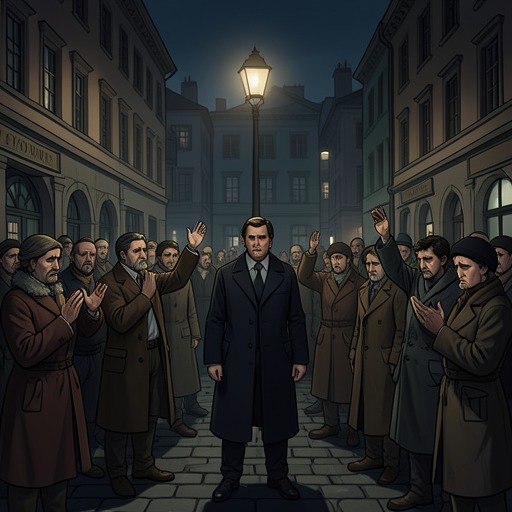
At a later Milan gathering, a Very flare rose above the crowd and served as the signal for Vecchi to take the stage. He spoke with the fanatical vehemence attributed to him, invoking the experience of battle and the condition of the dispossessed. His address attacked parliamentary dishonesty and presented the Arditi as enemies of a system that denied justice to poor people and small businessmen. The flare, a device associated with the wartime front, linked the gathering’s political theater to trench experience. Vecchi’s speech made him the event’s first featured speaker; Benito Mussolini followed him onto the stage, and the audience then turned its attention to the movement’s principal leader.
The relationship between public performance and material action appears again after the burning of Avanti!’s offices. In Mussolini’s newspaper office, Vecchi held the wooden sign that had been torn from the paper’s door. The crowd outside sang that Avanti! was no more, and the sign was to be presented to Mussolini as a trophy. When Vecchi handed it to him, Mussolini recoiled for an instant. The object condensed the political reversal: Mussolini had once edited and raised the circulation of Avanti!, and now its sign was being displayed as the defeated enemy’s emblem. Vecchi’s role in this scene is specific and consequential: he brings the captured sign into the office and takes part in the ritual that turns an attack on a rival newspaper into a public symbol of victory.
Arrest and Continuing Presence
On November 18, 1919, police raided the Arditi Association headquarters on Via Cerva. They seized SIPE bombs, Thévenot grenades, pistols, daggers, maces, and ammunition, and arrested Vecchi alongside Piero Bolzon and Edmondo Mazzucato. Albino Volpi and other veterans suspected of involvement in the attack on Via San Damiano escaped capture by fleeing over the rooftops. Later that day, police searched the Fascio headquarters and Il Popolo d’Italia; the raids formed part of a wider effort to suppress armed groups and the Fascist organization. Vecchi’s arrest placed the Arditi Association at the center of the authorities’ crackdown, but the account does not specify his individual legal outcome.
By 1920, Vecchi was again associated with Mussolini in Milan, often accompanying him through the Galleria in his Arditi captain’s uniform. The surrounding city was caught in a vast wave of strikes: transport stopped, stations were held by troops, and millions of workers took part in industrial stoppages. The narrative sets the pair’s presence against this continuing social crisis, rather than describing a particular action by Vecchi during it. His recurring appearance beside Mussolini nonetheless marks the persistence of the veteran-militant element within the movement as its political setting shifted.
Narrative Significance
Vecchi’s episodes trace the conversion of wartime identity into political presence. He presides at an early assembly, appears within interventionist organizing, signs a defensive account of street violence, speaks at a torchlit gathering, carries a rival newspaper’s sign into Mussolini’s office, and is arrested during a police raid on the Arditi. These are not interchangeable appearances: together they show how meetings, proclamations, weapons, uniforms, and trophies gave militant politics both organization and spectacle.
The book presents him as a volatile, forceful figure, but the evidence does not make him the movement’s chief strategist or spokesperson. Mussolini supplies the March meeting’s principles and takes the central speaking role at the later rally; Vecchi’s importance lies in a different register. He is a visible organizer and performer whose Arditi identity binds political action to the experience and symbols of war. His later presence beside Mussolini amid the strikes suggests that this connection remained part of Fascism’s public image even as the movement confronted a society in upheaval.