First World War
M: Son of the CenturyThe First World War is the decisive rupture behind the book’s postwar Italy: it leaves millions dead, millions of veterans returning to a country in crisis, and a political culture in which the language and organization of combat persist after the fighting. The war’s consequences are not confined to the battlefield. They enter rallies, elections, paramilitary structures, labor conflicts, and public ceremonies, making peace appear less like a settled condition than an unsettled inheritance.
Mass Death and the Returning Veterans
The war’s scale is conveyed through the image of a continent whose public stage has been emptied by loss. The dead are associated with the Carso, Ortigara, and the Isonzo River, while the living gather as survivors and former soldiers. One passage gives the toll as eleven million dead and describes five million veterans returning across territorial borders. These figures frame the postwar crowd as a political force shaped by shared loss, dislocation, and a sense that the older political class has failed.
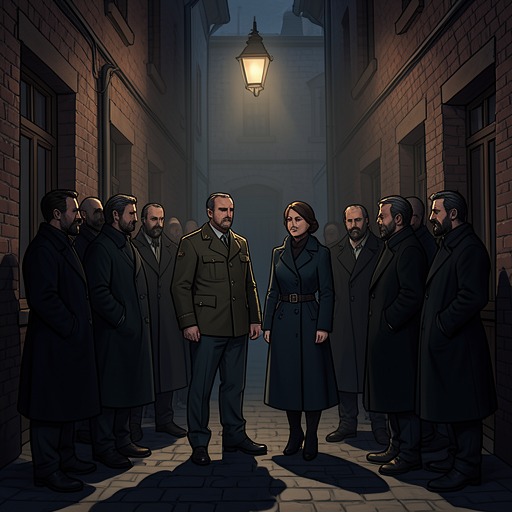
Veterans do not appear only as a social category. They become central to competing claims about who can speak for the nation. At a Milan rally in 1919, the socialist procession includes women carrying a portrait of Lenin and a red flag, while the smaller counter-demonstration includes men accustomed to wartime killing. The account stresses the gulf between the groups’ different experiences of death. When the cordon of the Carabinieri opens, the confrontation shifts rapidly from opposing marches to gunfire, and the socialist singing ceases. The scene shows how the war’s violence and divisions were carried into the streets, where political opponents could be treated as enemies rather than participants in a shared civic order.
The war also shapes the language of political recruitment. In 1919, socialist workers attack rallies by people who had supported intervention in 1915. Leonida Bissolati, a moderate socialist who had backed the war and volunteered to serve at the age of sixty, is prevented from speaking in the province of Cremona. In the same year, the Fascist electoral list presents its own front-line record as a qualification: eighteen of its nineteen candidates had fought, including volunteers, decorated soldiers, wounded men, and disabled veterans. Their military service is made part of the list’s public identity, linking electoral participation to the authority claimed by combatants.
War’s Afterlife in Political Action
The book repeatedly presents postwar politics as a contest over whether the war is truly over. At the end of 1919, a plan commissioned by the new National Fascist Party leadership proposes organizing its squads on the model of a Roman legion. The proposed structure includes squads of twenty to fifty men, larger formations of centuries and cohorts, and legions under consuls. Although ranks would be elected and local units would retain substantial autonomy, the plan identifies militarization, discipline, and hierarchy as guiding principles. Its central contradiction is explicit: a movement of elected local militants is to acquire the discipline of an army. The account concludes that, for the fascists, the war has never ended.
This continuity also appears in organized action against the rural leagues. In January 1921, a Ferrara punitive expedition is assembled using military methods: armed groups plan to strike several peasant-league centers at once, relying on surprise and trucks supplied by the Agrarian Association. The operation is not presented as a battle in the First World War, but its planning carries forward a wartime model of coordinated force. The contrast between the former soldiers’ experience and the civilian political setting helps explain how the language of combat could become a practical method of political intervention.
A different kind of mass mobilization occurs in Ferrara in May 1922. From midnight, impoverished agricultural laborers travel toward the city on foot, by bicycle, in wagons, and on barges. By morning, fifty thousand workers have assembled there. Telephone lines are cut, schools requisitioned for accommodation, and shops and businesses closed; the city is paralyzed as the countryside enters it in organized numbers. The episode demonstrates that large-scale mobilization was not limited to armed formations. In a country marked by wartime mass participation, numbers, movement, and coordinated presence could themselves become instruments of political pressure.
Fiume, the Dead, and National Renewal
In January 1920, Gabriele D’Annunzio describes 1919 to his legionnaires as a year defined by passion and by Fiume rather than by the negotiations at Versailles. In his contrast, Versailles signifies a Europe exhausted by suspicion and bargaining, whereas Fiume represents youth, life, and a future accompanied by the dead of the war. The speech turns the fallen into part of a political vision: memory of the dead becomes a claim that the nation can begin again. Yet the narrative immediately qualifies this vision. Italians have not followed D’Annunzio as he wishes, and his standing as a champion of youth is already undercut by events.
The Unknown Soldier’s burial gives collective mourning a national setting. On November 4, 1921, the body of an unidentified fallen soldier is carried across the country by special train and buried in a ceremony described as the most solemn in unified Italy. Chosen by lot to represent all the fallen, the unknown soldier becomes the focus of public mourning for losses that cannot be represented individually. The ceremony also gives political leaders a ritual through which to associate the nation with the war dead. Five days later, at the founding congress of the National Fascist Party, Mussolini and the party’s founders kneel at the soldier’s grave for more than half an hour. The juxtaposition of mourning and party formation makes the ceremony more than a remembrance: it shows how the dead could be incorporated into a political community and its public rituals.
Meaning and Consequences
The war’s legacy is presented neither as a simple explanation for the rise of postwar violence nor as a conflict neatly concluded by the armistice. Rather, the book follows the ways its consequences are reactivated: veterans become political symbols, wartime experience lends authority to new movements, and military forms are adapted to domestic conflict. At the same time, the mass politics that follow the war include socialist processions, rural leagues, strikes, and labor mobilizations, not only armed squads. These movements make competing claims on the same postwar society, where food, work, property, and political liberty remain contested.
The recurring promise of national renewal depends on the same memory that exposes the war’s cost. The dead can be invoked as witnesses to a new national beginning, while their commemoration lends solemnity to a politics increasingly organized around discipline, collective display, and confrontation. By moving between battlefields, returning veterans, street clashes, proposed militia structures, and the Unknown Soldier’s tomb, the account presents the First World War as an event whose political afterlife continued to shape Italy’s public life.