Fiume Legionnaires
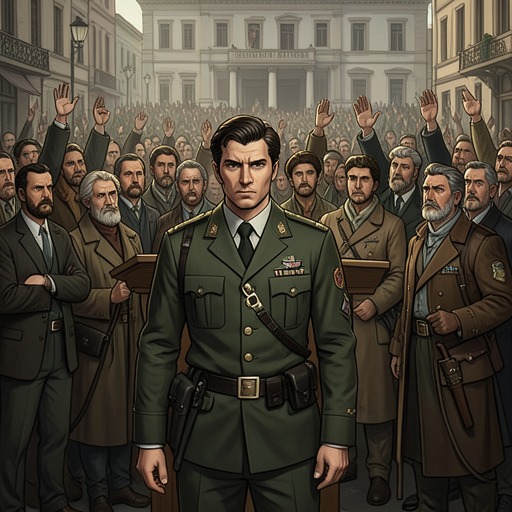
M: Son of the CenturyThe Fiume Legionnaires were the armed force behind Gabriele D’Annunzio’s control of Fiume, and the defenders in the confrontation that ended that rule in December 1920. Their story in the narrative is one of dwindling support: a proposed effort to bring in outside allies gave way to isolation, a brief armed resistance, and the surrender of the city’s military project.
Role and Political Isolation
The Legionnaires depended on the authority of D’Annunzio, whose command was also a point of conflict. As the settlement over Fiume drew nearer, Alceste De Ambris tried to persuade Benito Mussolini and the Fascists to aid the Legionnaires. By then the city faced a naval siege ordered by Giovanni Giolitti’s government. Mussolini refused the appeal to make his men subordinate to D’Annunzio and urged him to accept the Treaty of Rapallo instead. He argued that the Italian public had accepted the settlement and that the Legionnaires were being abandoned.
That isolation was not merely a rhetorical claim. Supporters who had once seemed available were withdrawing: Admiral Millo declared loyalty to the king, while General Ceccherini and Colonel Siani left, citing the Legionnaires’ lack of discipline. D’Annunzio would not surrender the absolute power he regarded as his remaining prerogative. The Legionnaires therefore entered the final crisis with their command intact at the center but their wider network of political and military support breaking apart.
De Ambris described a possible alternative to capitulation: moving troops and naval forces from Fiume to the Italian mainland, then seeking support for an advance on Rome. The proposed route depended on vessels already associated with the city, including the cruiser Mirabello, the destroyers Abba, Bronzetti, and Nullo, and a manned MAS flotilla. It also relied on possible cooperation from sailors and a regiment of Bersaglieri. This was a plan put forward during the effort to secure Fascist assistance, not an operation the Legionnaires carried out. Its scale reveals the ambition of the project, while its dependence on allies underlines how little could be achieved by the defenders alone.
The December Assault
On December 1, two armored battleships, eight torpedo destroyers, and two tugs were deployed outside Fiume’s port. The siege began, and the city came under fire. By December 24, only five thousand Legionnaires remained. When news of the government offensive reached the command room at about six in the evening, a Legionnaire inspector spent an hour trying to obtain D’Annunzio’s order to fire. In the meantime, the first garrisons advancing near Cantrida had already been surrounded and captured by the Italian Royal Army.
The attack proceeded rapidly, despite the Legionnaires’ initial orders not to engage. They fell back to the city’s final defensive line, while appeals to Italian brotherhood failed to stop the advance. Once D’Annunzio authorized them to open fire, the defenders reinforced gaps in the line and counterattacked. The surprise of the government’s assault was checked, and before nightfall the Legionnaires had re-formed the defensive perimeter around Fiume. The episode shows both their capacity to hold ground and the delayed, precarious character of the command response.
The fighting continued into the following days. The city’s bombardment was not heavy, but it lasted for forty-eight hours; one civilian was killed and several others were wounded. On December 28, General Ferrario refused to negotiate terms for the Legionnaires’ surrender and threatened to intensify the bombardment. City representatives then implored D’Annunzio to give up his powers. He handed authority to the mayor and people of Fiume, saying he could not impose ruin and absolute death on the city. During the week of fighting, he had hardly left his study and had not joined the Legionnaires on the firing line.
Demobilization and Significance
An agreement signed at Abbazia at 4:30 p.m. on December 31 provided for the Legionnaires’ total demobilization from the city. The force that had sustained D’Annunzio’s rule thus did not secure Fiume against the Italian government, and its final disposition followed the transfer of authority to the city’s representatives. Its resistance had temporarily restored the defensive line, but not reversed the larger political and military isolation that had made the siege possible.
The Legionnaires’ ending contrasts with the language of heroic sacrifice that had surrounded the Fiume cause. D’Annunzio had repeatedly presented himself as ready to die for it, yet in the crisis he sought to spare the city and relinquished his powers. The narrative places the Legionnaires between these competing realities: a force capable of fighting, but dependent on a commander and a political network whose ambitions could not overcome the withdrawal of support and the government’s attack.