Fiume as the “City of Life”
M: Son of the CenturyFiume as the “City of Life” was Gabriele D’Annunzio’s attempt to make a besieged city signify more than a disputed claim to Italian territory: it would become a beacon of renewal, freedom, and collective creation. The ideal’s force lay in its fusion of political program and public spectacle. Its limits were equally visible: the promise of a transformed life was proclaimed amid scarcity, administrative failure, and mounting estrangement between the Commander and the people he sought to lead.
From territorial claim to universal promise
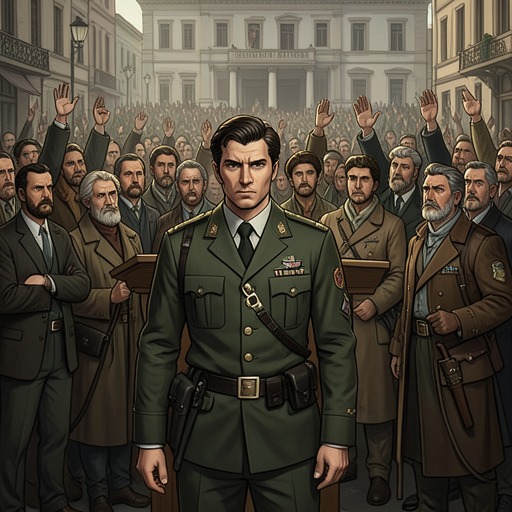
On October 24, 1919, at the Teatro Verdi, D’Annunzio spoke during a campaign intended to renew Fiume’s pledge of union with Italy. He had dissolved the city’s municipal representation and called new council elections, hoping that their result would reaffirm popular support. His speech began as an elaborate nationalist argument, specifying the borders of a free Italy with the precision of a mapmaker. Then it changed scale. Fiume, in his account, was no longer merely an Italian city or a symbol of sacrifice; it had become a light for the West, a “city of life,” and the point from which a new spiritual fire might spread.
The change mattered because it recast a local political impasse as a world-historical mission. D’Annunzio invited insurgents of many kinds to gather under Fiume’s insignia, declared that the defenseless would be armed and force answered with force, and imagined a common cause among oppressed peoples against wealthy, dominant powers. This was not presented as a detailed strategy. The speech’s momentum instead made the city itself seem like the event: a place where nationalist defiance could expand into a universal revolt. The subsequent election was a triumphant plebiscite for the poet and his future, giving the performance an immediate political confirmation without resolving the larger crisis.
In January 1920, D’Annunzio contrasted Fiume with the postwar settlement at Versailles. He cast the former as youth, beauty, faith, and a future carried by both the dead and generations yet unborn; Versailles stood for a weakened, fearful Europe. Yet the contrast also exposed a strain in the ideal. He chose to remain in Fiume against the will of its inhabitants, treating the city as the place where the soul was freest even as disagreement over its future persisted. A vision founded on collective affirmation could therefore coexist with a leader’s determination to define the community’s meaning himself.
The constitutional promise of a worthy life
The ideal acquired a more concrete political form when Alceste De Ambris delivered a draft constitutional charter to D’Annunzio on March 18, 1920. The proposed Carnaro Charter envisaged a democracy grounded in the rights of workers and individuals. Its account of citizenship crossed divisions of sex, race, language, class, and religion, and its guarantees ranged from freedom of speech, press, thought, and religion to schooling, physical education, minimum wages, and assistance in illness, disability, unemployment, and old age. D’Annunzio revised the text and added a demanding standard: life should be not only materially worthy but beautiful.
That standard extended beyond legal rights. Workers’ associations were to create their own emblems, music, songs, and ceremonies. Music was treated as a social institution, and even ordinary homes were to be enriched with folk art. Work, including its humblest forms, was imagined as something that could cease to be brutal toil and become creative effort that beautified the world. In this design, citizenship meant participation in a shared culture as well as protection by law; the community would make its public life through labor, art, ritual, and common remembrance.
The proposal also put limits on property in the name of social utility. Property could not simply be reserved to one person without regard for others, nor could land be left fallow or disposed of to exclude them. The provision revealed a conflict built into the project: its egalitarian purpose challenged the assumptions of modern capitalist commerce. The Charter offered a broad program for remaking civic life, but the book also records the objection that its property clause was incompatible with ordinary capitalist activity. The City of Life was thus a constitutional experiment in which social rights and aesthetic ambition met economic constraints rather than escaping them.
Celebration, leadership, and the people’s own voice
Fiume’s ideal was enacted as much through gatherings as through constitutional language. The city’s public life repeatedly took the form of parades, torchlight processions, music, dancing, speeches, and commemorations. In June 1920, during the celebration of San Vito’s day, the city was decorated with flags, inscriptions, lantern-lit boats, and flowers; festivities continued across the piazza, crossroads, and pier. The scene joined the land and sea to a single civic performance. Even as scarcity and devastation persisted, the people danced and sang in a city presented as defiantly alive before the sea and death.
A theater performance exposed the distance between D’Annunzio’s artistic authority and the desires of the legionnaires. During a production of his own play, he called for the audience to interrupt the performance and sing. The soldiers first joined familiar patriotic and military songs, but then insisted on a popular Neapolitan tune. As their unaccompanied chorus grew louder and more forceful, it overwhelmed the official songs. The officers eventually joined the amusement, while D’Annunzio fell silent. The people were not merely receiving a culture designed for them; in that moment, their chosen song displaced the poet’s script. The episode gave the City of Life’s ideal of collective expression an unsettled, unscripted form.
Material crisis and political isolation
The city’s claim to embody a new life was made under increasingly harsh conditions. By spring 1920, Fiume had waited months for annexation and was dependent on supplies controlled by the government in Rome. Food was rationed, fuel oil was scarce, and the city was cold and dark. A children’s crusade sent hundreds of poor children to Italian families after the embargo left them hungry; D’Annunzio had also prohibited the making and sale of the city’s celebrated pastries. These were not peripheral hardships. They made the gap between the Charter’s promise of a worthy life and the inhabitants’ daily deprivation impossible to ignore.
Political isolation compounded the material crisis. After the fall of Francesco Saverio Nitti’s government in June, celebrations continued, but the city’s forces of order were departing and clashes occurred among troops. Efforts promoted by Nicola Bombacci to reach an agreement with the socialists over a common acquisition of power failed. The Fiume National Council was openly hostile to D’Annunzio, who had become increasingly cut off from the outside world and dependent on morning newspapers for news. The proposed universal alliance of oppressed peoples, developed with Léon Kochnitzky, magnified the contrast: the project reached imaginatively across the globe while its sponsor’s authority at home narrowed.
The City of Life therefore remained both a political proposal and a performed ideal, never a settled achievement. Its rallies, songs, ceremonies, and constitutional ambitions turned Fiume into an image of collective renewal, but the same evidence records hunger, disorder, disagreement, and dwindling control. The ideal’s enduring significance lies in that tension: D’Annunzio sought to answer a damaged postwar world not only with national assertion but with a total design for civic dignity and beauty, even as the city’s lived conditions repeatedly challenged the promise.