Giovanni Giolitti
M: Son of the CenturyGiovanni Giolitti is presented as an old statesman whose mastery of mediation made him a political force across generations—and whose possible return to power shaped the calculations of both opponents and allies as Italy’s postwar crisis intensified. He sought compromise where industrialists demanded force, but by 1922 the prospect of his government had become a danger in Benito Mussolini’s eyes: Giolitti might restore state authority and close off the path to a Fascist takeover.
Identity and Political Method
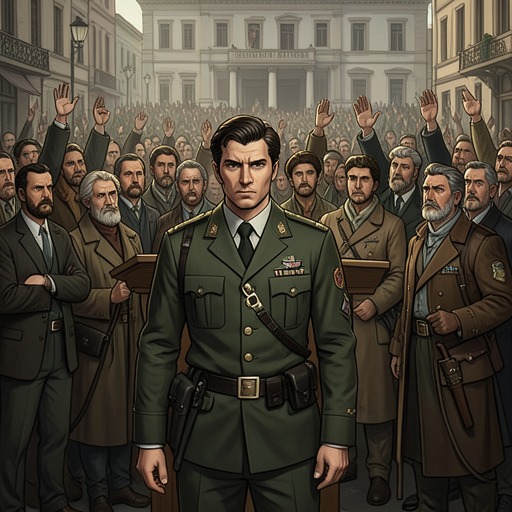
At eighty, Giolitti was described as more than six feet tall, nearly 200 pounds, and marked by an enormous grenadier mustache. He had served five times as prime minister and dominated Italian political life for roughly three decades. The portrait is not only physical: he is characterized as a patriarchal figure, practiced in parliamentary maneuvering, ministerial bureaucracy, and the art of what could be achieved through compromise. The narrative casts him as a politician of an entire epoch rather than a passing season.
His political standing had once seemed finished. Giolitti had firmly opposed Italy’s entry into the First World War in 1915, when nationalists attempted to storm his home. Yet his long experience of political bargaining kept him consequential. In June, as Francesco Saverio Nitti’s government fell amid hunger and the threat of socialist revolution, Giolitti’s moment returned. The account frames his renewed importance as a consequence of crisis: when conflict threatened to overwhelm the parliamentary system, the veteran negotiator again appeared capable of arranging an alternative.
The Turin Factory Settlement
The workers’ occupation of factories brought Giolitti’s method into sharp relief. Socialist leaders again deferred the revolution. Turin’s labor leaders feared that taking the struggle beyond the factories and into the streets without wider support would leave them exposed to defeat. Although workers possessed weapons, they believed those arms could withstand little more than ten minutes of fire. The General Confederation of Labour referred the decision to the Socialist Party leadership, which continued to postpone action. In this impasse, Giolitti’s political opening emerged.
Industrialists pressed him to suppress the occupations by force. He refused, reasoning that economic grievances lay behind the strikes and that a bloody intervention was not the answer. When Giovanni Agnelli reproached him for failing to act against the workers, Giolitti answered with a sardonic scenario: he could station artillery outside the gates of Fiat and order it to fire on the factory. The point of the retort was not a threat to the workers so much as a demonstration of what force would mean for the owners as well.
Giolitti instead brokered a settlement at the Hotel Bologna in Turin. Agnelli, De Benedetti, and Pirelli granted wage increases and improvements in working conditions, along with promises of worker control and profit sharing. Giolitti intended the last two concessions to remain promises. In exchange, the workers agreed to return the factories. The outcome preserved the distinction between economic gain and political power: workers won important material concessions, but the revolutionary challenge was relinquished. The narrative describes the exchange as a political defeat purchased with a limited economic victory.
Fiume and the Fascist Calculations
Giolitti’s influence also reached the crisis over Fiume, where military pressure and diplomacy proceeded together. While Benito Mussolini revised an insurrectionary plan that had initially assigned sweeping authority to Gabriele D’Annunzio, he knew that Giolitti was gathering troops near Fiume and negotiating with Yugoslavia. Mussolini’s revised arrangement assigned the organization of volunteer forces to the Fascist movement’s central committee. He also made a coup or march on Rome conditional: it would be risked only if negotiations produced an unjust settlement of the Adriatic dispute.
The episode distinguishes Giolitti’s actions from the uses others made of his possible return. He was not simply a name invoked in speeches; troop movements and negotiations made his government’s choices consequential to the Fiume question. At the same time, Mussolini’s conditional plan treated a diplomatic outcome as a possible trigger for insurrection. Giolitti’s combination of state power and negotiation therefore formed part of the strategic environment in which both D’Annunzio and Mussolini operated.
The 1922 Crisis and Mussolini’s Timing
As Fascist power expanded, Giolitti’s anticipated return became a central fear among its leaders. Italo Balbo worried that parliamentary parties might entangle the movement in electoral maneuvers and eventually join liberals and socialists against it. Mussolini argued that a march on Rome had to come at once, insisting that his negotiations with Luigi Facta were a diversion. He warned that a reconciliation between Giolitti and D’Annunzio, or Giolitti’s return to government, would alter the political balance. For the Fascists, Giolitti represented the possibility that the state could again be made effective through parliamentary compromise.
Mussolini’s dealings with political rivals and prospective partners were deliberately multiple. Through Milan prefect Alfredo Lusignoli, Giolitti was among those approached as the crisis unfolded; at the same time, Mussolini reassured Lusignoli that he preferred an arrangement with Giolitti, discussed five ministerial portfolios with Antonio Salandra, and received emissaries from Nitti. These overtures did not amount to a settled coalition. The narrative presents them as part of a strategy to delay, keep alternatives in play, and bring the crisis to a point at which a Fascist government would appear unavoidable.
The timing mattered. If Luigi Facta resigned too early, another government might form without the Fascists; if the Fascists waited too long, their military bluff might be exposed. Mussolini presented himself as the only person able to suppress the squad violence, while also relying on that violence to create the conditions for his entry into government. Giolitti’s potential return was one reason the Fascists feared delay: he was regarded as the statesman most capable of restoring authority through a ministerial compromise.
When the coup threat became immediate, the government received notice that the Fascists were preparing an action for the night of October 27. The options relayed from Milan included overwhelming them with numbers, suppressing them by force, or ignoring them. Shortly after six in the morning, Facta sent written orders for Rome’s defense; arrest orders followed, then the drafting of a state-of-siege telegram, and at 8:30 a.m. a manifesto appeared in the streets. A later reflection in the narrative considers whether Giolitti in government might have made the Fascist advance less easy, while stressing that a state determined to defend itself could prevail. Its stark conclusion is that the Italian state no longer existed in that effective sense.
Parliament and Political Afterlife
After Mussolini entered government, the Chamber was crowded with senators, diplomats, former deputies, and members of the public. During a break, parliamentarians urged Giolitti to protest in defense of the Chamber’s dignity. He declined, replying that the Chamber had the government it deserved. The answer is presented as a judgment on the institution as well as a refusal to intervene on its behalf. Later, Mussolini entered a formal gathering after the knights of the Order of the Annunziata, senators, and deputies; Giolitti did not greet him. Mussolini attached himself to a group of ministers rather than remain isolated.
Giolitti’s significance persists even when he is not the actor driving a later parliamentary confrontation. As opposition to the government grew, Giacomo Matteotti challenged restrictions on press freedom, support for the government weakened in successive votes, and Sem Benelli called for either Fascism to step down or the state to resign. The possibility of political succession reopened. Against that erosion, Giolitti’s earlier presence stands for the alternative the narrative repeatedly tests: an experienced parliamentary state capable of bargaining, resisting violence, and commanding obedience. His career demonstrates the reach of that method; the crisis demonstrates that experience and compromise could not, by themselves, guarantee that the state still had the power to act.