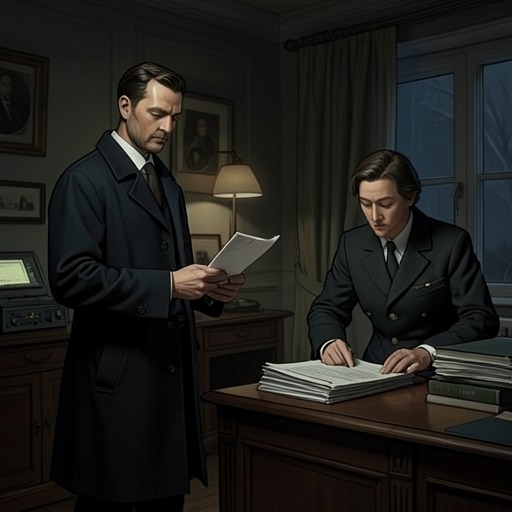
Italian Interventionism
M: Son of the CenturyItalian Interventionism was first a position on the First World War: Italy should enter the conflict rather than remain neutral. In the postwar politics depicted here, it became more than a retrospective defense of intervention. It offered Benito Mussolini a political identity linking his rupture with the Italian Socialist Party to the claims of veterans, patriotic left-wing groups, and a new movement seeking a place in national politics. Its significance lies in that unsettled inheritance: interventionism could be presented as a progressive mass politics, a defense of the nation, and a basis for alliances, but those purposes did not remain easy to reconcile.
From socialist neutrality to intervention
Before the war, Mussolini had risen within official socialism to become editor of Avanti!, the newspaper that guided the party. He was respected and loved by many comrades, and was regarded as unusually able to interpret the outlook of the proletariat. His conversion from a fervent advocate of absolute neutrality to an equally fervent advocate of intervention therefore registered as a betrayal to former allies. The account cautions against reducing the change to personal self-interest: it leaves open how far his convictions were altered by the financial demands of sustaining his new newspaper, Il Popolo d’Italia, his dealings with political factions, and the hostility directed at him by his former followers. It also presents his socialist identity as unresolved; Mussolini continued to want to appear, and perhaps to think of himself, as a socialist even after the break.
The political cost of that break became plain after the war. The Italian Socialist Party expelled Mussolini and branded him a traitor, while the mass demonstrations of Workers’ Day in 1919 showed the strength of a working-class movement that despised veterans and interventionists. The burning of Avanti! by fascists further severed his remaining ties with his old comrades. Efforts to gather left-wing interventionist factions into a constituency had failed, and the Fasci Italiani di Combattimento remained small, with only a few hundred adherents scattered across Italy. Interventionism had supplied Mussolini with a cause, but it had not yet supplied him with a secure political base.
A program for the postwar movement
At a March 1919 meeting of interventionists, Mussolini outlined a set of principles for the action of the fasci. They would affirm the war and those who had fought it; argue that imperialism was not peculiar to Italy; oppose foreign imperialism when it harmed the country; reject Italian imperialism directed against other nations; and contest elections on the war issue against parties and candidates hostile to the war. The proposals were approved after several speakers had addressed the gathering, which represented multiple Italian cities. This platform made interventionism a political program rather than only a memory of the decision to fight: it joined recognition of veterans to national claims while trying to distinguish those claims from a simple endorsement of conquest.
That platform sat within the stark postwar world the book describes. The returned veterans numbered in the millions, alongside the memory of millions killed; established politicians seemed exhausted by war and unable to avert further crisis. In this setting, veterans could be imagined as a new political force, and interventionism as a way to speak for those whom prewar party politics had failed. Yet the appeal depended on a difficult combination: it invoked the war as a source of legitimacy while addressing a country divided over its meaning and consequences.
The search for allies and the electoral test
In July 1919, as a general strike approached, Mussolini opposed the strike and condemned its organizers, while continuing to pursue cooperation with left-wing interventionists. On the eve of the strike, exiles from official socialism and radicals of the patriotic left gathered at the Liceo Beccaria in Milan. Mussolini proposed social and economic reorganization centered on workers’ welfare but free of Bolshevik influence, and suggested that the factions might overcome their divisions and run together in the November election. For a moment, the prospect of an electoral coalition seemed plausible.
At the same time, the Fasci were establishing a relationship with state authority. On Mussolini’s instructions, Michele Bianchi had reached an agreement with Milan’s prefect to make the fasci available for maintaining public order. The prefect also relayed a confidential government circular urging fascist collaboration against revolutionary attempts, including violent repression, on condition that the groups accepted the authorities’ command. The episode exposed the unstable position of interventionist politics: a movement presenting itself as a force outside the old parties could also be enlisted by the liberal state to resist the revolutionary left.
By late October, the alliance with the interventionist left was again in doubt because its leaders did not want Mussolini on their electoral list, fearing a reaction from socialists. Mussolini had spent months arguing that fascism should not support the governing bloc, liberals, democrats, or nationalists; he had portrayed it as a dynamic movement that would renew politics and bring the masses into public life. When Umberto Pasella made clear that the alliance might fail, Mussolini reversed course and argued against it. He said he could not accept exclusion from an interventionist list when he had been the movement’s prophet and had suffered for intervention, including police beatings and fifty-six mortar fragments received during the war. The personal and political claims had become inseparable: he presented his own body and history as the embodiment of the interventionist left. The audience remained unconvinced, and challenged why he had not made the same case two days earlier.
From interventionist inheritance to national rebirth
The movement’s later language broadened the meaning of its wartime inheritance. In January 1920, Gabriele D’Annunzio contrasted the passion and youthful promise he associated with Fiume to the weary negotiations at Versailles. His account placed the dead behind the living and the unborn before them, turning the memory of war into a promise of national renewal. The contrast helps clarify the larger political atmosphere in which interventionism operated: the war could be remembered both as sacrifice and as an unfinished national project. D’Annunzio’s rhetoric was not identical to Mussolini’s program, and the account notes that Italians did not simply follow him, but it shared the effort to make wartime experience a source of postwar political authority.
At the founding of the National Fascist Party, Mussolini recast that inheritance within a much wider vision. He described fascism as a synthesis capable of absorbing liberalism after violence had displaced older methods, and presented national unification, imperial ambition, and the conquest of the masses as parts of its future. The emphasis had moved beyond intervention as a single wartime question. Its legacy now helped authorize a politics that promised to turn regional populations into a nation and the nation into a state, while treating the war’s veterans and dead as part of a story of collective rebirth. The concept’s trajectory is therefore not a simple continuation of its original platform: interventionism gave the postwar movement a language and constituency, but its political meaning changed as fascism sought power, allies, and command over the state.