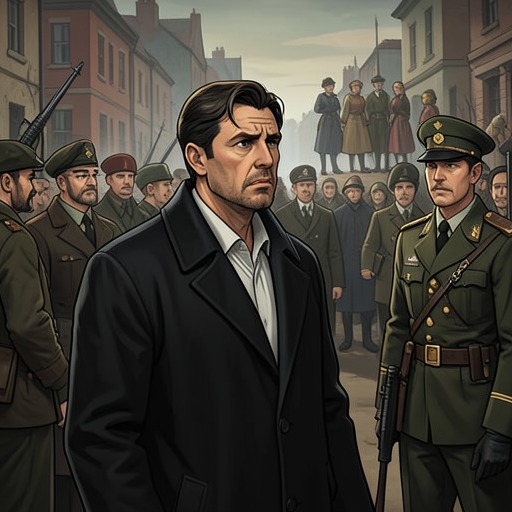
Italian Proletarian Revolution
M: Son of the CenturyThe Italian Proletarian Revolution was a postwar political project that joined the socialist promise of workers’ rule to mass meetings, strikes, factory occupations, and rural organization. It mattered not as one completed uprising but as an expectation that repeatedly gathered force and was repeatedly deferred. Its central tension was visible throughout: workers and peasants developed substantial capacity to organize daily life and production, while socialist leaders disagreed over whether, when, and how to turn that capacity into a seizure of political power. Meanwhile, Fascist groups mobilized against the socialist movement with increasingly organized force.
Origins and Revolutionary Expectation
The prospect of revolution took shape amid the unsettled aftermath of the Great War. The return of five million soldiers, widespread political disillusionment, and the continued presence of war in public life made the old political order appear vulnerable. In this atmosphere, the Italian Socialist Party’s congress in Bologna adopted a maximalist platform inspired by the Bolshevik Revolution and revised the party’s program. It named Nicola Bombacci secretary, placing a prominent advocate of a Soviet republic at the center of the party’s public hopes.
At a vast rally in Bologna, Bombacci hesitated before declaring that revolution was near. His hesitation reflected a real strategic dispute, not simply a lack of enthusiasm. Socialist leaders differed over whether force was historically necessary, whether conditions were sufficiently certain, and whether the party should test its strength before attempting a decisive move. Filippo Turati warned that socialist forces were poorly prepared in comparison with their adversaries, while other leaders urged delay or treated the prospect more cautiously. The book emphasizes the gulf between socialist leadership and opponents shaped by wartime experience: revolutionary symbols and speeches did not by themselves close that gulf.
The expectation nonetheless had powerful emotional and political foundations. Reports of deaths in clashes, including those of the peasant Rosa Vagnoli and the socialist tram driver Giovanni Cerea, reinforced the belief among militants that the postwar settlement remained a truce rather than a durable peace. At the Bologna rally, Bombacci invoked these losses and promised that a revolution would force the king from power within a month. The promise condensed grief, party faith, and confidence in an approaching break into one dramatic declaration. The party’s adopted program also stated that workers might use force to defend themselves, acquire power, and establish a transitional proletarian regime.
Organization in the Streets and the Countryside
The revolution’s potential rested on more than speeches. During the 1919 socialist demonstration in Milan, a large procession moved toward the city center. A smaller counter-demonstration formed around Filippo Tommaso Marinetti, and troops and Carabinieri separated the opposing crowds. After the cordon opened, a brief clash followed: demonstrators threw stones and clubs, while officers, Arditi, and Futurists fired first into the air and then toward the socialist column. The marchers fell silent. The scene set the socialist promise of collective liberation against opponents whose experience of organized killing had been shaped by years at war.
In 1920, workplace disputes made the prospect of revolution tangible. At Fiat in Turin, workers resisted the government’s extension of daylight-saving time, asserting control over their working time against the authority of Senator Giovanni Agnelli. An industrial lockout helped precipitate a ten-day general strike involving 120,000 workers in Turin and its province; 60,000 occupied factories. The immediate dispute concerned the clocks, but the larger conflict concerned who would control work and authority. Socialist leaders condemned or declined to support the action as a decisive path to power, exposing the gap between workers’ willingness to act and the party’s readiness to lead them.
That gap also appeared in the countryside. In Emilia, socialist organizations controlled 223 of 280 municipalities. The leagues organized hiring, work shifts, threshing, seed supplies, and crop decisions, presenting collective control as a response to seasonal insecurity: farmhands averaged only 120 days of work a year. In Ferrara, 81,000 people belonged to the leagues of proletarian unity by mid-May 1920. Their spring victories secured wage increases, labor-managed hiring, and employment quotas requiring landowners to hire five workers for every thirty hectares during months when little agricultural work was available. This was a material basis for socialist power, but the system also depended on enforcing shared rules and excluding those who undermined them. The revolutionary project therefore took shape in practical struggles over employment, food, land, and the organization of production—not solely in the language of political doctrine.
The Factory Occupations and the Decision to Wait
During the factory occupations, workers maintained production for thirty memorable days despite the absence of bank financing, raw materials, and technical guidance. Workers organized surveillance shifts, guarded equipment and supplies, and prohibited alcohol during factory shifts. The episode demonstrated disciplined collective capacity: workers acted not merely as laborers but as organizers responsible for keeping industrial processes functioning. In the narrative, this achievement makes the subsequent retreat especially consequential. The workers had shown that they could govern production; they had not obtained agreement among their leaders to carry the struggle into a broader contest for state power.
Turin’s labor leaders feared that acting beyond the factories would leave them isolated and overwhelmed. The General Confederation of Labour referred the decision to the Socialist Party leadership, which did not authorize a decisive move. Giovanni Giolitti’s opportunity followed this postponement. The revolutionary moment thus appears neither as a simple defeat in battle nor as proof that workers lacked organization. It was also a political choice made amid doubts about military strength, responsibility, and the risk of acting without wider support.
Claudio Treves gave this delay a longer historical frame in Parliament. He described revolution as a drawn-out process, unfolding through gradual erosion and sudden shifts rather than through one conclusive day. This account contrasted with Bombacci’s recurring declarations of imminent transformation. In April, after returning from Denmark, Bombacci again attacked parliamentary caution, arguing that revolution should proceed independently of Parliament and in opposition to it. Yet the book presents his confidence as increasingly detached from material developments: the councils he envisioned risked becoming an abstraction while the expected revolution receded.
Countermobilization and Unfulfilled Promise
Socialist organization also faced opponents building their own networks and methods. In Bologna, the Fascist organization had dwindled to six members after republican founders left, and it lacked the money to rent an office. Benito Mussolini nevertheless urged Leandro Arpinati to take charge and organize civic-defense militias amid strikes. In the countryside around Ferrara, socialist leagues had become influential across villages, while disputes over labor rules and landowner authority sharpened the conflict. These circumstances made organization itself a contested resource: the same local instability that could strengthen socialist mobilization also gave Fascists an opening to present armed intervention as a response to disorder.
That intervention became more coordinated. A Fascist punitive expedition launched from Ferrara on January 23, 1921, was organized to strike several rural targets at once, using trucks supplied by the Agrarian Association. In May, thousands of impoverished farmworkers marched into Ferrara overnight, and the city awoke occupied by an estimated 50,000 people. The carefully arranged mobilization included the cutting of telephone lines, the use of schools for accommodation, and the closure of shops and businesses. These actions were not the realization of the socialist revolution: they showed how mass organization and control of public space could be redirected into a Fascist demonstration of power.
The Labor Alliance later called a general strike to defend political and union freedoms, describing it as a final collective stand. Its announcement was disclosed early, disrupting preparations. Fascist leaders issued an ultimatum to the state, claiming the right to act if it failed to assert its authority. The episode exposes a decisive asymmetry: socialist leaders had repeatedly postponed a unified transfer of power, while Fascist organizers used the crisis to challenge the state and expand their own claim to authority. In the book’s account, the Italian Proletarian Revolution remains a powerful but unrealized horizon—made credible by workers’ and peasants’ capacity for collective action, yet frustrated by leadership hesitation and overtaken by the increasingly organized forces mobilized against it.