January 3, 1925
M: Son of the CenturyJanuary 3, 1925, marks a decisive parliamentary confrontation: Benito Mussolini publicly assumed political, moral, and historical responsibility for Fascist actions while presenting strength, rather than negotiation or a vote, as the answer to the crisis. Before a Chamber of Deputies crowded with supporters and opponents, he invoked the statute of the kingdom and then recast accusation as a challenge to his enemies. The session ended without debate or a vote, leaving his warning of action in the provinces as the speech’s unresolved consequence.
The Chamber and the crisis
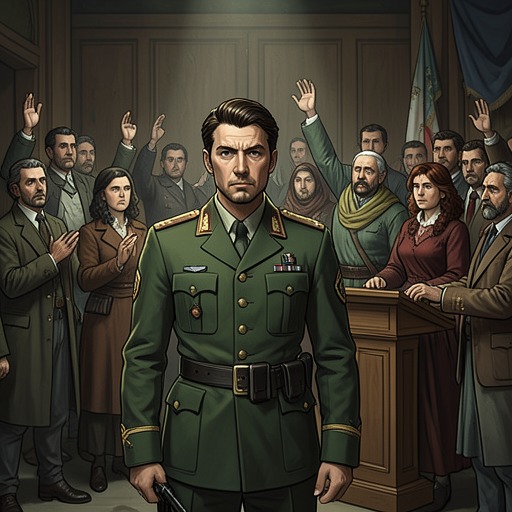
The scene is set in Rome at three in the afternoon, in the Chamber of Deputies at Montecitorio. The hall is packed from its center to the far right, but the vacant benches on the left give the assembly a visible imbalance. Most of the opposition deputies associated with the Aventine secessionists are present, though they are concealed among the spectators in the galleries. Their physical presence does not translate into parliamentary participation: the empty seats remain a mark of the opposition’s withdrawal from the chamber.
Below, the atmosphere is noisy and openly partisan. Francesco Giunta jokes with Alfredo Rocco at the presiding bench; a deputy calls out a patriotic slogan, Roberto Farinacci answers with a Fascist one, and the blackshirts sing Giovinezza. The gathering is full of applause, shouting, and song, yet no one speaks. This contrast matters to the encounter: the chamber is crowded, but the ordinary work of parliamentary debate has stalled. The scene’s tension comes not from a vote underway but from the question of whether the prime minister can be made to answer politically for the violence and disorder surrounding Fascism.
A refusal to seek a vote
Mussolini dismisses the ritual applause with a wave and takes his place at the presidency bench. When Rocco gives him the floor, he adjusts his tie, a habitual gesture, and begins by denying that his address is a conventional parliamentary speech. He says he is not asking the deputies for another political vote. The refusal establishes the terms of the encounter: he will speak to his adversaries from the position of prime minister, not negotiate with them for a parliamentary decision.
He then picks up the deputies’ manual containing the kingdom’s statute. The book focuses the chamber’s attention on a specific constitutional mechanism. Referring to Article 47 of the Statuto Albertino, Mussolini states that the Chamber of Deputies can bring charges against the king’s ministers and submit them to the Supreme Court of Justice. He asks whether anyone in the chamber, or outside it, intends to use that provision. The gesture turns the statute into a challenge: rather than evade the possibility of prosecution, he places the legal route before his opponents and demands that they act on it.
The declaration of responsibility
Mussolini’s central declaration shifts the speech from legal challenge to political commitment. He says that he alone accepts responsibility for what has happened, expressly including political, moral, and historical responsibility. He makes this claim conditional on the charge being true: if Fascism is understood as a movement of coercion and criminality rather than as the patriotic ardor of its young adherents, he says, the blame is his and he is its leader. The formulation does not specify an individual order or resolve the particulars of responsibility. Instead, it gathers the accusations against Fascism into a claim he is willing to own publicly.
The chamber does not interrupt him. The response is a roar of support from those present, which the narrative presents as devoted and enthusiastic. That acclamation answers the speech politically even though no formal vote occurs: the supporters affirm Mussolini while the opposition does not rise to stop or challenge him in the chamber. He then describes the conflict as one in which strength is the only solution. His appeal to force follows directly from his refusal to bargain and his provocation over Article 47; the speech presents coercive action not as a departure from politics, but as the means by which the deadlock will be broken.
The warning and its unresolved outcome
Mussolini promises that the situation will be made clear within forty-eight hours, using the phrase in all provinces. In the account, this deliberately administrative and geographically sweeping expression falls over the Chamber of Deputies with the weight of a tombstone. It gives no detailed account of what measures will follow, but it makes the threat broader than the chamber itself. The warning thus transforms the speech’s ambiguity into a political signal: the response will be visible throughout the country, while its specific form remains unstated.
The session ends without discussion or a vote. The deputies are to be summoned again by telegram, so the speech produces no immediate parliamentary resolution. After the Fascist ovations subside and the hall gradually empties, Mussolini remains alone at the presidency desk for a long time. That final image separates the public performance from its uncertain aftermath: he has claimed responsibility, confronted his opponents, and promised action, but the chamber has neither judged that claim nor determined what comes next.
The speech in the book’s political arc
The event gathers together themes that recur elsewhere in the narrative. In its account of postwar Italy, returning soldiers confront an exhausted political order, while war remains imaginable as a continuing force rather than a concluded episode. In Mussolini’s later programmatic language, Fascism promises to make Italians into a unified nation and state, and presents national renewal as a movement toward expansion. At a commemorative gathering, the growth from small groups to legions is described as a resurrection and as the transformation of a people into a nation. These earlier formulations connect youth, unity, and national rebirth to the promise of a new political order.
The January speech brings that language of regeneration into contact with a concrete institutional crisis. The earlier image of Mussolini as the arbiter who would impose order on chaos is echoed by his claim that strength alone can resolve an unyielding struggle. But here the question is no longer only what a new movement promises: it is what the prime minister will do when the opposition seeks accountability. His public assumption of responsibility and his warning to the provinces leave that question hanging. The speech is therefore a hinge in the narrative, joining Fascism’s claims to national renewal with an explicit refusal to let parliamentary procedure determine the outcome.