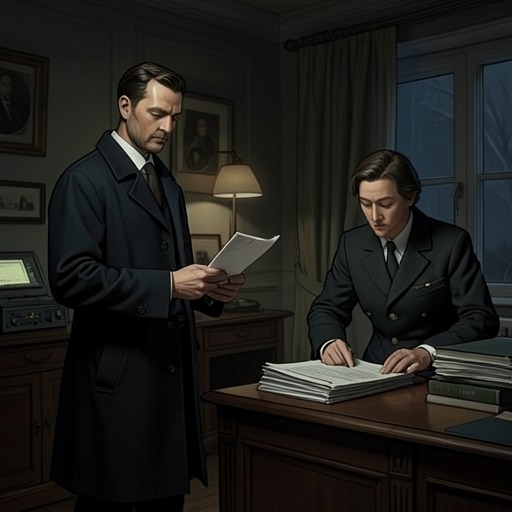
Kursaal Diana
M: Son of the CenturyKursaal Diana was a theater within a recreational and cultural complex in Milan, a place where operetta and dance drew audiences across social lines. Its performance hall became the setting of a bombing that killed twenty people and wounded eighty, and its aftermath transformed the venue from a site of shared entertainment into a focus of political accusation, retaliation, and public display.
Entertainment and Audience
The Kursaal Diana offered the pleasures of operetta: comic plots, parody, elaborate scenery, lively music, and dances that carried the story as much as the dialogue. The audience included bourgeois patrons drawn to the familiar spectacle and visitors from the masses, who also flocked to the complex. On the night of the bombing, the attraction was Franz Lehár’s The Blue Mazurka, a popular dance piece whose measured, sharply accented steps linked the refined world of Viennese-style entertainment to a dance enjoyed by poorer audiences.
The performance began late after an orchestra member was dismissed. His colleagues protested, and he was reinstated; the evening then proceeded to the fifteenth and final reprise of the operetta. That small labor dispute sits immediately before the catastrophe in the account, but the evidence does not establish a connection between it and the attack. Its place in the scene instead emphasizes how ordinary disputes and familiar routines continued inside the hall until violence abruptly broke their course.
The Bombing
The bomb appears to have exploded at the end of the first act. The damage was concentrated near the performers’ entrance on the Via Mascagni side, where debris filled the street and the stage could be seen through broken window frames. Royal guard patrols cleared a route toward Via Melzo while Bersaglieri sent from police headquarters formed a guard outside the partly shuttered entrance. Firefighters worked to extinguish the flames, and rescuers carried the injured and dead from the wreckage.
The immediate response extended beyond the theater. Porta Venezia’s nearby clinic filled with dead and seriously injured people; ambulances took others to more distant centers, while residents opened their homes to those needing care. Relatives gathered at what remained of the entrance, and reporters documented the scale of the disaster for the morning papers. The account gives the toll as twenty dead and eighty wounded, at least thirty of them seriously. These details place the venue within the neighborhood as well as within the city’s public life: the response depended on nearby medical care, emergency services, residents, and the crowd that gathered in the street.
Attribution and Political Reversal
The first explanation fastened on anarchists. Errico Malatesta, their historical leader, was in prison in Milan and had been on hunger strike; small bombs had also been exploding elsewhere. Some survivors reportedly said they had seen an anarchist throw the bomb toward the stage, but the narrative itself treats that claim as likely false. It presents the attribution as politically charged rather than securely established. The possibility that the intended target was police chief Giovanni Gasti, who lived above the adjoining Hotel Diana Majestic and had met Benito Mussolini there, is likewise presented as a likelihood, not a confirmed motive.
Fascists who came to the scene spoke of retaliating against socialist, labor, and anarchist institutions. Mussolini neither discouraged them nor urged them on; he remained at the site as they departed. The account makes the bombing a turning point in political presentation: Mussolini’s newspaper insisted that Fascists fought openly and did not attack theater audiences, setting their violence against the terrorism attributed to their enemies. The venue thus became more than the location of an attack. It furnished a setting in which competing claims about legitimate and illegitimate violence could be staged, even as the perpetrators’ identity remained uncertain in the evidence presented.
Funeral and Public Memory
The funerals took place on Easter Monday, five days after the bombing, because agreement over the ceremony could not be reached immediately. Milan’s socialist municipal leadership offered to organize funerals at the city’s expense, but citizen associations opposed socialist participation, associating socialists with the alleged perpetrators. The government eventually called for state funerals, with only the Italian tricolor displayed in mourning. The delay and the dispute over flags and organizers show that the tragedy did not suspend political conflict; it became another object of it.
At the Cimitero Monumentale, clergy blessed the dead before the procession moved toward the cathedral, led by mounted carabinieri and the 3rd Savoy cavalry. A column of two thousand Fascists followed the coffins in organized platoons. They had attacked the offices of Avanti! and the anarchist newspaper, presenting retaliation as their own answer to the dead. Their disciplined march through Milan, described as a working-class and red city, made the funeral procession a public display of growing Fascist presence. At the cathedral steps, Mussolini stood at the head of the squads as the archbishop blessed the bodies. In the narrative’s account, the Kursaal Diana’s destruction and the procession that followed mark a change in the city’s political landscape: mourning, accusation, and Fascist spectacle converged in the streets around the dead.