Leagues of Proletarian Unity
M: Son of the CenturyThe Leagues of Proletarian Unity were a mass rural organization whose influence in Ferrara extended well beyond collective bargaining. By coordinating agricultural labor and shaping the terms of production, they became a governing power in the countryside; their victories and controls, in turn, helped intensify the political conflict that Fascist organizers would exploit and confront with force.
Membership and political reach
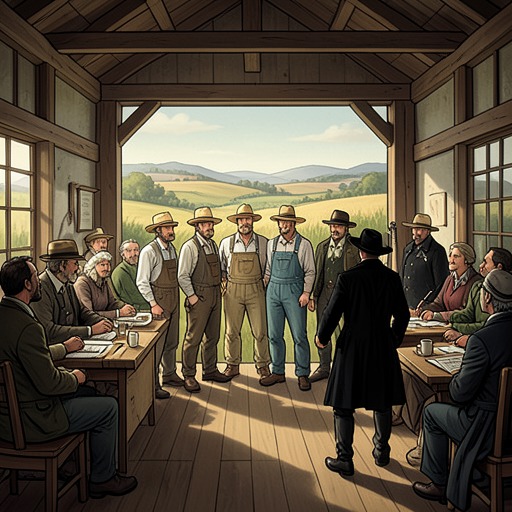
The Leagues brought together agricultural workers, tenants, sharecroppers, and small landowners. At their first congress, held by mid-May, they recorded 81,000 members—more than twice their membership ten years earlier. Their growth accompanied a sweeping socialist advance: in Emilia, the socialists controlled 223 of 280 municipalities, while in Ferrara the local party won all 54 municipalities in the November 1920 elections, receiving 10,185 votes against 2,921 for all the other parties combined.
The election victory was also made visible through occupation of civic space. After the first council meeting in the Estense Castle, leaders of the farmers’ leagues and the Ferrara Chamber of Labor held a banquet in the Government Room, placing the castle’s doorkeeper at the head of the table. The gesture asserted that institutions and symbols once associated with ruling elites could be claimed by the new political majority. Their authority was not merely electoral: the Leagues’ organization was embedded in the daily arrangements of rural work.
Labor, production, and local discipline
The Leagues’ power rested on their ability to coordinate employment. Their placement offices controlled hiring, while their influence extended to work shifts, threshing-machine operations, seed supplies, and decisions about planting. In Ferrara, seasonal workers and their allies won changes to the collective farm agreement after a strike suspended sowing of hemp and sugar beet, crops central to the provincial economy. By March 1920, landowners had accepted wage increases, worker-managed recruitment centers, and a compulsory hiring quota: five workers for every thirty hectares from November through April, when agricultural work was scarce.
These arrangements answered a precarious labor economy. Farmhands could find work for an average of only 120 days a year, making employment terms and wages matters of survival during the idle months. The Leagues sought to prevent landowners from bypassing their rules: fines were imposed on employers who violated the compulsory labor agreements, and those who undercut agreed wages could face boycotts and exclusion from local commerce. Their reach could also govern aspects of community life beyond the workplace. The account describes a league leader in Cona determining which feast days young people could dance and setting a calendar for puppet shows. Such examples show how organization designed to protect collective labor could become a comprehensive local authority, enforcing solidarity while narrowing room for dissent.
Electoral victory and contested authority
Ferrara’s November 1920 result made the Leagues’ broader political environment unmistakable. Their socialist allies secured every municipality in the province, and the red flag was raised on Saint Paul’s Tower at the Estense Castle. The leaders’ banquet inside the castle followed the council meeting and turned their electoral success into a public claim on the old seat of power.
That ascendancy also sharpened conflict with landowners and other opponents. The spring victories had allowed seasonal farmhands, then tenants and sharecroppers, to press for control over working conditions, wages, and even crop choices, leaving landowners with little more than the provision of capital. In the surrounding political crisis, a massacre of peasants was followed by a three-day general strike across the province. Farmers, manufacturers, merchants, professionals, public employees, and homeowners then organized the Bolognese Association of Social Defense, whose delegation told Prime Minister Nitti that it was prepared to replace the state in defending its members. This response was directed at a wider climate of socialist power and violence, not simply at the Leagues as a single organization, but it marked the hardening of organized opposition to the rural movement.
Fascist counter-mobilization
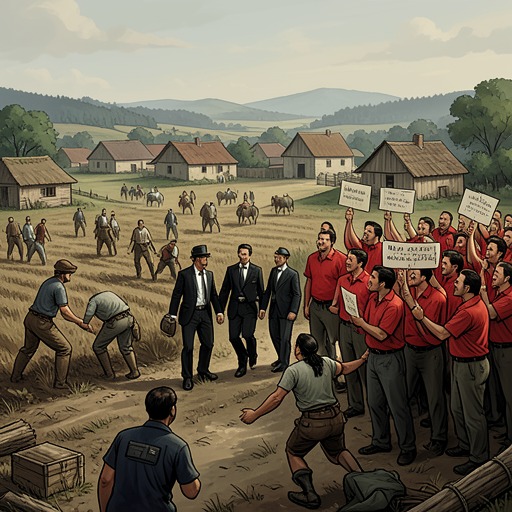
The Leagues became explicit targets of a new kind of Fascist action. On January 23, 1921, a punitive expedition set out from Ferrara to attack their organizations in San Martino, Aguscello, Cona, Fossanova San Biagio, Denore, and Fossanova San Marco. The operation was planned to strike several places at once, using armed men, surprise, and trucks supplied by the Agrarian Association. Its coordination represented a shift from scattered local clashes toward a deliberate campaign against the Leagues’ rural network.
The resources behind Fascist expansion exposed a competing structure of patronage. In the month after the Castello Estense massacre, numerous new Fascist sections appeared in the province; agrarians supplied material support, and by December 20 had contributed 20,000 liras to Fascist funds. The resulting contest was therefore fought not only over political doctrine but through money, organization, and control of rural life. In May, Italo Balbo’s Fascists mobilized tens of thousands of impoverished farm laborers from the countryside into Ferrara, demonstrating their own capacity to organize the rural population. The Leagues’ achievement had been to make collective organization a source of political power; their opponents answered by building a rival mass mobilization and directing organized violence at the institutions that sustained that power.