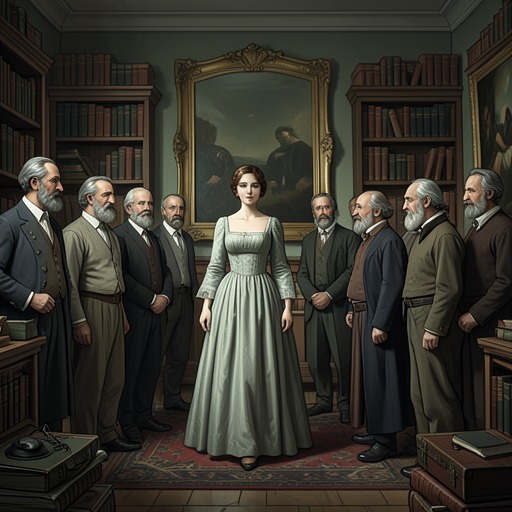
Luigi Pirandello
M: Son of the CenturyLuigi Pirandello appears as a celebrated playwright whose public praise helped give cultural prestige to Benito Mussolini’s first year in power. In the book’s portrait, his ideas about masks and the making of reality lend an especially charged resonance to his endorsement of Mussolini’s political project.
Playwright and Public Figure
Pirandello is introduced as the brilliant author of Six Characters in Search of an Author, a play highly regarded by Benito Mussolini. The book connects the work’s revelation that every person is only his own mask to Pirandello’s later public reflections on reality and its creation. He is presented not only as a major artist but also as one of the prominent figures who joined the chorus celebrating the new regime.
Visit to Palazzo Chigi
Before leaving for America, Pirandello went to Palazzo Chigi to pay his respects to Mussolini. The visit occurs amid a broader account of public approval for the regime’s first year: liberal philosophers, artists, and other influential figures are described as welcoming Mussolini’s rule. Pirandello’s appearance makes that cultural endorsement concrete, placing the playwright in person among those honoring the Leader.
The Interview and the Making of Reality
In an interview published by La tribuna di Roma on October 23, 1923, Pirandello stated: “I have always had great admiration for him, and in fact I believe I am among the few capable of understanding the beauty of this continuous creation of reality that Mussolini is achieving: an Italian and fascist reality that is not conditioned by the reality of others. Mussolini knows, as few do, that reality lies only in the power of a man to construct it, and that it is created only by the energy of the spirit.” The statement presents political reality as something made through will and creative energy, rather than simply received from the world beyond it. Set beside the book’s account of Pirandello’s interest in masks, this praise gives his public support a particular irony: the playwright associated with the instability of identity celebrates a leader’s effort to construct a unified national and fascist reality.