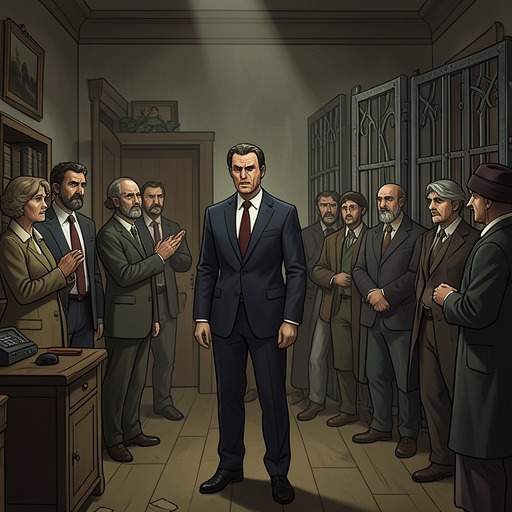
Macchia della Quartarella
M: Son of the CenturyMacchia della Quartarella, a densely wooded area near Via Flaminia, became nationally consequential when Giacomo Matteotti’s remains were discovered there in August 1924. The forest’s hidden clearing and hurriedly prepared grave gave physical form to the effort to conceal his killing; the discovery sent shock waves through Italy and helped turn the site into a place of public memory.
The wooded setting
The Macchia was a deep, thickly vegetated wood separated from the road by a substantial fence. Tall trees and thorny undergrowth concealed a ravine farther inside. Between the wood’s western edge and the ravine lay a small clearing containing an abandoned charcoal cellar, invisible from the road and surrounded by brambles and oak trees. Its seclusion made the clearing difficult to see from outside, but also placed it within reach of those who knew the terrain.
Ovidio Caratelli, a brigadier in the carabinieri who was staying with his family in Riano Flaminio, knew the surrounding woods from childhood hunting trips. One evening, his dog began pawing at the ground near the clearing. It was already dark, so Caratelli went home. The next day, as they approached the Quartarella again, the dog ran through the brush to the same spot and resumed digging.
Discovery and investigation
Caratelli probed the leaf-covered ground with a stick. When it sank into soft soil, he kicked at the earth; its condition prompted him to clear more of the surface. The excavation exposed human remains. Giacomo Matteotti was found in an advanced state of decomposition, folded into a grave too short for the body. A coarse metal file left standing in the ground marked the burial; it was also the tool used to dig the grave.
Investigators recorded the grave’s exact setting: a clearing formerly used as a charcoal pit in Quartarella Wood, opposite Via Flaminia at kilometre post 23 from Rome, between Riano and Sacrofano. The shallow, oblong pit measured from 0.40 to 0.75 metres across, reached a maximum length of 1.20 metres, and was no more than 0.45 metres deep. The medical examiner concluded that the grave had been dug hastily and was too small, and that the body had been forced into it. Two gold teeth helped confirm that the remains were those of Matteotti.
The remains could not establish a precise cause of death. The examination report considered a wound to the upper left chest likely, based on blood on the jacket found nearby, but the absence of internal organs and of other clothing limited what could be determined. The distinction between physical evidence and inference remained important: the grave and the identification were documented, while the exact circumstances of death could not be established from the remains alone.
A discovery that reached the country
Carabinieri continued searching the surrounding soil. Before evening, a crowd with flashlights had gathered at the edge of the woods; deputies of the Unitary Socialist Party were among the first to arrive. Filippo Turati pressed a handkerchief to his face, his reaction caught between grief and revulsion. The clearing, hidden from the road, had become the focus of a public confrontation with what had been concealed there.
Reports of the grave and the treatment of Matteotti’s body drew intense press attention. The depositions of Carabinieri captain Domenico Pallavicini and Caratelli, who had found the jacket, contradicted one another, prompting suspicions that the discovery had been manipulated. Those doubts persisted alongside the emotional force of the find. During the night, posters of Benito Mussolini in the capital were marked with red paint, as the discovery’s impact spread well beyond the forest.
From hidden grave to public memorial
The site’s significance belongs to a wider pattern in which the book links burial places and objects to competing claims over national memory. In Rome, Gabriele D’Annunzio had presented Giovanni Randaccio’s bloodstained flag as a memorial to the war dead and to Italy’s territorial claims. At the burial of the Unknown Soldier, the unidentified body had instead served as a collective emblem of sacrifice. Macchia della Quartarella offered a starkly different setting: not a public monument or a ceremonial grave, but an obscure clearing where the attempt to hide a political killing was exposed.
On August 21, Matteotti’s remains were buried again, this time at Fratta Polesine, his home region. His wife, Velia, refused a political burial at Rome’s Verano cemetery. The procession from Monterotondo and the gathering of mourners at Fratta made the funeral a public event, but the chosen resting place was no longer the hidden forest or the capital. Macchia della Quartarella remained the place of discovery; Fratta Polesine became the place where his remains were returned to the earth and where the dead deputy’s memory was carried home.