Milan
M: Son of the CenturyMilan is the book’s recurring political stage: the city where the Fasci di Combattimento first gathered, where socialist and Fascist processions confronted one another, and where Benito Mussolini’s movement met both spectacular setbacks and opportunities to regroup. Its importance lies not in a single decisive scene but in the way its places register competing forms of power: a small rented meeting room, streets occupied by rival crowds, a newspaper office under attack, an industrial factory, and the elegant squares where political ambition sought a public audience.
A city of beginnings and uneasy scale
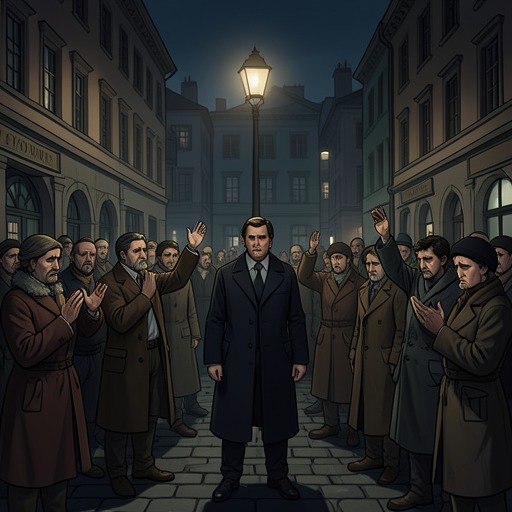
The narrative opens at Piazza San Sepolcro on March 23, 1919, in Milan, and immediately sets the movement’s claims against the modest circumstances of its first rally. The meeting had been advertised for weeks in Il Popolo d’Italia as a momentous occasion and was initially scheduled for the Teatro dal Verme, whose 2,000 seats promised a large public. That venue was canceled. Instead, the gathering took place in a meeting room at the Association of Traders and Merchants, with drab greenish-brown walls, Biedermeier armchairs, and a view over a desolate parish square. A few veterans and men associated with ordinary trades filled the room; an association member occasionally looked in from the back. The contrast between the promised event and its constrained setting makes Milan an early measure of Fascist aspiration: the movement announced itself in grand terms before it could command a grand audience.
The city’s political geography also connected speeches to organization. Only a few streets separated the editorial offices of Il Popolo d’Italia on Via Paolo da Cannobio, described as the number two lair, from the Milan section of the Arditi Association at 23 Via Cerva, the number one lair. In the spring of 1919, the book presents these streets as squalid and dangerous, not as neutral passages between institutions. They joined a newspaper operation to a veterans’ association, placing propaganda and organized militancy close together within the same urban landscape. The proximity gives the city’s political life a material form: offices and meeting places were near enough to be part of a shared neighborhood of mobilization.
Processions, confrontation, and the destruction of a newspaper
On April 15, 1919, Milan’s streets became the route by which a large demonstration changed character. In the early afternoon, several thousand people broke away from the enormous procession and marched along Via Orefici toward the Duomo. The demonstration moved from the stadium toward the piazza, and the narrative frames this turn as a rush toward revolution. It is a city scene shaped by momentum: an organized procession gives way to a breakaway march, and the urban route itself carries the crowd toward a more direct political confrontation.
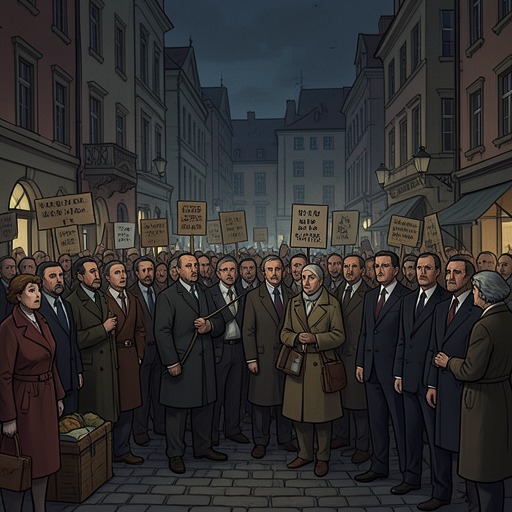
At Via dei Mercanti, a cordon of Carabinieri blocked the outlet and separated the opposing groups. Women led the socialist column, holding a portrait of Lenin and a red flag. They sang songs of liberation and marched for a better life for their children. Across the cordon stood a smaller cortege of men who had lived with killing during the war. The numerical imbalance did not erase the deeper contrast the scene draws between them: one group approached the street as a place for a hopeful demonstration, while the other brought a different, wartime familiarity with death. Milan’s public space thus held more than two political programs; it held opposing experiences of violence and different expectations of what a march could accomplish.
That confrontation extended from the street to the press. The Milan headquarters of Avanti!, the flagship newspaper of Italian socialism, stood on Via San Damiano, beside a canal. Toward evening, the attackers arrived to find the building defended by uniformed soldiers, but the defense was half-hearted; many activists had been the attackers’ commanders during the war. What began as a guarded building became a siege. The episode gives Milan’s newspaper offices a double significance: they were physical targets and symbols of a political movement. In the logic of the assault, defeating an enemy meant burning the enemy’s home, and the socialist newspaper became the city’s emblematic home to be attacked.
Electoral failure and political vulnerability
Milan also exposed the distance between street presence and votes. The city’s November 16 election brought a sweeping socialist result: 1,834,792 votes nationally and 156 elected parliamentarians. The Fascist ticket, by contrast, received only 4,657 votes among approximately 270,000 voters in the Milan district. Mussolini himself received 2,427 preferential votes, and no Fascist candidate was elected. The result was not a narrow defeat but a complete failure to convert the movement’s activity into parliamentary representation. For Mussolini, the setback also frustrated his expectation of becoming a deputy from Milan.
The aftermath made the city a setting for state action against the movement. After a raid on Fascist headquarters at 16 Via Silvio Pellico, a socialist delegation—Claudio Treves, Filippo Turati, Giacinto Menotti Serrati, and mayor Emilio Caldara—went to the prefecture. They demanded that the Arditi be banned from the city and the Fasci di Combattimento dissolved. Police agents then searched Il Popolo d’Italia and found 13 new revolvers of various calibers, 419 cartridges, and a recently used flare gun concealed in a stove. Umberto Pasella, Enzo Ferrari, and Filippo Tommaso Marinetti were arrested on accusations of threatening state security and organizing armed gangs. Mussolini was taken to San Vittore Prison, where he occupied cell 40 for twenty-four hours. In this sequence, Milan’s newspapers and headquarters are not merely symbols: they are searched, their contents become evidence, and the city’s political contest enters the machinery of policing and imprisonment.
Later returns: squares, factories, and spectacle
Mussolini returned to Milan’s public spaces with more deliberate attention to their form. For the only Milan-based electoral rally of the Fasci di Combattimento, he chose Piazza Belgioioso, an elegant square surrounded by neoclassical buildings. Its open side made it easier to defend against aggression. The decision followed an on-site inspection, and the square’s aristocratic character made it a markedly different setting from the cramped room of the first rally. The choice joined political display to security: the stage needed an audience, but the space also had to be defensible. At a later campaign rally on May 3, Mussolini spoke from the balcony of a private palace in the same square, which gave him satisfaction because its prince had refused to receive him two years earlier. The return transformed a former slight into a public vantage point.
Yet Milan’s political life was never confined to rallies or elite settings. At the Alfa Romeo Portello plant, an ultra-modern factory on the city’s northwestern outskirts, engineers prepared the launch of the postwar Alfa Romeo RL, a six-cylinder sports car with a two-seat Spider chassis. Executives and owners placed hopes in the red Torpedo, while workers invested their own hopes in the factory’s future. On September 1, they waved red flags bearing the hammer and sickle. The same industrial site therefore held competing expectations: commercial innovation for management and owners, and collective political aspiration for workers. The factory makes the city’s class divisions visible within the machinery of production itself.
The city’s cultural venues also entered the book’s account of political life. In the early months of a later year, Mussolini attended performances at La Scala and the Teatro Manzoni, appearing as a fashionable spectator; at La Scala, his tuxedo and canary-yellow shoes provoked notice among regulars. In another scene outside La Scala, a truck plowed into a crowd with the word Terror painted on its side. The juxtaposition places the opera house at the intersection of cultivated public life and political violence, without making the venue itself responsible for either. Across these episodes, Milan’s theaters, squares, workplaces, and streets become more than backdrops: they expose how political movements seek visibility, how crowds occupy the city, and how fragile the boundary can be between public spectacle and confrontation.