Milan Clashes and Burning of Avanti! Headquarters on 15 April 1919
M: Son of the CenturyThe Milan Clashes and Burning of Avanti! Headquarters on 15 April 1919 transformed a mass demonstration into an armed confrontation and the deliberate destruction of the leading newspaper of Italian socialism. The day joined street violence to an attack on the press: after socialist marchers were routed in Piazza del Duomo, assailants burned Avanti!’s Milan headquarters on Via San Damiano. Benito Mussolini, who had remained inside his newspaper office during the events, called the clash the first episode of civil war and ordered armed protection for his own paper.
Background and Participants
The action unfolded amid intense expectation of upheaval. Tens of thousands of proletarians had gathered at the Milan arena on the morning of 15 April, listening to inflammatory speeches and anticipating a possible cataclysm. In the early afternoon, several thousand demonstrators broke away from the main procession without a prearranged plan and proceeded along Via Orefici toward the Duomo. The protest spilled from the stadium into the streets, carrying the sense of revolutionary urgency into the city center.
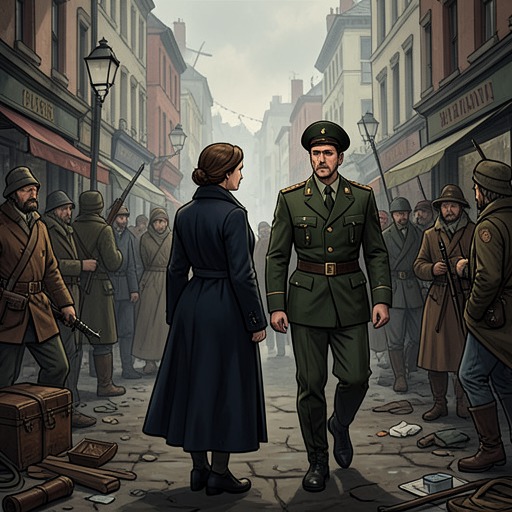
At Piazza del Duomo, Filippo Tommaso Marinetti addressed a mixed crowd of civilians, officers, university students, Arditi, and fascists. He urged bystanders to join the counter-demonstration and rejected the possibility of remaining neutral. The contrast between the two processions was stark: socialist marchers, led by women holding a portrait of Lenin and a red flag, sang songs of liberation and called for a better life for their children. Opposite them stood a smaller group of men accustomed to wartime killing. The narrative presents their different experiences of death as a gulf separating the factions before the fighting began.
The Clash in Piazza del Duomo
A cordon of Carabinieri blocked the outlet from Via dei Mercanti, briefly holding the opposing groups apart. Once the cordon opened, uniformed officers and Arditi advanced in small groups, revolvers in hand. The fighting lasted about a minute. Socialist demonstrators threw rocks and a few clubs; the officers, Arditi, and Futurists answered with gunfire, first into the air and then toward the procession.
The marchers initially held their ground, then fell silent and scattered in panic. As people sought shelter beneath the arches of the Loggia dei Mercanti, officers and Arditi advanced and assaulted demonstrators with clubs. The scene reversed the procession’s earlier movement and sound: a singing crowd became a mass trying to escape, while the armed counter-demonstrators remained on their feet. One young man on the ground held out a few lire, apparently hoping to buy mercy. Elsewhere, an Ardito climbed the equestrian monument and stabbed a communist demonstrator. The rally ended; Marinetti later returned to the monument, bruised and exhausted, but his subsequent speech was not remembered.
The Attack on Avanti!
After the socialist procession had been broken up, the attackers turned toward its institutional center. Avanti!, the flagship newspaper of Italian socialism, occupied a building on Via San Damiano. When the assailants arrived toward evening, uniformed soldiers were guarding it, but the defense was half-hearted; many activists on the opposing side had served as their wartime commanders. The standoff became a siege.
A rifle shot from inside the building, apparently fired in fear, killed a young military guard named Michele Speroni. A small gap opened in the cordon to let the stretcher through, and the attackers entered. Further shots came from inside, but the socialists had already escaped through a back door. The building was left undefended. Assailants looted it, poured flammable liquid through its rooms, overturned desks, wrecked typewriters and filing cabinets, and smashed the historical archive. Lithographed photographs of Lenin were thrown from the windows. The rotary presses presented a different obstacle: clubs and daggers could not readily damage the heavy machinery.
Edmondo Mazzucato, a former typographer who had worked for anarchist and revolutionary publications, stepped forward with an iron bar. He pushed it into the presses’ gears and set the machinery in motion, destroying the equipment. In the act, the former printer turned his skill against the means of production through which he had once served the revolutionary press. Half an hour later the building was in flames. Police watched beside the men who had started the fire, and firefighters were prevented from intervening so that the blaze could burn itself out.
Political Meaning and Immediate Aftermath
That night, Filippo Tommaso Marinetti recounted the day’s events at Il Popolo d’Italia. Benito Mussolini had not joined the street action: he had remained in his small office throughout the day, eating lunch on the stair landing and checking that his revolver was working. The account places the newspaper editor at a distance from the confrontation itself but at its political center. After hearing the report, he addressed the Arditi gathered in the courtyard: “This is a day of our revolution,” followed by, “The first episode of the civil war has taken place.”
The declaration acquired a practical consequence. An armed patrol of veterans was assigned to bivouac in the newspaper’s basement; an old Fiat machine gun was installed on the roof, and barbed-wire chevaux de frise were placed at the alley entrance. Il Popolo d’Italia was to be defended like a command center in a war zone. The measures made the day’s logic visible: the burning of a socialist newspaper was answered not by a return to ordinary political safeguards but by fortifying a rival press office.
The event therefore mattered both for what was attacked and for how the attack was interpreted. The assault joined the defeat of a socialist street demonstration to the destruction of its newspaper, while the armed protection of Mussolini’s paper carried the conflict into the organization of fascist political life. By naming the clash the opening episode of civil war, Mussolini presented street violence not as an interruption of politics but as the beginning of a revolutionary struggle.