Palazzo Chigi
M: Son of the CenturyPalazzo Chigi is presented as both the working headquarters of Benito Mussolini’s government and a stage on which the instability of his authority becomes visible. Its carefully ordered offices promise a disciplined state; within the same political world, the building’s courtyard serves a clandestine operation, its rooms receive the wife of a missing opponent, and its prime minister’s office is entered by militia leaders prepared to defy him. The contrast between administrative control and coercive power gives the place its recurring significance.
Government headquarters and the work of rule
After moving his offices to Palazzo Chigi, Mussolini settled in the Galleria Deti, where his desk stood beneath a vaulted ceiling decorated with stuccoes and biblical scenes as well as heraldic symbols. The setting joins the practical business of administration to images of religious and political authority. The office was not simply a backdrop: its ordered furnishings and daily routines helped stage the image of a leader who could impose order on a weary country.
Mussolini arrived at eight in the morning, with a sharpened pencil and a basket of fruit brought to him, and worked into the evening and night—sometimes for ten, twelve, or eighteen hours. He read newspapers himself, received hundreds of visitors, and produced a stream of decrees, beginning with measures to simplify the bureaucracy. Rather than delegate, he carried the backlog of government business himself, a practice attributed to his distrust of others. At day’s end he carefully returned even unnecessary papers to his familiar yellow leather briefcase. The recurring objects—the pencil, newspapers, decrees, and briefcase—make the office’s order tangible, while the volume of work suggests how much that order depended on Mussolini’s personal exertion.
In this setting, he described the task of government as making the nation into a state: a moral idea expressed through a hierarchy in which everyone took pride in duty. The statement gives the office’s routines a larger political purpose. Bureaucratic simplification, discipline, and the proposed remaking of civil servants were presented as parts of a national reconstruction, not merely office management. Yet the account also stresses that the world outside remained resistant to the tidy arrangement of the room.
Order, image, and the limits of command
The office’s controlled atmosphere recurs in a later description of Mussolini’s working room. After his morning horseback ride at Villa Borghese, the Hall of Victories had been cleared of flies with geraniol, applied by Quinto Navarra according to the prime minister’s instructions. The yellow briefcase was in place, and decrees authorizing police measures and press censorship had already been signed. The smallest details were attended to; even on the last day of the year, the room appeared prepared for business as usual. Outside it, newspapers carried demands for Mussolini’s resignation and threats from extremist Fascists. The neat desk and the disordered political world occupy the same scene, without the former resolving the latter.
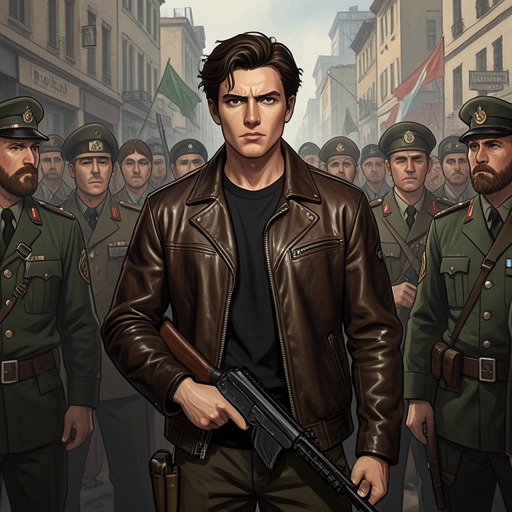
That contrast sharpens when thirty-three militia consuls arrive at the prime minister’s office. They had come separately and incognito from across Italy, stayed at militia barracks, and gathered in small groups at Galleria Colonna before entering Palazzo Chigi. Wearing black shirts and medals, some with daggers at their belts, they arranged themselves in a semicircle around Mussolini’s desk. Their formation made the office a space of direct pressure: the leader remained seated while the consuls crowded around him, led by Enzo Galbiati and Aldo Tarabella.
Mussolini rebuked the consuls for leaving their posts without authorization and insisted they were liable to sanctions. Some stepped back, but Tarabella remained. His parting declaration—that the men would stand at attention but slam the door as they left—turned military discipline into an explicit refusal of political obedience. Palazzo Chigi’s office, designed to embody the authority of the head of government, thus became the setting for a confrontation that exposed the limits of his command over the militia.
Violence and political crisis at the threshold
The building also appears in the preparations for the abduction of Giacomo Matteotti. A Lancia Lambda rented by Filippo Filippelli was parked overnight in Palazzo Chigi’s courtyard. Amerigo Dùmini reassured the Carabinieri on guard that the car was needed for important government business, relying on his connection to the prime minister’s press office. The detail places a vehicle intended for the operation inside the government headquarters while showing how access and official familiarity could be used to disguise its purpose. The evidence locates the car there; it does not establish that the abduction itself took place at Palazzo Chigi.
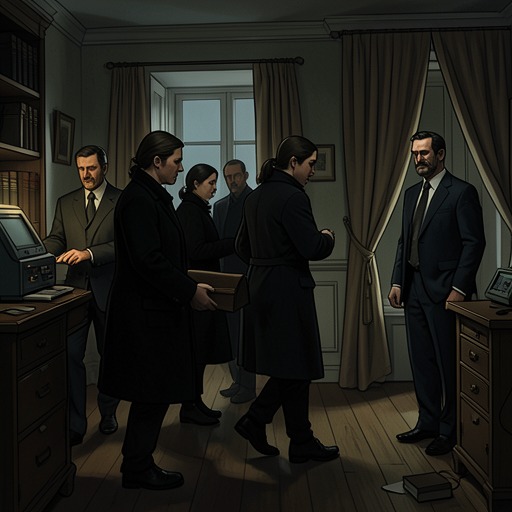
After Matteotti disappeared, Velia Matteotti sought an audience with Mussolini. In the regime press’s account, Mussolini received her standing in a room at Palazzo Chigi, accompanied by deputies Giacomo Acerbo and Sardi. When she began to sob, he stood at attention and assured her that the government would do its duty, that nothing positive was known, and that some hope remained. The account attributed to her brother-in-law, attorney Casimiro Wronowski, differs in its circumstances: Velia waited in the anteroom with her sister Nella for a clerk to announce her. In that version, Mussolini again received her standing, but with undersecretaries behind him. The competing reports make the audience a contested scene of political representation: a display of sympathy in one version, and a carefully staged official reception in both.
A headquarters under pressure
Palazzo Chigi’s recurring scenes trace a widening gap between the government’s formal authority and the forces operating in its name. Mussolini’s long hours, signed decrees, and meticulous attention to the office’s arrangement embody the effort to make administration legible and obedient. But the courtyard episode links the premises to a secret violent operation; the audience with Velia Matteotti places the government’s reassurance amid uncertainty over her husband; and the militia consuls’ entry turns the leader’s own office into a site of challenge. The building’s significance lies in this accumulated contrast: it is a headquarters from which power is organized, but not a space that can contain or settle the conflicts on which that power depends.