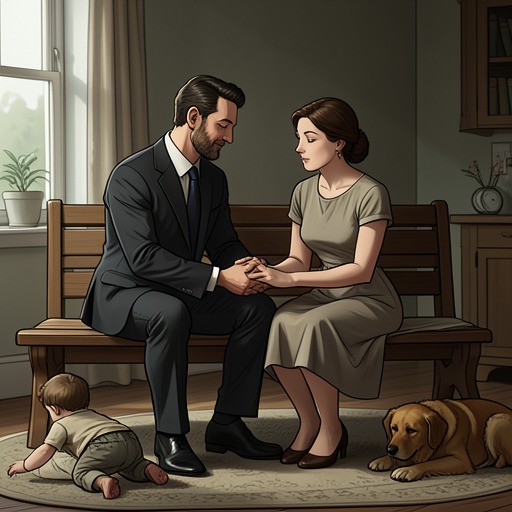
Rachele Guidi Mussolini
M: Son of the CenturyRachele Guidi Mussolini appears in the account not as a public political actor but as Benito Mussolini’s wife, present at the household’s most consequential threshold: the October 1922 transition from Milan to Rome. Her actions are practical and consequential. She has grenades removed from the house, keeps a firearm of her own hidden, is ordered to remain available during the crisis, and later packs her husband’s bags. The narrative sets these details against Mussolini’s public ascent, making the domestic sphere neither a refuge from politics nor a simple reflection of it, but a place where danger, ambition, and family life meet.
Identity and Domestic Setting
On the morning of October 26, 1922, Rachele is still in her dressing gown as she watches Benito Mussolini eat after returning from Naples. He concentrates on his bowl and his starched shirt; the two do not speak. The account presents their silence as a familiar habit, one shaped by the expectation that speaking could expose differences between them. It imagines, conditionally, how she might have answered if he had confided his ambition to become prime minister: with a peasant proverb warning against abandoning the familiar path, and, if he had described the office as unpaid, with blunt contempt for an honor that brought no wage. These are hypothetical responses, not words spoken in the scene. Their function is to convey the practical skepticism the narrative assigns to Rachele, while leaving the actual morning defined by silence.
That silence does not make her passive. When Mussolini returns, she tells him that she has already disposed of the hand grenades he kept hidden at home, judging them too dangerous with searches likely. Her sister Pina, who was gravely ill, carried them away one at a time and dropped them into the moat at Castello Sforzesco. The account gives Rachele the decision and the responsibility for removing the explosives; Pina carries out the task. The episode places a concrete act of household management inside the looming political emergency, showing Rachele responding to its risks rather than merely observing them.
Weapons, Risk, and Agency
The grenades are not the only weapons in the household. Mussolini asks whether Rachele still has the gun she had demanded for protection from infatuated rivals. She does: it remains concealed beneath the mattress of the sofa where their young son Vittorio sleeps. The juxtaposition is striking but specific. She has judged the grenades too dangerous to keep in the house, yet retains a firearm for her own protection. The account does not explain how she assessed the contrasting risks, or report that the gun was used. It does establish that she had requested it and kept it hidden.
Together, the weapons complicate any picture of Rachele as simply sheltered by her husband’s political life. The account does not give her a political programme, a public role, or a direct explanation of her choices. Instead, her agency appears in decisions about what stays in the home, what is removed, and what she wants available for her own defense. The narrative’s attention to those objects makes the household a place of practical calculation, not an untouched private world set apart from the crisis.
The October Crisis in Milan
After a telephone conversation with Michele Bianchi about the uncertain political situation, Mussolini instructs Rachele to stay at home for the next forty-eight hours, remain by the telephone, and carefully record calls. He says that momentous events are approaching and that he will sleep at the newspaper. The account records the order, but does not say whether Rachele complied or what she thought of it. Her assigned task is nonetheless concrete: she is to serve as a point of contact and keep a record while her husband moves between political negotiations and public appearances.
Later in the same account of the crisis, Mussolini goes to the theater with Rachele, rather than with Margherita Sarfatti, his longtime lover. This appearance gives the marriage a public visibility different from the private morning scene. The account does not explain how the theater outing related to his instruction that Rachele remain at home, nor does it describe her response to the evening. It does, however, place her beside him in a moment when his political victory is taking shape, distinguishing his legitimate spouse from the companion associated with his earlier social and cultural life.
When Mussolini receives the commission to form a government, Rachele is already packing his bags. Her task marks the material consequence of his departure from Milan for Rome: the transfer of a political ambition into a new household arrangement. The narrative says that he left her and the children in Milan to avoid family interference as he began governing. It does not say that Rachele chose this separation, approved it, or objected to it. Her presence in the account is therefore both intimate and constrained: she prepares for the move, but the decision to leave the family behind is attributed to him.
Marriage, Separation, and Narrative Significance
In January 1923, from Rome, Mussolini calls Rachele once each day. He tells her that these are the happiest months of their lives, then returns to his work. The repeated calls make the distance between them part of the narrative’s account of his new position: family life remains important to him, yet it is maintained across separation and alongside the demands of government. The evidence offers his declaration and the daily routine, not Rachele’s answer or her private assessment of the arrangement.
The portrayal depends on this imbalance of perspective. Mussolini’s movements, ambitions, and political calculations occupy the foreground; Rachele is seen through domestic encounters and tasks, and the imagined replies attributed to her remain hypothetical. Yet the details give her more than a decorative place in his biography. She removes dangerous weapons, retains a means of personal protection, is assigned responsibility for the telephone during a critical period, accompanies him to the theater, and prepares his luggage as the center of power shifts to Rome. The account does not resolve the contradictions between marriage and separation, or between the family’s place in Mussolini’s language and his decision to govern at a distance. It leaves Rachele at that threshold: an active presence in the practical life of the household, but a figure whose own account of the marriage and the political upheaval is not supplied.