Socialism
M: Son of the CenturySocialism in the narrative is not merely a doctrine debated in party congresses: it is a broad movement embodied in labor organizations, rural leagues, electoral victories, demonstrations, and strikes. Its reach gives workers and peasants practical power over local life, but its leaders’ divisions and contested approach to political violence leave that power increasingly exposed to fascist counter-mobilization.
A mass movement rooted in local organization
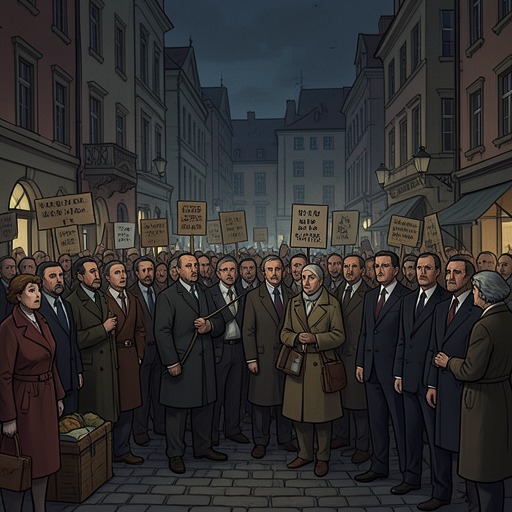
The scale of postwar politics is set against a Europe transformed by war and the return of millions of veterans. The narrator presents the old political order as exhausted and the coming conflict as a struggle between those who belong to the past and those who will shape what follows. In this unsettled landscape, Socialism is one of the forces able to assemble people beyond the traditional parliamentary class: its presence is visible in the crowds, organizations, and competing claims to represent the future.
In Bologna, socialist influence reaches from the city into the countryside. Two labor chambers compete in radicalism, while the surrounding villages contain socialist institutions and networks, including farmers’ unions, cooperatives, local party cells, and people’s houses. In the account of the city’s deepening polarization, even a comparatively moderate socialist mayor is described as responding to pressure for occupations of elegant homes and demands that tenants treat their apartments as their own. The reported denial of bread to people without union cards makes the movement’s power concrete: collective organization can defend members, but it can also enforce boundaries and punish those who stand outside them.
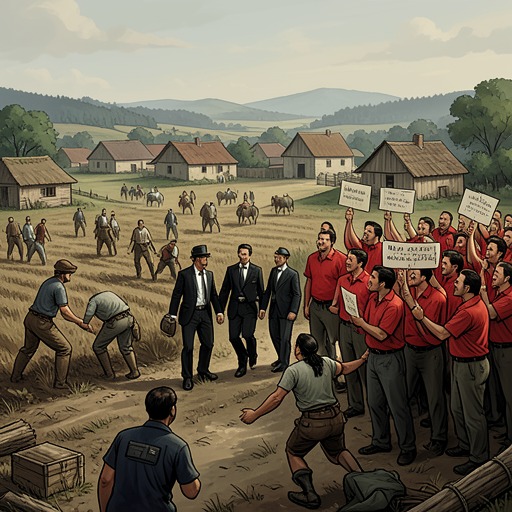
The countryside offers an even sharper measure of that organizational reach. In Emilia, Socialists control 223 of 280 municipalities. Farmworkers average only 120 working days a year, making wage levels and access to employment matters of survival during the idle months. The peasant leagues extend their influence through hiring offices and rules governing shifts, threshing, seed supplies, and planting. By mid-May, the Ferrara leagues of proletarian unity have 81,000 members, including agricultural workers, tenants, sharecroppers, and small landowners. Their gains reshape the balance between laborers and landowners: the leagues help determine wages, working conditions, and even which crops are grown, while landowners are left chiefly to provide capital.
This strength depends on coordinated enforcement. The narrative describes a system in which hiring is routed through league offices and violations of labor agreements bring fines and social exclusion. It also records the harsh pressure placed on those who accept lower wages or break ranks. The movement’s social justice claims therefore coexist with coercive local discipline: the same networks that enable workers to bargain collectively can make dissent within the community costly.
Electoral power and the approaching confrontation
Socialist strength is expressed not only through economic organization but through elections. After the movement’s electoral success, the Socialist Union in Bologna decides to resist fascist violence with violence of its own. Its members reject reliance on police forces because they regard the state as serving the bourgeoisie, and they plan a large demonstration for the inauguration of the city council at Palazzo d’Accursio, assigning armed security to red guards. The Bologna Fascio, whose approximately 400 members meet on Via Marsala, prepares in turn. With both sides arming themselves and the prefect and police chief aware of the danger, the confrontation appears to the narrative as a collision being anticipated by both camps rather than an isolated eruption.
The movement’s street politics are also shown in Milan, where a large socialist procession draws tens of thousands to a rally at the arena. In the early afternoon, several thousand demonstrators break from the main procession and head toward the Duomo without a prearranged plan. Beyond a cordon of Carabinieri, women at the head of the socialist column carry a portrait of Lenin and a red flag, sing songs of liberation, and call for a better life for their children. Across from them stands a smaller cortege of officers, Arditi, and Futurists. The brief clash ends the singing: rocks and clubs come from the socialist side, while gunfire from the opposing side moves from the air toward the marchers. The episode sets two different relationships to political violence against one another, without making the demonstration’s hopes for a better life interchangeable with the armed response it encounters.
The countryside’s organized confrontation with landowners is likewise placed beside the advance of fascist violence. A Ferrara punitive expedition in January 1921 is assembled in military fashion, with armed men, trucks supplied by the Agrarian Association, and simultaneous targets among the peasant leagues. The comparison reveals a struggle over both territory and organizational capacity: socialist leagues have built durable systems of collective control, while fascists organize a mobile force intended to break them.
The split at Livorno
The movement’s institutional reach contrasts with the division exposed at the Italian Socialist Party congress in Livorno in January 1921. The factions occupy different parts of the Teatro Goldoni: communists in the left tiers, centrists in the orchestra, and reformists on the right. Their respective electorates number 58,000, 100,000, and 15,000. These divisions take place within a party that has recently won a majority in 2,162 municipalities, holds 156 parliamentary seats, counts 216,000 members in 4,300 sections, and publishes Avanti! to a daily circulation exceeding 300,000.
The pressure comes in part from the Communist International’s 21 conditions for continued membership. To remain in the International, Italian Socialists are told to change the party’s name and reject as counterrevolutionaries comrades who support socialism without accepting revolution. The dispute is not a small procedural quarrel: it makes unity conditional on an ideological separation that the congress cannot avoid. The account suggests a widening gap between the movement’s broad social presence and the revolutionary confidence of its delegates. Nicola Bombacci and the communists remain committed to revolution, while many of the maximalists led by Giacinto Menotti Serrati no longer believe in it, despite continuing to use its language.
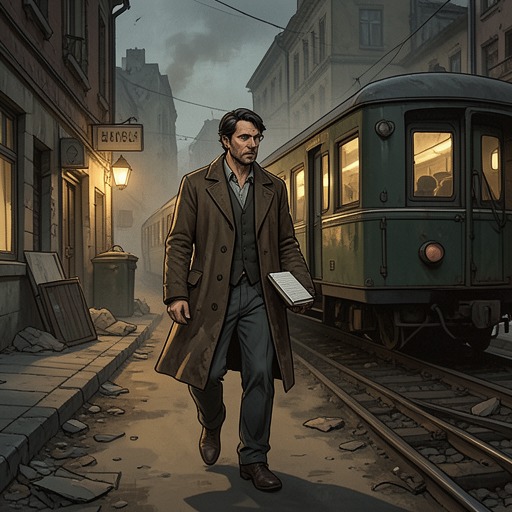
Giacomo Matteotti’s departure from Livorno gives that gap a practical and political consequence. After listening for two days to arguments about socialist unity, Marxist orthodoxy, and Moscow’s conditions, he leaves before addressing the congress. He travels by regional train via Florence and Bologna to Ferrara, where the Chamber of Labor needs a new leader after its secretary and the mayor have been arrested. The narrative stresses that the congress has spent hours debating doctrine while saying nothing about fascist squads operating in Emilia and Romagna. Matteotti’s journey redirects attention from internal alignment to the immediate defense of local labor organization.
The later description of Livorno as the beginning of the Italian proletariat’s tragedy gives the split its retrospective weight. The congress does not erase Socialism’s electoral or organizational strength, but it exposes the cost of a movement unable to hold together its reformist, maximalist, and communist constituencies at a moment when its opponents are organizing in the streets.
Rival mobilizations and political appropriation
The narrative places socialist mobilization beside competing efforts to claim the same dislocated population. In 1919, the spontaneous Milan procession and the women carrying Lenin’s portrait present a public movement with collective hopes and a visible connection to international revolutionary politics. Later, when the Labor Alliance calls a nationwide legalitarian strike beginning at midnight on July 31, its stated purpose is to defend political and union liberties through a united front of workers’ and peasants’ organizations. The strike is presented as a last, high-stakes attempt at resistance. Its announcement leaks prematurely, and Michele Bianchi uses the disruption to issue an ultimatum on behalf of the fascists, threatening that they will replace a state unable to assert its authority.
In Ferrara, the alternative form of mass politics takes shape through a march organized by fascist leaders. Beginning at midnight on May 11, thousands of impoverished farmworkers travel from the countryside on foot, by bicycle, in wagons, and on barges. The following morning, 50,000 laborers enter the city. The fascist organizers cut telephone lines, requisition school buildings for lodging, and close shops and businesses; the influx surrounds the castle and leaves the city occupied and paralyzed. The episode shows how a movement able to mobilize rural hardship can also redirect it into a display of force under different political leadership.
Fascism’s program increasingly claims to contain or supersede the political alternatives. At the founding of the National Fascist Party, Benito Mussolini presents fascism as a synthesis and says that violence has buried earlier methods. He promises to make Italians into a single national people, links national greatness to empire, and rejects anticlericalism in favor of accommodation with the Roman Church. He also asserts that the state belongs to fascism and describes the masses as needing an interpreter who can educate them and, when necessary, discipline them. These claims do not resolve the material conflicts that gave Socialism its base; they recast political belonging and popular agency under a nationalist authority.
The movement’s closing contrast is between socialist organization and the fascist image of national rebirth. The narrative’s portrait of the fascist leader as a new man set against the old political order turns disorder into a promise of restored command. At a later ceremony in Piazza Belgioioso, Mussolini recalls a transformation from a few hundred adherents to legions, then presents the volunteers as a people becoming a nation and a nation becoming a state. Against that staged unity, Socialism remains visible as an expansive but fractured movement: powerful in its local institutions and mass constituencies, yet unable to make its varied political forces act as one when fascist organization turns that fracture into an opening.