Teatro Verdi
M: Son of the CenturyTeatro Verdi is a gathering place in Fiume’s theatrical and political life, most notably the setting for Gabriele D’Annunzio’s October 24, 1919 speech and for a later evening when he turns a performance of his own play into a communal song. The theater’s significance lies in this contrast: it can hold a charged political event whose consequences are described as incalculable, then become a space where the Commander openly sets aside his earlier literary self.
Speech and suspended time
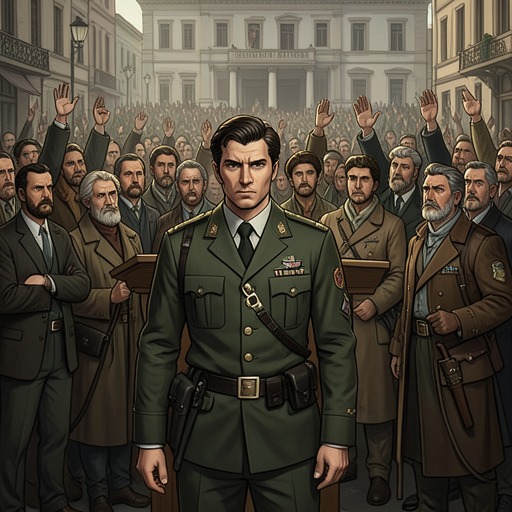
On October 24, 1919, Gabriele D’Annunzio speaks at Teatro Verdi. The scene is not framed as a tactical plan or strategy, nor simply as a man addressing the people of Fiume. Instead, the narration suspends ordinary measures of time: the moment seems to stretch into tedium or contract into an instant. Its consequences are called incalculable, while its force is said to have no defined objective. Teatro Verdi thus becomes the setting for an occurrence poised between historical undertaking and caprice.
The image attached to the speech extends beyond the room. Fiume, described as the city of life, is imagined turning forever around its own backbone, like a dervish. The theater scene is therefore linked to a larger portrait of the city: political action is rendered not as a settled program but as movement charged with a force whose direction remains uncertain.
A play interrupted
On other evenings, after supper, the group often goes to the theater. One performance is La fiaccola sotto il moggio (The Torch under the Bushel), an apocalyptic drama written by D’Annunzio in 1905. Its subject is the collapse of an ancient family whose members are all presented as flawed, unwell, cursed, or corrupt. The choice of play places D’Annunzio’s earlier literary world before an audience formed by the march and political action of the present.
D’Annunzio himself interrupts that world, protesting against his own work and calling for the boring play to be stopped so that the company can sing its songs. The narration sets this gesture against the image of the twenty-year-old returning from the morning march: the young marcher and the older author are in conflict. The interruption is more than a change of entertainment; it makes the tension between the Commander’s public role and his former literary identity visible inside the theater.
From performance to collective song
At the Commander’s goliardic signal, singing rises at once from the orchestra and balconies. The audience takes up Giovinezza, followed by Garibaldi’s Hymn and Mameli’s Hymn. What began as a performance of a dark family catastrophe becomes a shared act of song, with youth, joy, and gaiety filling the theater.
D’Annunzio sings from his stage box. His position remains distinct, but he joins the chorus rather than returning to the play he wrote. The account presents him as happy to be shedding his literature at last. Teatro Verdi consequently holds two contrasting kinds of public action: the suspended, directionless charge of the October speech and the later, immediate transformation of a theatrical audience into a singing crowd. In the latter scene, the theater becomes the place where D’Annunzio’s break with his own literary past is enacted collectively.