Vittorio Emanuele III
M: Son of the CenturyVittorio Emanuele III, King of Italy from July 1900, stands at the constitutional hinge of the narrative: his signature, refusals, and silences shape whether political crises become barriers to Benito Mussolini or openings for him. The king is introduced as introverted, insecure, and pedantic, with a frail physique and a character described as weak. His authority is therefore measured less by grand speeches than by decisions made at moments when the state’s survival appears to depend on him.
Identity and Constitutional Position
The king occupies a role that is both ceremonial and decisive. He opens parliamentary sessions, receives the head of government, and formally appoints Mussolini; yet the narrative repeatedly shows that constitutional authority requires action to be effective. When confronted with the growth of Fascist power, Vittorio Emanuele III can approve or withhold measures, but his choices do not consistently protect the institutions whose legitimacy rests on the monarchy.
This tension is clearest in the contrast between the king’s public presence and his private decisions. He appears before Parliament and later greets a Fascist procession from a balcony, while the crucial question of whether to authorize force against the March on Rome is resolved away from the crowd. The monarchy remains visible throughout; its capacity to restrain the new political power becomes increasingly uncertain.
The Parliamentary Break with the Socialists
At the opening of a new legislature, the king is expected at 10:30 a.m. to deliver the customary speech from a throne installed in the parliamentary chamber. The chamber is decorated by an immense allegorical frieze celebrating the virtues and history of young Italy. Against that official image of national unity, 156 newly elected socialist deputies occupy the first three sections on the left, wearing red carnations. Their presence displaces even Giovanni Giolitti from his customary seat, marking a change in parliamentary life before the king arrives.
When Vittorio Emanuele III enters, approximately 500 representatives rise and cheer. The socialist deputies remain seated while the others greet him; when Francesco Saverio Nitti invites the assembly to sit, they rise and leave. The departure is a deliberate refusal of the expected encounter between sovereign and representatives. Nicola Bombacci leads the dissidents past the throne and calls for a socialist republic, leaving the king to deliver his speech to a half-empty hall. The scene makes the monarchy’s ceremonial claim to embody the nation collide with a mass political movement that rejects that claim.
The break does not remain only a parliamentary gesture. Outside, the socialist deputies celebrate briefly, but the narrative soon records nationalist attacks on them in Rome. The contrast between the ceremony inside and the violence in the streets shows how little the king’s symbolic presence can guarantee the safety or standing of those who oppose the political order.
The March on Rome and the Unused State of Siege
In October 1922, as the Fascist mobilization intensifies, Vittorio Emanuele III is on vacation at San Rossore. Luigi Facta sends him a telegram expressing the hope that Mussolini’s Naples speech signals impatience rather than resolve. The king’s absence from Rome becomes part of the suspense: the government is considering extraordinary measures, but the decision that could give them force belongs to the sovereign.
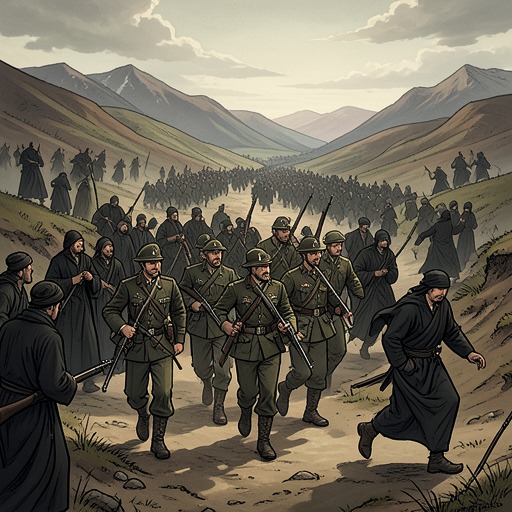
When Vittorio Emanuele III reaches the station in Rome at 8:05 p.m., he tells Facta that he is tired, disappointed, and disconsolate, and threatens to abdicate and withdraw to the countryside with his wife and son. He then declares that Rome must be defended and that a state of siege may be necessary if armed Fascists approach the capital. Facta returns to the Ministry of the Interior and prepares the decree. Orders for Rome’s defense go to General Emanuele Pugliese; arrest instructions are sent to prefects; and a proclamation is posted in the streets. For a few hours, the legal machinery appears ready to stop the march.
The decisive act, however, is not taken. The king does not sign the decree, and the state of siege is suspended. The narrative offers no settled explanation for his reversal, emphasizing instead the consequences of the refusal. Mussolini, who has been negotiating over a place in a possible government, insists that no solution is possible without him. On October 30, Vittorio Emanuele III gives him the task of governing Italy. The appointment converts the king’s failure to authorize emergency resistance into the gateway to Mussolini’s premiership.
The next day the king appears on the balcony as the Fascist marchers parade through Rome, flanked by General Armando Diaz and an admiral. His greeting is brief, while the procession continues for six hours. The spectacle follows the transfer of power: the sovereign is still present at its ceremonial center, but the force he has admitted into government now supplies the public theater.
Ceremony, Confidence, and the Crisis of 1924
After the April 1924 elections, Mussolini’s supporters claim a sweeping victory, and the new Parliament is inaugurated on May 24. Vittorio Emanuele III addresses the newly elected representatives as the generation of Victory. The socialists leave the chamber in protest against electoral irregularities, creating another visible divide between royal ceremony and parliamentary opposition. Mussolini watches from the government bench without reacting. The repeated pattern is significant: the king presides over formal proceedings even as their legitimacy is contested within the chamber.
The crisis following Giacomo Matteotti’s abduction brings the opposition’s constitutional challenge directly to the sovereign. Giovanni Amendola, speaking on behalf of the constitutional opposition groups, asks the king to use his position and the army’s loyalty to force Mussolini to resign. Vittorio Emanuele III, recently returned from Spain, thanks Amendola for his frankness. But at his June 16 meeting with Mussolini, he urges conciliation, a reshuffle, and normalization. Despite widespread outrage, he confirms his confidence in the prime minister. Mussolini responds by beginning a political counteroffensive, including surrendering the interior ministry to Luigi Federzoni and removing Emilio De Bono from his post.
The king’s later actions continue to combine formal authority with accommodation. When the abduction sends the markets tumbling, he signs a decree authorizing prefects to seize publications judged harmful to the nation. The measure quiets market anxiety by gagging the press, while the narrative presents it as a further retreat from constitutional protections. When a delegation of ex-combatants seeks urgent action, the king changes the subject to his daughter having killed two quails. The detail compresses the distance between a grave national crisis and the king’s distracted domestic attention.
Refusal, Inaction, and Narrative Significance
The opposition makes one more appeal through documentary evidence. Giovanni Amendola sends the king Cesare Rossi’s account, which implicates Mussolini in the violence, hoping that the sovereign will resolve the crisis. The king does not act. Amendola eventually publishes the account, and the accusation enters public debate without producing the intervention the opposition had sought from the Crown.
Later, when Mussolini asks for a blank decree dissolving Parliament so that he can threaten deputies, Vittorio Emanuele III refuses to sign it unless Mussolini first secures a vote of confidence and passage of electoral reform. This refusal places a limit on the prime minister’s immediate demand, but it does not amount to a broader effort to remove him or restore political competition. The king’s conditional answer contrasts with his earlier failure to sign the state-of-siege decree: he can withhold a particular instrument, yet the narrative’s accumulating crises show no sustained use of royal authority against the regime.
Vittorio Emanuele III’s arc is thus not a simple passage from power to powerlessness. He remains capable of consequential choices, including the refusal of the blank dissolution decree, but repeatedly chooses conciliation, delay, or silence where the opposition expects a defense of constitutional government. His monarchy survives as ceremony and procedure while political violence, restrictions on the press, and electoral pressure narrow the space in which those procedures can operate. The story’s central irony is that the sovereign who is asked to safeguard the state helps preserve its outward forms even as his decisions enable Mussolini to dominate them.