1921 Ferrarese squadrist offensive
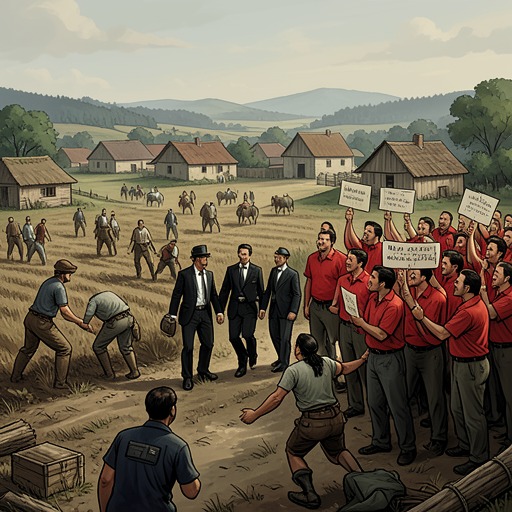
M: Son of the CenturyThe 1921 Ferrarese squadrist offensive was a systematic campaign to break the socialist organizations that governed work and community life across the countryside around Ferrara. In a few months, coordinated Fascist attacks destroyed labor exchanges, cooperatives, and peasant leagues; the resulting collapse was not merely a change in political allegiance but the destruction of institutions built through generations of labor. The campaign’s military organization turned local force into a decisive advantage over communities whose strength depended on durable, place-bound networks.
Background and Organization
Ferrara’s countryside entered 1921 with a powerful socialist infrastructure. Peasant leagues and their placement offices regulated hiring and working conditions, while cooperatives and community centers anchored collective life. In Emilia, socialists controlled 223 of 280 municipalities. Farmhands averaged about 120 days of work a year, making wages and employment arrangements questions of subsistence. The leagues therefore sought control over hiring, shifts, threshing, seed supplies, and crop planting; landowners who breached collective agreements faced fines, while workers who accepted lower wages risked exclusion from the community’s economic life.
This system had grown amid sharp conflict over who would control the land and its labor. Ferrara’s spring labor struggle had secured wage increases and worker-managed hiring, including a compulsory employment quota for the months when agricultural work was scarce. The leagues’ reach brought practical gains to workers, but also made them targets for landowners and Fascists seeking to break their authority. In the towns, too, class tension was pronounced: disputes over labor, union membership, and housing fed a sense among the middle classes and employers that their position was under pressure.
The offensive had an earlier, explicitly military precursor. On January 23, a force assembled in Ferrara to strike several rural leagues at once, using surprise, coordinated targets, and trucks supplied by the Agrarian Association. Its intended targets included San Martino, Aguscello, Cona, Fossanova San Biagio, Denore, and Fossanova San Marco. That operation set a pattern in which concentrated manpower and mobility were treated as strategic tools, rather than leaving the outcome to isolated confrontations.
The Spring Campaign
After the chambers of parliament were dissolved on April 8, the employment bureau at Jolanda was burned and its administration forced to resign. Two days later, following the death of squad member Arturo Breviglieri during a raid at Pontelagoscuro, Fascists occupied the town, burned its Chamber of Labor, and compelled socialists to take part in a humiliating submission around their comrade’s body. On April 11, squads attacked the Chamber of Labor at Granzette, in Polesine, and killed its treasurer, Luigi Masin, at home in front of his family.
The attacks widened. On April 14, about a hundred Squadristi held Ferrara under siege for two days, assaulting the Casa del Popolo and the railwaymen’s association. The following day, during a gathering at Roncodigà of league members who had moved to a Fascist union, Umberto Donati advocated returning to the Chamber of Labor and was killed. Further operations struck organizations in Bondeno, Gaibanella, and Ostellato. The sequence—from the destruction of a hiring office to assaults on union and community institutions—shows how the campaign targeted the practical infrastructure through which socialists organized work and mutual support.
Collapse and Resistance
The cumulative result was stark: within a few months, nine chambers of labor, one cooperative, and nineteen peasant leagues in Ferrara had been destroyed. In Rovigo, the Chamber of Labor associated with Giacomo Matteotti, already repeatedly deprived of its material possessions, ceased to exist permanently. The destruction of such organizations made it harder for workers to coordinate resistance or preserve the gains they had secured through collective bargaining.
The collapse was swift enough to astonish socialist leaders. In many places, peasants tore down red flags and joined Fascist unions; others who continued to resist faced further shootings, destruction of property, and the killing of animals or uprooting of vines. Matteotti urged people to remain at home and avoid responding to provocations, a counsel that expressed the perilous position of a movement whose opponents controlled the initiative and could choose the time and place of attack. In Codrea, socialists voted to resist, but when squad members beat the secretary before the gathering, peasants joined the local Fascist organization there and then.
Angelo Tasca, who had witnessed some of the attacks, explained the asymmetry in terms of mobility and organization. Many Fascists were former Arditi or soldiers, led by officers, able to move between locations and live away from home. Workers, by contrast, were attached to the land and to institutions built through long struggle. The squads could attack and withdraw; the communities they targeted had invested in places they could neither abandon easily nor treat as expendable. Tasca’s contrast between mobile offensives and rooted defenses helps explain why the campaign could dismantle painstakingly constructed institutions so quickly.
Political Significance and Aftermath
The offensive exposed the limits of socialist control when confronted by disciplined force. Community centers and labor organizations embodied accumulated work and local attachment; their defenders’ reluctance to use them simply as instruments of combat left them vulnerable to attackers prepared to burn or destroy them. The campaign’s success therefore rested not only on violence itself but on the unequal conditions under which violence was used: coordinated mobility against institutions whose value depended on continuity and collective trust.
The shift was not confined to the destruction of socialist organizations. On May 11, thousands of impoverished rural laborers began moving toward Ferrara by foot, bicycle, wagon, and barge. The next morning, about fifty thousand workers had entered the city in an organized mobilization, which paralyzed ordinary activity and placed the prefecture under pressure. This later demonstration of mass coordination differed from the spring attacks, but showed how Fascist organization could turn its rural reach into a force capable of occupying an urban center.
The offensive thus marked a political reversal in the countryside: institutions that had organized employment and sustained socialist allegiance were dismantled, while Fascist unions gained ground amid coercion and capitulation. Its outcome also foreshadowed a broader contradiction in the political order. Parliamentary forms remained in view, but organized violence was reshaping the conditions under which political participation and local authority could operate.