Benito Mussolini
M: Son of the CenturyBenito Mussolini’s decisive achievement in the narrative is to turn a marginal movement into a governing power without surrendering the violence and spectacle that made it formidable. At first, the gathering around Piazza San Sepolcro is scarcely a hundred men, and his movement’s first electoral test ends in humiliation. Mussolini survives not through a steady march toward power but through waiting, shifting alliances, and exploiting the liberal state’s own attempts to contain its enemies. His appointment as prime minister in October 1922 marks both his ascent and the beginning of a struggle to turn a fragile seizure of power into durable control.
Identity and political vision
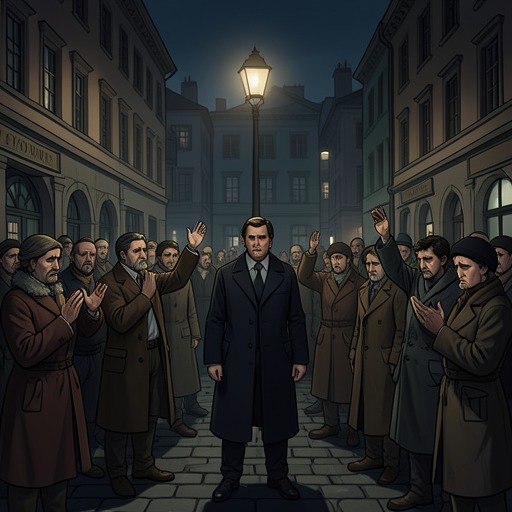
The narrative presents Mussolini as a physically sturdy man despite his syphilis, but gives equal weight to the political uncertainty surrounding his early movement. At Piazza San Sepolcro, the small company appears to him as politically isolated and already marked by defeat. His broader diagnosis is that the old European political class has been overtaken by the mass of returning soldiers: millions of veterans are moving back into public life, and the future belongs to those who can organize them. He treats the postwar moment not as a return to settled peace but as a contest between an exhausted old order and a new political force.
That vision has a regenerative promise and a coercive edge. In his account of the future, fascism will make Italians into a single national people, superseding regional identities, while an imperial mission will give the nation a purpose beyond its borders. The Roman Church, once a target of anticlerical hostility, can also be incorporated into this expansive national story. The scale of the ambition is striking: fascism is presented not as one party among others but as a synthesis capable of absorbing its rivals and remaking the country.
The movement’s first program complicates any simple account of that ideological project. Published in Il Popolo d’Italia on June 6, after months of discussion and revision, the Fasci di Combattimento platform remained close to the revolutionary socialists and stood to the left of the reformists. Socialist exiles had helped conceive it as a means of attracting former comrades. The program therefore began less as a settled doctrine than as an instrument of recruitment, open to political revision as Mussolini sought a constituency.
From defeat to tactical patience
The November 1919 election delivered an unmistakable reversal. Socialists won 1,834,792 votes and 156 seats, while the fascist ticket in the Milan district received just 4,657 votes out of roughly 270,000. Mussolini himself secured only 2,427 preferential votes; no fascist candidate was elected. He had imagined himself as Milan’s deputy, but the result left him without a parliamentary foothold and exposed the distance between his movement’s ambitions and its actual support.
He did not answer this defeat with immediate action. Through the turmoil that followed, he weighed alternatives, moved among political circles, and declined to commit himself to any one faction. When Giovanni Giolitti returned to office, Mussolini—despite their history as adversaries over Libya and interventionism—welcomed him as a statesman who might restore social equilibrium and internal order. He also kept contacts open with radical fascists, left-wing unionists, workers, and Trieste nationalists. The pattern was not inactivity so much as deliberate suspension: he watched for a moment when competing forces might create an opening.
The question of Fiume made that calculation visible. In Venice in September 1919, Mussolini was in the company of Margherita Sarfatti, while police feared that he might join Gabriele D’Annunzio’s expedition and breach the fragile embargo imposed by Francesco Saverio Nitti. Mussolini continued publicly to promise that he would defend Fiume at the cost of his life, sharing the movement’s admiration for D’Annunzio’s exploits. Yet the narrative distinguishes that declaration from his practical intention: he did not want to be drawn into what he regarded as another losing venture. The contrast between Fiume’s intoxicating political spectacle and the more concrete prospects opening on the mainland helps explain why he could invoke the Commander while declining to follow him.
Building power through the state and the street
Mussolini’s movement did not grow only in opposition to the liberal state. Acting on his instructions, Michele Bianchi reached an agreement with the prefect of Milan to make the fascists available for public-order duties. A confidential government circular urged fascist cooperation in suppressing revolutionary attempts, including by violent means, provided the groups accepted official command. The state thus helped authorize the participation of the force that would challenge its own authority, treating fascists as a means of resisting mass strikes and revolutionary organizing.
This relationship between official power and armed party organization became more consequential as the movement expanded. During Bonomi’s government, a prefectural circular attempted to regulate truncheons as weapons and classify fascist paramilitary groups as illegal. Within forty-eight hours, Michele Bianchi, newly elected secretary general of the National Fascist Party, declared that party sections and combat squads formed an inseparable unit. The directive appeared openly in Il Popolo d’Italia. The episode shows the difficulty of separating the party’s public organization from its coercive arm, even as the government tried to impose limits on both.
By 1922, Mussolini framed the crisis as proof that the state had forfeited its right to exist: a government that could not defend itself, he argued, could not legitimately govern. He presented the fascist armed organization, with its officers and regulations, as evidence that power was already passing beyond the state. The coming march on Rome was described not merely as a future operation but as a process already under way. In this rhetoric, violence could be cast as liberation, the liberal state as a mask, and the fascist militia as the force capable of purging a political wound.
His appearance at the Teatro San Carlo in Naples on October 24, 1922, converted that argument into a mass spectacle. The crowd’s enthusiasm recalled the response to D’Annunzio but, in the narrative’s contrast, Mussolini offered not sacrifice but the promise of triumph. He told the Blackshirts that the demonstration should not become a battle, while insisting that the government must either be handed over or seized by marching on Rome. The movement’s show of force was therefore also a performance of control: the crowd was to demonstrate the capacity for violence without yet spending that capacity in combat.
After a series of final affirmations, Mussolini summoned Cesare Rossi and read him the proposed ministerial list. The decision to make himself prime minister transformed the threat into a claim to government. The state of siege declared during the crisis was then revoked after Victor Emmanuel III declined to sign the decree. With the decree suspended, the way was open for the king to appoint Mussolini. On October 30, at thirty-nine, with only sixteen months’ experience in the Chamber of Deputies and no experience in government administration, he became Italy’s youngest prime minister and, at that moment, the youngest ruler in the world. He climbed the Quirinal Palace stairs in the black shirt that marked him as the leader of an armed party.
From appointment to consolidation
Mussolini’s first appearance before Parliament made the contradiction of his position explicit. The Chamber was packed with senators, diplomats, former deputies, elegant visitors, and ordinary people who had come to see the new government. Before this audience, he asserted that the people had given themselves a government outside and above parliamentary appointment, and declared the Blackshirt revolution legitimate. He was exercising office through the monarchy and the existing political order while claiming that his authority came from a revolution against parliamentary procedure.
His stated project was to make Italy into a unified state: a moral idea embodied in a clearly defined hierarchy, with every member of the nation expected to take pride in duty. The language of hierarchy supplied an institutional counterpart to the movement’s earlier promise of national rebirth. Yet the practical problem remained immediate. Mussolini had only thirty-six fascist deputies in the congress. He could pressure Parliament with the threat of violence or dissolution, but stable control required new elections and a reform that would give him a secure majority and help contain troublesome allies as well as dissident fascists.
The movement’s transition from squad violence to an enduring party-state was not frictionless. At a meeting where some men expected simply to enjoy the fruits of their victory, Mussolini’s announcement revived the prospect of a life organized around violence. Emilio De Bono then presented the plan for the Voluntary Militia for National Security. The proposal made the armed character of the movement an official question of government: victory would not mean that the squads could simply be forgotten, but that their force would have to be reorganized within the new political order.
Mussolini also sought room to maneuver in foreign affairs. When Italian officers serving on an Allied mission were killed near the Greek-Albanian border, the absence of the experienced foreign secretary Salvatore Contarini created an opportunity to appeal to Italian nationalism in the Eastern Mediterranean. Mussolini had long awaited an occasion to challenge what he viewed as subordination to Britain. This episode extends the same political method beyond domestic competition: a crisis could be used to give national ambition a new field of action.
By the time the Chamber was dissolved on January 25 and elections were scheduled for April 6, the political contest had become a test of Mussolini himself. The coming vote was presented as a plebiscite for or against him, rather than merely for or against the fascist regime. A year after the march on Rome, the movement had weakened, yet Mussolini had become more powerful. The contrast captures the growing personalization of authority: the fortunes of the regime and the stature of its leader were no longer treated as identical.
The Matteotti crisis and the limits of control
Giacomo Matteotti’s parliamentary challenge brings Mussolini’s public composure into conflict with the evidence of private reaction. During Matteotti’s long speech, Mussolini remained at the presiding desk, appearing indifferent as he read newspapers, made pencil notes, and tapped the pencil on the wood. When he finally left the Chamber, reporters observed that his face was tight and that he appeared livid. The performance of detachment did not erase the political force of the challenge.
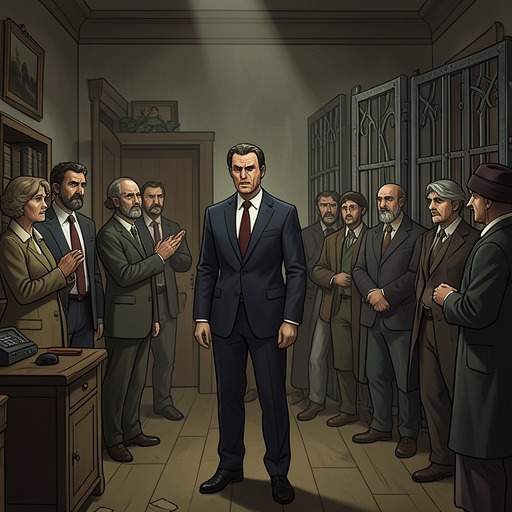
Later, at Palazzo Chigi, his private secretary Arturo Benedetto Fasciolo stood before Mussolini’s desk. Between them lay a wallet encrusted with dried blood. Mussolini took it, opened a drawer, and put it away. The narrative presents this moment as the point at which he knew the essential facts. Yet before the Chamber, he claimed that the police were pursuing suspicious persons and expressed hope that Matteotti would return to Parliament. At that moment, he knew where the grave was, its size, and how it had been covered. The difference between the public account and his knowledge makes the crisis not simply a failure of information but a deliberate act of concealment.
When pressure threatened to carry responsibility toward him, Mussolini sought to break the chain by asking Aldo Finzi and Cesare Rossi to resign. His response to an accusatory telephone call was an angry outburst, after which the line went dead. The scene marks a turn from the earlier politics of waiting: under immediate threat, he moved to sacrifice close collaborators in order to protect the head of government.
The monarchy nevertheless maintained him in office. After returning from Spain, Victor Emmanuel III met Mussolini on June 16, urged conciliation and a reshuffling of the government, and pressed him to continue along the path of normalization. Despite public outrage, the king reaffirmed his confidence in the prime minister. Mussolini rallied, and his government won the Senate’s confidence on June 26 by 225 votes to 21, with six abstentions. Formal constitutional support gave him a means to begin a counteroffensive even as the underlying crisis remained unresolved.
The closing images of the year place meticulous administration beside political uncertainty. After his morning ride in Villa Borghese, Mussolini found that Quinto Navarra had cleared the flies from his office with geraniol. His familiar yellow leather briefcase stood on the table, and decrees authorizing police measures and press censorship were already signed. The office was orderly down to its smallest details, while the world outside remained unwilling to submit. In his later parliamentary declaration, Mussolini assumed sole political, moral, and historical responsibility for what had happened, and identified himself with the fascist movement even if it were judged a criminal band. The admission was also a bid to make responsibility the instrument of renewed authority: rather than disowning the movement’s violence, he claimed it as his own.